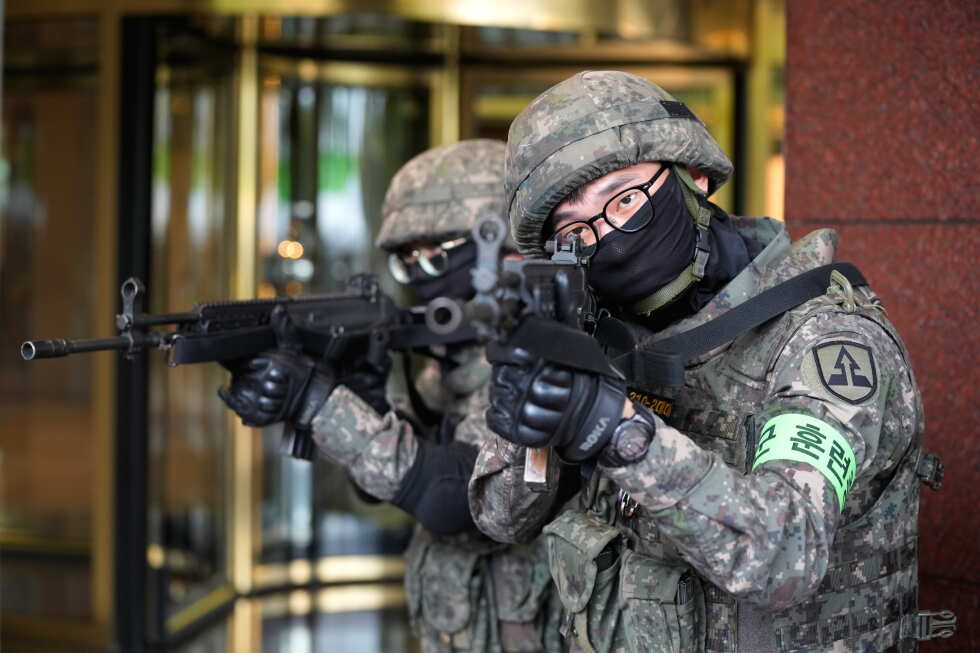
In a surprising conciliatory move aimed at paving the way for renewed diplomacy with North Korea, the United States and South Korea have wrapped up their annual Ulchi Freedom Shield military drills six days ahead of the original schedule this Friday. This scaled-down exercise was first ordered abruptly by former U.S. President Donald Trump just days before the drills kicked off this Monday, when he instructed the Pentagon to “substantially reduce” the scope and duration of the long-planned training.
Trump cited two core justifications for the last-minute change: his self-described positive personal rapport with North Korean leader Kim Jong Un, and South Korea’s refusal to back U.S. policy amid heightened tensions over the war in Iran. However, the goodwill gesture failed to win over Pyongyang, with Kim Yo Jong — the powerful and influential sister of Kim Jong Un — rejecting the overture just two days before the early conclusion of the drills. In her public statement, Kim Yo Jong argued that merely trimming the length and size of the exercises does nothing to alter their fundamental “provocative, aggressive nature,” which North Korea has long framed as a rehearsal for an invasion of its territory.
Following through on its pre-stated threat to respond to the drills, North Korea launched a volley of roughly 10 short-range ballistic missiles into the sea the day after Kim Yo Jong’s statement. The U.S. Pacific Command quickly assessed that the missile launches did not present an immediate threat to U.S. territory or its regional allies, while reaffirming Washington’s unwavering commitment to defending the American homeland and its partnership with South Korea.
The rejection of the U.S. overture has dimmed prospects for an early resumption of nuclear diplomacy between Washington and Pyongyang, which collapsed in 2019 after earlier high-profile talks failed to deliver breakthroughs. Since the diplomatic stalemate began, Kim Jong Un has moved to strengthen his negotiating position by upgrading North Korea’s nuclear and missile arsenals, and deepening his alignment with Russia amid its ongoing war in Ukraine. Pyongyang has repeatedly made clear it will not return to talks until the U.S. abandons its demand that North Korea commit to denuclearization as a precondition for any diplomatic negotiations.
Observers note that despite the hardline stance, Kim Yo Jong’s public remarks struck a relatively measured tone, avoiding the fiery, hostile rhetoric that often characterizes North Korean statements. She also referenced what she described as an “excellent” relationship between Kim Jong Un and Trump, a signal that Pyongyang has not completely closed the door to future dialogue. Analysts say the approach suggests North Korea is holding out for larger concessions from Washington, including international recognition as a legitimate nuclear weapons state and widespread relief from harsh international economic sanctions.
North Korea’s deepening military and economic cooperation with Russia — where Pyongyang has supplied ammunition and troops to support Moscow’s war effort in exchange for much-needed economic and military assistance — has also strengthened Pyongyang’s hand. This closer alignment with Russia has further allowed North Korea to gain more leverage with China, its largest trading partner, opening the door to additional support from Beijing.
“After this strategic play has run its course, Kim may seek further economic and reputational benefits from Washington,” explained Leif-Eric Easley, a professor of international studies at Ewha University in Seoul. Easley added that such a move would likely come after the U.S. midterm elections, when then-President Trump was expected to face a weaker domestic political position and be more inclined to pursue high-profile foreign policy wins to boost his standing.
Kim Dong-yub, a professor at the University of North Korean Studies in Seoul, offered a different interpretation of Kim Yo Jong’s statement. He argued that her remarks made clear North Korea’s position that the personal rapport between Kim Jong Un and Trump cannot singlehandedly move the needle on the long-stalled bilateral relationship. Kim Dong-yub added that Kim Yo Jong likely sought to pre-empt speculation that Trump’s scaled-back drills could restart diplomacy, so North Korea would not bear full blame if the diplomatic process fails to materialize.
In a notable contradiction, Kim Yo Jong also denied Trump’s earlier claim that Kim Jong Un had responded to his request for new talks. When reporters asked Trump earlier that week if he planned to meet Kim Jong Un before the end of the year, Trump had replied, “Yeah, I will be.”
The Ulchi Freedom Shield exercises are one of the largest annual joint military training events between the U.S. and South Korea, designed to sharpen their collective defense capabilities against potential North Korean aggression. The decision to downsize the drills has already sparked concerns among defense analysts about a potential erosion of joint operational readiness between the two allies.