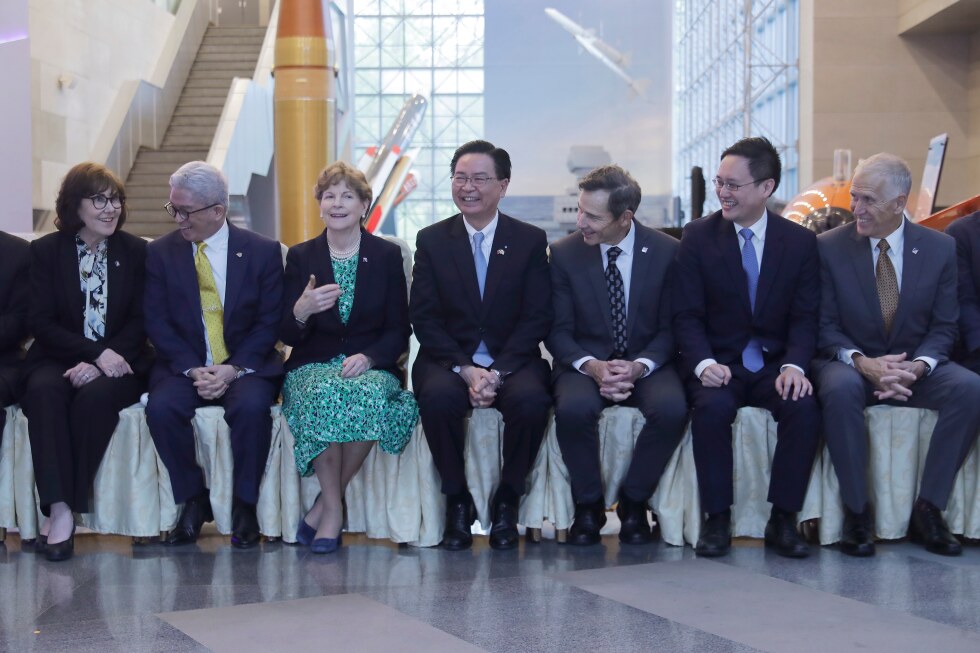
A bipartisan delegation of U.S. senators visiting Taipei has expressed strong support for Taiwan’s efforts to advance a $40 billion special defense budget currently deadlocked in the opposition-controlled legislature. The congressional group, comprising Democrats Jeanne Shaheen (New Hampshire) and Jacky Rosen (Nevada) alongside Republicans John Curtis (Utah) and Thom Tillis (North Carolina), met with Taiwanese President Lai Ching-te during their two-day visit focused on strengthening informal bilateral ties.
The diplomatic engagement occurs against a backdrop of escalating regional tensions, with China maintaining its longstanding claim over Taiwan as a breakaway province that must be reunified—by force if necessary. The visit coincides with preparations for an upcoming summit between U.S. President Donald Trump and Chinese leader Xi Jinping, where substantial American arms sales to Taiwan are expected to feature prominently in discussions.
During Monday’s meeting, Senator Curtis explicitly acknowledged Taiwan’s progress in enhancing defense capabilities and societal preparedness, noting that “the seriousness is noticed in Washington D.C., and your efforts on the special defense budget are also noticed and supported.” The proposed eight-year security package would fund advanced missile defense systems (dubbed ‘T-dome’), artificial intelligence integration into national defense, and development of indigenous military technology.
President Lai urged legislative approval of the budget “without delay,” affirming his government’s “unwavering resolve” to strengthen self-defense capabilities and bilateral cooperation with the United States. Meanwhile, opposition leaders have advocated for reduced defense spending, creating parliamentary gridlock.
China’s Foreign Ministry spokesperson Mao Ning condemned the congressional visit, demanding the U.S. cease “all forms of official exchanges with Taiwan” and refrain from sending “wrong signals to Taiwan independence separatist forces.” Beijing has labeled President Lai a separatist seeking to transform Taiwan into a “powder keg” while refusing to engage with his administration.
In a contrasting diplomatic maneuver, opposition leader Cheng Li-wun announced plans to visit China next month to promote peaceful cross-strait relations, though potential meetings with Chinese leadership remain unspecified.