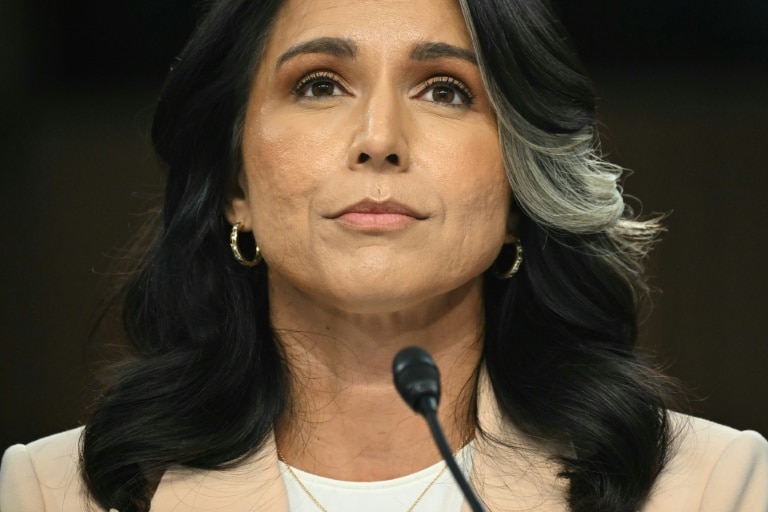
In a sudden announcement that has shaken the upper ranks of the Trump administration, Director of National Intelligence Tulsi Gabbard confirmed Friday she will step down from her post, effective June 30, to stand beside her husband as he fights a newly diagnosed rare form of bone cancer. The departure also closes out a turbulent tenure defined by longstanding ideological clashes with the president over his push for war with Iran, a rift that left the nation’s top intelligence coordinator increasingly sidelined from key national security decisions in recent months.
In a public letter to Trump posted to the social platform X, the 45-year-old laid out the deeply personal reason for her exit, writing, “My husband, Abraham, has recently been diagnosed with an extremely rare form of bone cancer. He faces major challenges in the coming weeks and months. At this time, I must step away from public service to be by his side and fully support him through this battle.” Gabbard’s role centered on coordinating global intelligence data and presenting consolidated national security assessments to the president.
President Trump responded to the announcement with praise for Gabbard, one of the only remaining women in his cabinet, via his Truth Social platform. “Tulsi has done an incredible job, and we will miss her,” he wrote, noting that her desire to support her husband through cancer treatment was rightful. He also confirmed that Gabbard’s deputy, Aaron Lukas, will step into the role as acting Director of National Intelligence following her departure.
Gabbard’s appointment to lead the sprawling U.S. intelligence apparatus was controversial from the start. A former Democrat and Iraq War veteran who served in the Army National Guard, her deployment experience shaped a long career of opposition to U.S. foreign military interventions, a stance that put her at odds with administration policy long before the current conflict with Iran. Most notably, she repeatedly voiced public opposition to launching a war against Iran, and grew increasingly isolated from Trump’s inner circle as he moved forward with strikes.
Multiple reports indicate Gabbard was excluded from high-level strategy meetings in the immediate lead-up to the joint U.S.-Israeli strikes on Iran launched February 28. After the war began, she repeatedly declined to back key administration justifications for the attack. She refused to endorse Trump’s claim that Iran posed an imminent military threat, the core assessment the administration used to justify the strikes. When testifying before Congress, she emphasized that the final call for military action rested solely with the president. Gabbard also contradicted another key administration justification, confirming U.S. intelligence had concluded Iran was not rebuilding the nuclear enrichment facilities destroyed in joint U.S.-Israeli strikes the previous year.
Beyond her disagreements over Iran policy, Gabbard has long faced criticism from lawmakers on both sides of the aisle over past controversial positions. Her 2017 meeting with deposed Syrian leader Bashar al-Assad drew widespread scrutiny, and she has been accused of spreading Kremlin-aligned propaganda, including false conspiracy theories regarding the war in Ukraine. She also faced cross-partisan suspicion for her support of NSA leaker Edward Snowden, whose disclosures of secret U.S. surveillance programs were widely viewed as compromising American national security.
Beyond her public service, Gabbard, a Hawaii native, was raised in the Hindu tradition by her mother, who converted to the faith; her first name, Tulsi, references a plant considered sacred in Hinduism, and she has been a vegetarian her entire life. She married Abraham, a Hawaii-based cinematographer, after the pair met while filming her campaign advertisements, and he proposed to her during a sunset surf session.