The long-standing strategic competition between China and the United States has expanded beyond high-profile domains like artificial intelligence and space exploration into a new frontier: fusion energy, a game-changing power source widely hailed as a near-limitless, zero-carbon solution to the global climate crisis. Both nations are racing to scale domestic fusion capabilities and lock in resilient supply chains to support future commercial reactor deployment, and both have turned to Europe for its irreplaceable expertise in core fusion technologies ranging from superconducting magnets and high-power lasers to advanced robotics and tokamak design—expertise that is critical to moving fusion from small-scale laboratory research to full-grid commercial operation.
Tokamaks, the most widely tested magnetic confinement fusion design, are doughnut-shaped chambers that use intense magnetic fields to contain superheated plasma heated to hundreds of millions of degrees Celsius, the core condition required to sustain a fusion reaction. But as Washington and Beijing both court European partnership, the global fusion community remains deeply divided over how Europe should navigate the growing US-China rivalry in this sector. Some experts urge European stakeholders to align exclusively with the United States, arguing that denying China access to advanced fusion technology is critical to preventing Beijing from gaining an edge that could reshape the existing global geopolitical order. Others counter that the extraordinary technical complexity of commercial fusion development demands broad, inclusive international collaboration—including active participation from China.
One of the most prominent voices calling for open international partnership is Laban Coblentz, chief strategic advisor to the International Thermonuclear Experimental Reactor (ITER), the world’s largest multinational fusion megaproject hosted in southern France. In an interview with Asia Times in London, Coblentz pointed to China’s track record of large-scale nuclear infrastructure delivery to illustrate the benefits of integrating global supply chains: China completed construction of its 1,000-megawatt Hualong-1 third-generation fission reactor in just five years for $5 billion, a timeline and cost that outpaces most comparable projects in the United States and Europe. What many observers miss, he noted, is that 140 French firms are embedded in the Hualong-1 supply chain, a clear example of how cross-border collaboration drives efficient, affordable progress.
Coblentz also voiced hope that upcoming talks between US President Donald Trump and Chinese President Xi Jinping, scheduled for mid-May in China, will break down existing trade and technology barriers and shift the relationship from pure competition to complementary collaboration. His remarks referenced ongoing contract negotiation challenges between ITER and American firms, where trade barriers have created unnecessary delays and added costs. During a speech at the Fusion Industry event organized by Economist Impact on April 14, Coblentz shared a surprising anecdote about US Senator Joe Manchin, a prominent critic of Chinese technology policy who has publicly accused Chinese scientists of intellectual property theft from US research labs. After touring the ITER assembly hall in 2022, Manchin told a gathering of 30 US ITER staff that he saw, for the first time in years, a “light at the end of the tunnel” for global energy security, and even a path to long-term world peace. Manchin noted that many historical conflicts have been rooted in competition over energy access, and observed that the ITER site brings together scientists and engineers speaking Mandarin, French, Italian, English, Russian and dozens of other languages—proof that if fusion succeeds, it could fundamentally rewrite the rules of global geopolitics.
ITER, the foundational global fusion project, traces its origins back to 1986, when Euratom, Japan, the Soviet Union and the United States agreed to co-design a large-scale international fusion test facility. Concept development began in 1988, with the final design approved in 2001, laying the groundwork for one of the most ambitious international scientific collaborations in modern history. Construction launched in 2013 with an initial budget of 6 billion euros ($6.8 billion), but costs have ballooned far beyond initial projections: ITER’s official 2021 estimate put total costs at roughly 22 billion euros, while the US Department of Energy projects total costs could reach $65 billion by 2039, the current target date for full fusion operations. The European Union covers 45.6% of ITER’s total costs, with China, India, Japan, South Korea, Russia and the United States each contributing approximately 9.1%.
Despite the long history of multinational collaboration on ITER, a growing cohort of US experts are warning that the West risks falling behind China’s rapid fusion expansion, pointing to China’s close diplomatic and trade ties with US adversaries including Russia, Iran and North Korea. Ylli Bajraktari, president and CEO of the Special Competitive Studies Project (SCSP), a non-partisan US think tank, used an address at the same Fusion Fest event to warn that the West is at risk of repeating the same mistakes it made in other emerging clean energy sectors, where China now holds dominant global market share.
“China didn’t create the original scientific breakthroughs for electric vehicles, solar panels or 5G infrastructure, but they prioritized government subsidies and scaled manufacturing capacity rapidly, and that strategy paid off massively,” Bajraktari argued. “China didn’t scale solar manufacturing just to hit net-zero emissions targets; they sold panels at below production cost to lock in global economic dependence. The same scenario will play out in fusion if the US and EU don’t move quickly and coordinate closely.”
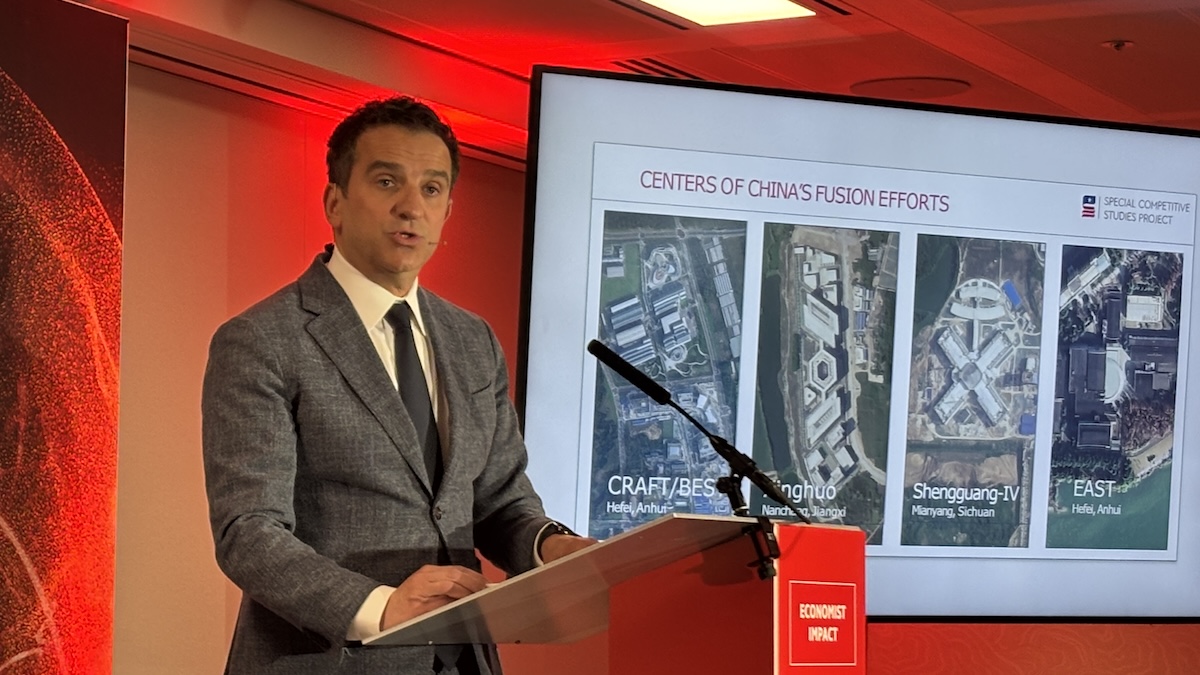
Bajraktari noted that since the Lawrence Livermore National Ignition Facility achieved the first net energy gain from fusion three years ago, China has invested $6.5 billion in new fusion infrastructure—with independent analysts putting the actual figure as high as $10 to $13 billion, a level of spending that outpaces current US investment. He outlined four major public projects that form the backbone of China’s national fusion strategy: the Chinese Fusion Engineering Testing Reactor (CRAFT) and Burning Plasma Experimental Superconducting Tokamak (BEST) in Hefei, Anhui, an integrated research campus designed to move from component testing to grid-connected net fusion power demonstration by the end of this decade; the Xinghuo fission-fusion hybrid reactor in Nanchang, Jiangxi, which targets 100 megawatts of output by the early 2030s; the Shengguang-IV laser fusion facility in Mianyang, Sichuan, a large inertial confinement fusion facility estimated to be far larger than the US National Ignition Facility; and the long-running Experimental Advanced Superconducting Tokamak (EAST) in Hefei, which has repeatedly set global records for plasma confinement and serves as the anchor of China’s domestic fusion research program.
Beyond large-scale test facilities, Bajraktari emphasized that China is also investing heavily across the entire fusion supply chain: scaling domestic production of high-temperature superconductors for fusion magnets, tightening export controls on critical raw materials including gallium and germanium, securing long-term access to copper and other key resources through overseas investment, and expanding domestic capacity in precision manufacturing and advanced components. “Control of the fusion supply chain is an existential threat to the West’s long-term energy future,” he said. “We can’t outcompete China by copying their state-driven model. For the West to succeed, we need to collaborate across our allied bloc.” Bajraktari outlined a proposed allied division of labor that leverages each partner’s existing strengths: the United Kingdom leads in magnetic confinement and radiation-resistant robotics, the US in inertial confinement, beryllium supply and venture-backed private innovation, Germany in laser technology, and Japan in high-performance superconductors. “It’s time to stop treating fusion like a distant academic science project,” he said. “It’s no longer a curiosity. We need to take it as seriously as China does—this is critical national infrastructure that we have to build.”
Global fusion development currently follows two primary technical pathways: magnetic confinement fusion (MCF) and inertial confinement fusion (ICF). MCF is the more mature approach, which includes tokamak and stellarator designs: tokamaks use magnetic fields in a doughnut-shaped chamber to contain and heat plasma, while stellarators use complex twisted coils to achieve more stable long-term plasma confinement. ICF, by contrast, uses high-energy lasers or particle beams to rapidly compress and heat fusion fuel pellets to trigger the reaction, a pathway pursued most prominently at the US National Ignition Facility.
China’s state-led fusion program pursues a diversified portfolio across both pathways, with active projects in tokamaks, stellarators and inertial confinement systems. Its EAST project, often nicknamed the “artificial sun,” made global headlines in January 2025 when it sustained plasma at 100 million degrees Celsius for 1,066 seconds, a new world record for fusion plasma confinement. The EAST program aligns closely with research at France’s WEST tokamak, which tests tungsten plasma-facing components and steady-state plasma conditions to support ITER development. As a core ITER member, China has not only absorbed European tokamak technology through the project but has also emerged as a key supplier of large-scale critical components: in April 2025, China shipped key oversize components for ITER’s tokamak magnet feeder system to the project site in southern France.
In contrast to China’s state-driven model, the US Department of Energy supports a market-driven approach that prioritizes funding for private fusion firms. Current US funding supports projects including Commonwealth Fusion Systems’ tokamak development, Type One Energy Group’s stellarator program, and Xcimer Energy’s laser-based inertial confinement fusion work. Jennifer Arrigo, senior adviser for fusion energy sciences at the US Department of Energy, acknowledged that China is a major global fusion player but emphasized that the West’s core advantage lies in dynamic public-private collaboration. “China is one of the big players in this space, but if you look at the innovation ecosystem across the US and Europe, the partnership between private industry and government is just as powerful,” Arrigo said. “It’s critical that we support our domestic industry and lead on inclusive international collaboration with our allies. That’s how we win the fusion race—by keeping it a global endeavor with the US at the center of that effort.”
In comments to Asia Times, Arrigo added that a core goal of the US Fusion Science and Technology Roadmap, launched in October 2025, is to build out a diversified domestic and allied supply chain. The Department of Energy is currently working with fusion-related private firms, supporting university spinouts and expanding domestic industrial capacity, with the explicit goal of reducing reliance on Chinese parts, components and services and securing alternative supply sources across the US and its allied partners.
Last month, Duan Xuru, chief scientist for fusion energy at China National Nuclear Corporation, noted that global commercial fusion development is accelerating faster than many forecasts predicted. Following China’s phased, risk-mitigation strategy, the country aims to complete its first full-scale engineering test reactor by around 2035 and a full commercial demonstration reactor by approximately 2045, putting it on track to be one of the first nations to deploy grid-connected commercial fusion power.