Growing geopolitical friction has gripped the strategic Strait of Hormuz, one of the world’s most critical energy shipping chokepoints, after planned peace negotiations between the United States and Iran collapsed in Islamabad, Pakistan earlier this week. The breakdown of talks has triggered a sharp escalation of hostile rhetoric and military posturing, while a fragile extension of the Israel-Lebanon ceasefire has failed to ease broader regional volatility.
In a provocative social media announcement this week, former US President Donald Trump issued a direct order to the US Navy, instructing forces to immediately “shoot and kill” any Iranian small craft caught laying sea mines in the strait’s international waters. Trump emphasized there should be “no hesitation” in carrying out the order, adding that ongoing US minesweeping operations in the waterway would be tripled in intensity. The president also drew widespread condemnation after reposting a user-generated video that endorsed calls to kill Iranian leaders who refuse to accept a negotiated peace deal.
Iranian officials have roundly rejected the US threats, framing the rhetoric as blatant aggression against Iranian sovereignty. Iranian Foreign Ministry spokesperson Esmail Baghaei highlighted that Trump’s repost of the call to assassinate Iranian leadership marks an unprecedented violation of basic diplomatic norms. Top Iranian government figures, including President Masoud Pezeshkian and Foreign Minister Seyed Abbas Araghchi, have pushed back against US claims of internal division among Iranian factions, issuing a unified public statement emphasizing national solidarity. “In Iran, there are no radicals or moderates; we are all ‘Iranian’ and ‘revolutionary’, and with the iron unity of the nation and government, with complete obedience to the Supreme Leader of the Revolution, we will make the aggressor criminal regret his actions,” the leaders posted on their social media accounts.
The recent escalation comes on the heels of the cancellation of high-stakes US-Iran peace talks scheduled for Wednesday in the Pakistani capital, just as an existing US-Iran ceasefire was set to expire. Trump ultimately extended the ceasefire deadline hours ahead of its expiration, avoiding an immediate full escalation. Despite the collapse of this week’s meeting, three anonymous Pakistani sources reported Friday that talks could resume imminently, with Araghchi expected to arrive in Islamabad Friday night. Two Pakistani government sources added that a US logistics and security delegation has already deployed to the city to prepare for new negotiations. Neither Washington nor Tehran has issued an official response to these reports as of press time.
Regional analysts warn that the tit-for-tat escalation at the Strait of Hormuz is a deliberate coercive strategy that carries severe risks. Nagapushpa Devendra, a West Asia analyst and research scholar at Germany’s University of Erfurt, told China Daily that Trump’s positioning is designed to force Iran back to the negotiating table through pressure, even as he publicly claims he faces no time pressure to end the conflict. Devendra noted that Iran has shown no willingness to concede, and instead is prepared to leverage its control over the strait to counter US pressure. The most likely outcome of this dynamic, she explained, is an extended protracted standoff, marked by increased vessel seizures, higher risk of accidental military clashes, and growing volatility for global energy and shipping markets. Diplomatically, she added, the escalation risks eroding US allied support in the region while drawing Israel deeper into an expanding regional crisis.
The United Nations has warned that the ongoing US-Iran conflict has already triggered devastating humanitarian consequences across the Middle East and beyond. Alexander De Croo, administrator of the United Nations Development Programme, told Reuters that the conflict has already pushed more than 30 million people back into extreme poverty, with food insecurity projected to worsen sharply in the coming months. “Even if the war stopped tomorrow, those effects, you already have them, and they will be pushing back more than 30 million people into poverty,” De Croo said, also warning of secondary impacts including widespread energy shortages and a collapse of remittance flows that support millions of vulnerable households across the region.
In a further show of military buildup, US Central Command announced Thursday that a third American aircraft carrier strike group, led by the Nimitz-class USS George H.W. Bush, has arrived in the command’s area of responsibility, which covers all US military operations in the Middle East, according to Xinhua News Agency.
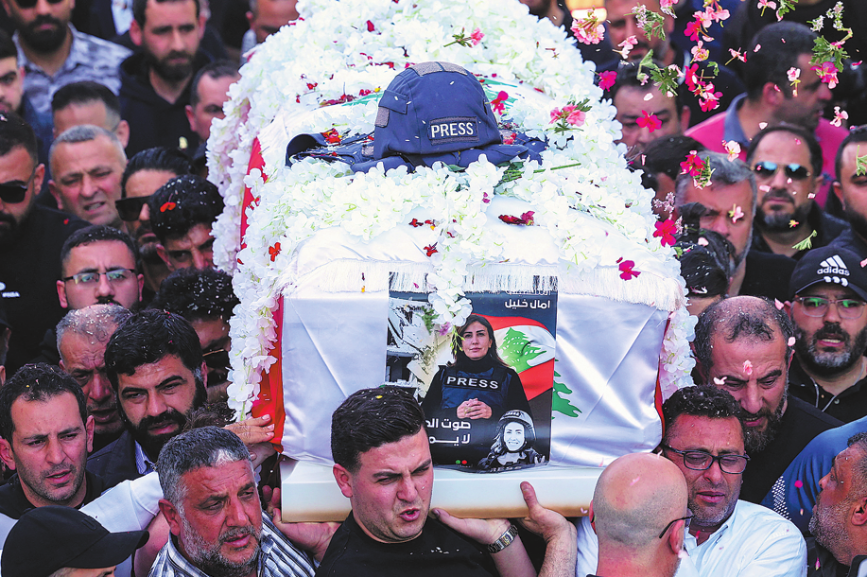
Parallel to the US-Iran escalation, the conflict between Israel and Lebanon has entered a new phase after the two sides agreed to extend their existing ceasefire for an additional three weeks during Thursday’s White House talks brokered by Trump. The extension comes one day after an Israeli airstrike across the border killed five people, including veteran Lebanese journalist Amal Khalil, who worked for local newspaper Al-Akhbar. The strike marked the deadliest day in Lebanon since the original ceasefire took effect on April 16, Reuters reported.
Despite the ceasefire extension, Lebanese militant group Hezbollah has rejected the terms of the truce, reserving its right to respond to any Israeli aggression during the 21-day period. Hezbollah MP Ali Fayad said that extending the ceasefire “makes no sense” in light of ongoing Israeli hostile acts, adding that the continuation of attacks gives “the resistance the right to respond at the appropriate time.” Mourners gathered in Lebanon Thursday to lay Khalil to rest, throwing flowers on her coffin as she was carried through funeral processions.
Xinhua News Agency and other international agencies contributed reporting to this article.