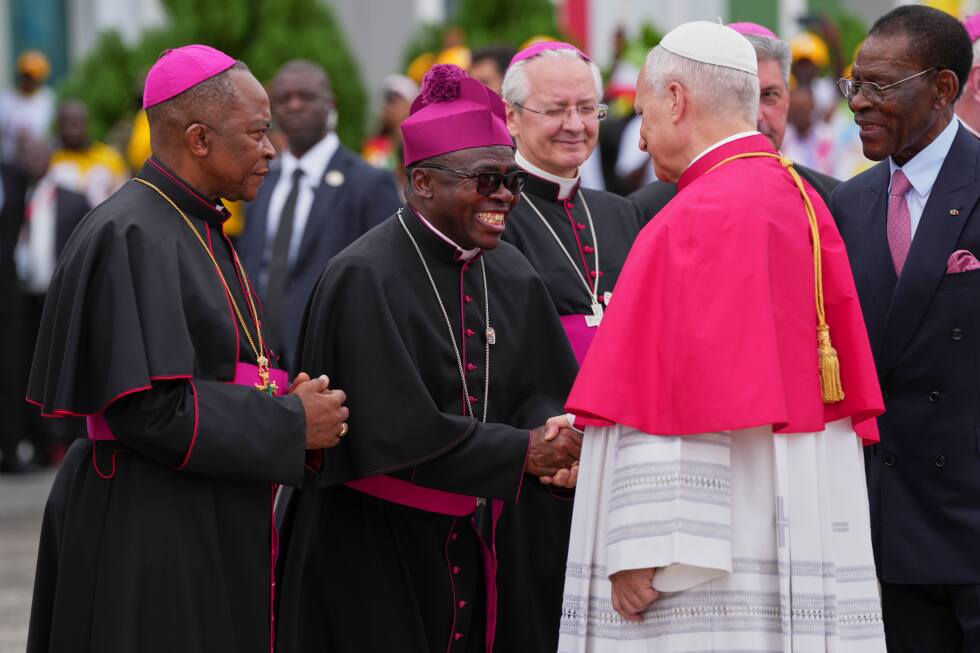
As Pope Leo XIV wraps up an ambitious 11-day, four-nation African tour that spanned from North Africa’s Algeria to Southern Africa’s Angola, with a stop in Cameroon along the way, his final full day in the continent centers on a high-profile visit to one of Equatorial Guinea’s most notoriously troubled correctional facilities.
On Wednesday, the pontiff traveled to the infamous Bata City prison, a stop that carries on the legacy of his predecessor Pope Francis, who made prison visits a core priority of his papacy. Francis launched these visits with a dual mission: to extend a message of hope to incarcerated people and affirm the Church’s solidarity with them, while also drawing global attention to systemic injustices including overcrowding, judicial misconduct, and inhumane confinement conditions.
Leo XIV’s day began with an early morning Mass in Mongomo, a city in Equatorial Guinea’s far eastern region, before he traveled to Bata, the coastal nation’s most populous urban hub. Later in the day, he was also scheduled to lead a prayer service at a memorial honoring the victims of a 2021 military barracks explosion in Bata, a disaster widely attributed to government negligence.
Longstanding concerns over systemic human rights and judicial abuses in Equatorial Guinea have framed the pontiff’s visit. Led by President Teodoro Obiang Nguema Mbasogo, who has held power since 1979, the country has faced consistent international condemnation over widespread corruption and authoritarian rule. While the United Nations human rights body welcomed Equatorial Guinea’s 2022 abolition of the death penalty, both global monitors and human rights organizations have repeatedly flagged deep flaws in the nation’s prison and justice systems.
In its 2023 country report, the U.S. State Department documented a long list of violations, including extrajudicial and arbitrary killings, unlawful detentions, widespread political imprisonment, routine torture, life-threatening prison conditions, and a severe lack of judicial independence. Marta Colomer Aguilera, senior campaigner for Amnesty International’s West and Central Africa division, emphasized the organization’s deep alarm over the country’s human rights landscape. She confirmed that torture is routinely used to extract confessions or punish dissidents, human rights advocates face constant harassment, and the absence of judicial independence effectively eliminates any guarantee of fair trials.
A particularly contentious issue that has taken center stage during the papal visit is the controversial third-country migrant deportation deal struck with the Trump administration, under which Equatorial Guinea has received millions of dollars to accept migrants deported from the U.S. who have no connection to the country. AP investigative reporting has confirmed at least 29 such migrants have been deported to Equatorial Guinea. While none were placed in the Bata prison, many remain in detention in the capital Malabo with severely limited access to legal representation and medical care. Others have been forcibly transferred back to their home countries, where they face targeted persecution.
The Equatorial Guinean government has repeatedly denied allegations of human rights abuses, and has not issued any public response to questions regarding the migrant deportation agreement. Notably, Leo XIV, who was born in the United States, has previously condemned the Trump administration’s broader deportation policy as “extremely disrespectful” of human dignity.
On the eve of the prison visit, 70 global and regional human rights organizations published an open letter urging the pope to use his platform to speak out explicitly about the third-country deportation scheme, and to pressure African nations to refuse complicity in the practice. The letter argues that these deportation arrangements bypass international humanitarian protections, leave vulnerable refugees exposed to arbitrary detention and coercion, and violate the international legal principle of non-refoulement, which prohibits sending people to territories where their lives or freedoms face direct threat.
“The conditions under which these deportations have been carried out have also reflected a very troubling disregard for human life and safety. We call for the intercession of Pope Leo XIV to discourage African countries from being complicit in these violations and instead to protect these individuals,” the groups wrote.
One of the letter’s signatories, EG Justice, is an organization that has long documented and condemned the detention of political prisoners in Equatorial Guinea. The group has called on Leo to leverage his global moral authority to address the issue directly. Tutu Alicante, the U.S.-based director of EG Justice, noted: “There are individuals — prisoners of conscience, and human rights activists — in detention whose cases raise serious humanitarian and due process concerns. At moments like this, sentence review and a real commitment to reform the judiciary can send a powerful signal of a willingness to turn a page toward justice and reconciliation.”
Alicante acknowledged that the Equatorial Guinean government has taken minor, cosmetic steps to improve certain detention facilities in the months leading up to the papal visit, but emphasized these changes are temporary. “The real test will be whether humane conditions, access to medical care, and basic rights are sustained long after the papal visit concludes,” he said.
This coverage of religious affairs from the Associated Press is produced through a collaboration with The Conversation US, with funding provided by Lilly Endowment Inc. The AP holds sole responsibility for all content.