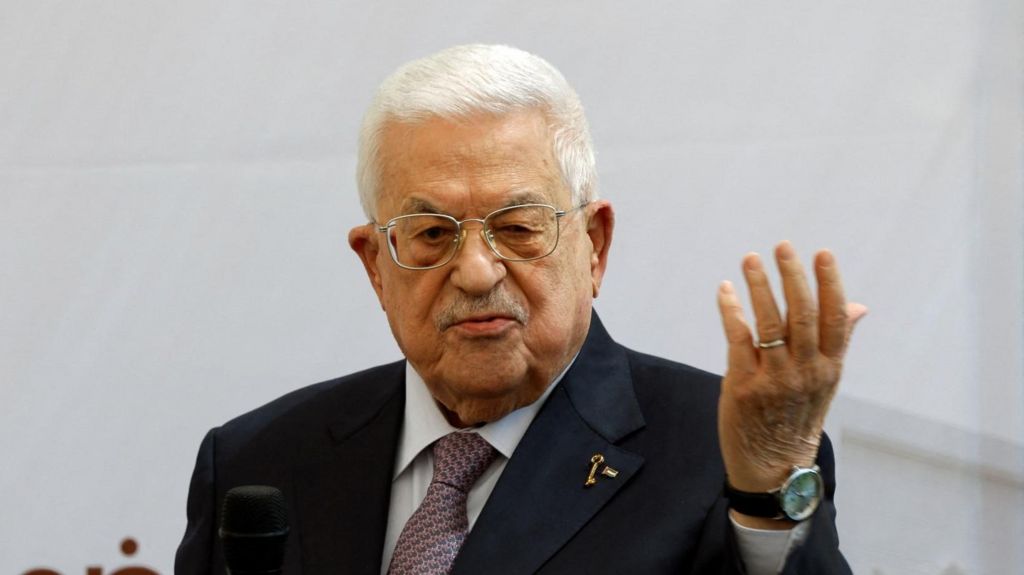
Two Palestinian sources have confirmed to the BBC that the United States has refused to issue an entry visa to Palestinian President Mahmoud Abbas, blocking his planned in-person attendance at next week’s United Nations General Assembly gathering in New York City. This latest visa restriction follows a formal US announcement expanding existing visa sanctions on unnamed Palestinian officials, with Washington accusing the targeted individuals of failing to uphold commitments made under the Israeli-Palestinian peace process.
Visa restrictions for Palestinian leadership were first rolled out in August 2025, when 80 Palestinian officials were blocked from accessing that year’s annual UN General Assembly meeting. In its official justification for the expanded sanctions, the US has leveled accusations against both the Palestinian Authority (PA) and the Palestine Liberation Organization (PLO), claiming the bodies “glorify terrorism” and seek to “internationalize” the long-running Israeli-Palestinian conflict. This critique comes against the historical backdrop of the Oslo Peace Accords, which established the PA and secured international recognition for the PLO as the official representative of the Palestinian people – an agreement reached in exchange for the PLO’s formal recognition of Israel and commitment to renounce armed violence.
The Palestinian Ministry of Foreign Affairs condemned the visa denial in an official statement released Thursday, framing the move as an unjustified action that directly undermines global efforts to rebuild trust between parties, advance constructive Palestinian-US relations, and cultivate the political conditions needed to implement a two-state solution and reach lasting regional peace and stability. Palestinian leadership has uniformly rejected long-standing accusations pushed by both the previous US administration and the Israeli government, emphasizing that under international law, they retain the right to pursue accountability for actions committed by the Israeli occupying force.
Following last year’s identical visa block for Abbas, a spokesperson for the Palestinian president noted that the US decision ran in clear violation of both international law and the long-standing UN Headquarters Agreement. Under the terms of this agreement, the US – as host country for the UN headquarters – is legally required to grant unimpeded access to foreign diplomats traveling to New York for official UN business. However, the US government has repeatedly asserted its right to deny visa access on grounds of national security, countering extremism, and core foreign policy priorities. Last year, after the in-person access was blocked, Abbas addressed the full General Assembly gathering of global leaders via pre-recorded video link. This week, all 193 UN member states are scheduled to hold a vote on Thursday to approve whether Abbas will be permitted to address the 2026 assembly through the same remote format.
Currently, an estimated 75% of the UN’s 193 member states formally recognize the State of Palestine, including major global powers such as the United Kingdom, France, Canada, and Australia. Among the five permanent members of the UN Security Council, the US remains the only country that does not extend formal recognition to an independent Palestinian state.
The US visa decision comes at a moment of extreme humanitarian crisis in the Gaza Strip, with the United Nations repeatedly warning that conditions remain catastrophic despite a ceasefire agreement reached last October. Ongoing Israeli air strikes and ground operations continue to target populated civilian areas, causing repeated civilian casualties, widespread destruction of civilian property, and new waves of forced displacement. On Tuesday alone, Israeli air strikes killed at least five Palestinians, including two young children and a senior Hamas commander, according to local Palestinian health officials and Hamas sources. The Israeli military confirmed it targeted a Hamas commander in southern Gaza and a separate militant fighter in northern Gaza, and acknowledged that child casualties were reported in both strikes.
In a separate incident, the UK-based medical charity Medical Aid for Palestinians reported that an Israeli drone strike killed a patient at a health clinic the organization supports in Jabalia, located in northern Gaza. A spokesperson for the Israeli military stated that the force had no record of this specific incident.
The current round of conflict in Gaza began after the Hamas-led cross-border attack on southern Israel on October 7, 2023, which killed approximately 1,200 people and abducted 251 others as hostages. According to the Hamas-run Ministry of Health in Gaza – whose casualty data is assessed as reliable by the United Nations – more than 73,790 people have been killed in Gaza in the 23 months since the conflict began.