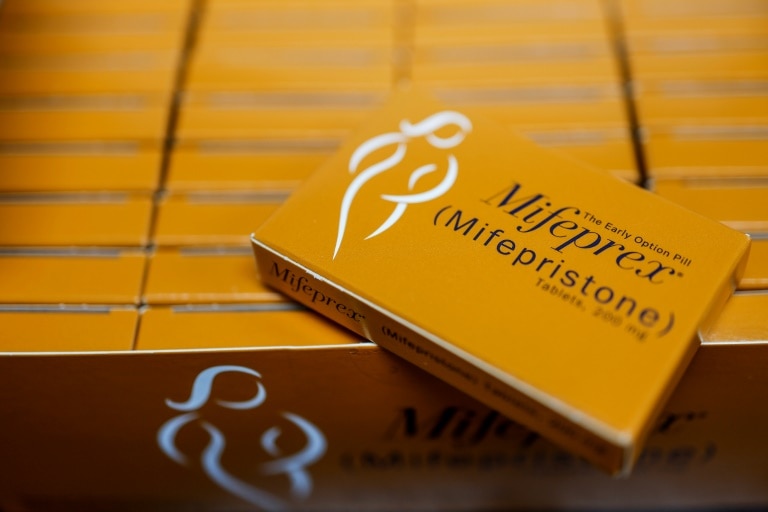
In a move that reignites the decades-long national debate over abortion access in the United States, a federal appeals court imposed a temporary suspension on mail and pharmacy delivery of mifepristone Friday, the medication that accounts for the majority of abortion procedures across the country. The order came in a lawsuit filed against the U.S. Food and Drug Administration (FDA) by the state of Louisiana, a southern U.S. state with some of the nation’s most restrictive anti-abortion policies.
The ruling came from a three-judge panel of the conservative-majority 5th Circuit Court of Appeals. It reverses an earlier lower court decision that permitted mail delivery of the drug to continue while the FDA undertakes a review of its existing regulatory framework for mifepristone. Under the new order, any person seeking mifepristone anywhere in the U.S. must obtain the drug in person from a licensed health clinic, eliminating all options for delivery by post or commercial pharmacy.
Supporters of tighter restrictions on mifepristone have centered their arguments on a non-peer-reviewed study conducted by a conservative think tank, which was released via a public website rather than a peer-reviewed scientific journal. The FDA first granted formal approval to mifepristone, which is sold under the brand name Mifeprex, back in 2000. Today, it is the most widely used method of abortion care in the U.S., and it is also a standard treatment for managing early-stage pregnancy loss.
In clinical use, mifepristone works by halting the progression of a pregnancy, and it is paired with a second medication, misoprostol, which expels the uterine lining. Together, the two drugs are approved by the FDA for terminating pregnancies up to 10 weeks (70 days) of gestation.
Louisiana Attorney General Liz Murrill, a leading opponent of abortion access, celebrated the court’s decision, framing it as what she called a “Victory for Life!” In a statement following the ruling, Murrill claimed the Biden administration had facilitated what she labeled an “abortion cartel” that caused “the deaths of thousands of Louisiana babies (and millions in other states) through illegal mail-order abortion pills,” adding that “today, that nightmare is over.”
But abortion rights advocates have sharply condemned the ruling, which is already on track to be appealed to the U.S. Supreme Court. Nancy Northup, president and CEO of the Center for Reproductive Rights, called the order politically motivated rather than evidence-based. “This isn’t about science — it’s about making abortion as difficult, expensive, and unreachable as possible,” Northup said in an official statement.
Julia Kaye, an attorney with the American Civil Liberties Union (ACLU), emphasized that the decision creates unnecessary barriers to a medication that has been used safely by both abortion patients and people experiencing miscarriage for more than two and a half decades. “Anti-abortion politicians have just made it much harder for people everywhere in the country to get a medication that abortion and miscarriage patients have been safely using for more than 25 years,” Kaye noted.
The latest legal development comes amid a sweeping shift in U.S. abortion policy that followed the Supreme Court’s 2022 decision to overturn Roe v. Wade, the landmark 1973 ruling that had enshrined a constitutional right to abortion nationwide for 50 years. Since that 2022 ruling, roughly 20 states have implemented full or partial bans on abortion care. Despite aggressive pushes from conservative groups to outlaw or severely limit abortion, consistent public opinion polling shows a majority of U.S. adults support maintaining widespread access to safe, legal abortion.
Most recently, in 2024, the U.S. Supreme Court dismissed a separate challenge to mifepristone access, ruling that anti-abortion groups and physicians who brought the suit lacked the legal standing required to challenge the FDA’s approval of the drug.