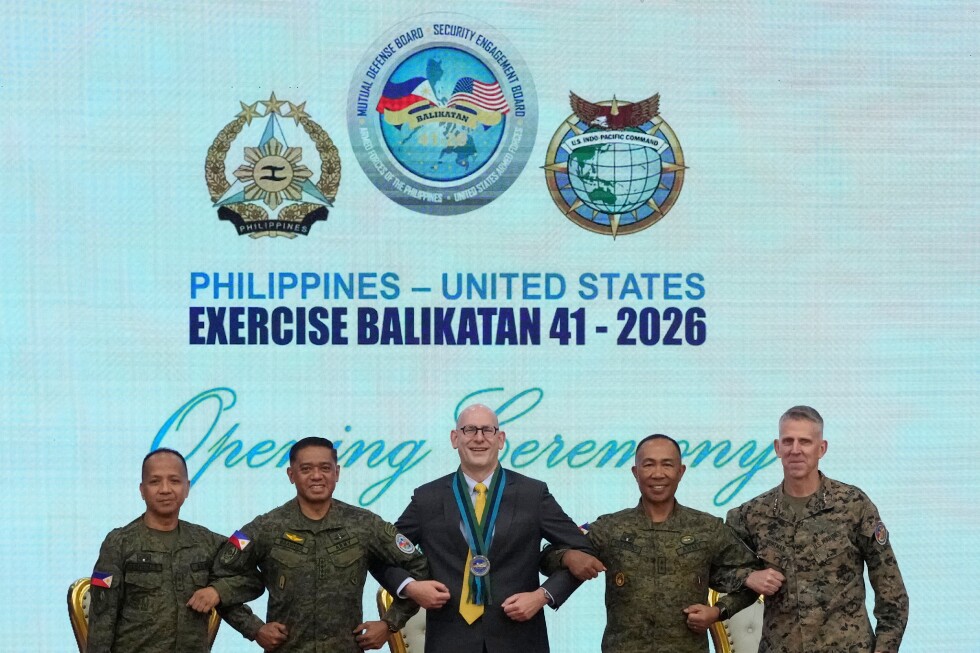
MANILA, Philippines – The United States and the Philippines officially launched one of the largest joint military exercises in their alliance’s history on Monday, rolling out an annual show of coordinated military capability designed to strengthen deterrence against regional aggression, even as Washington remains heavily engaged in ongoing conflict in the Middle East.
This year’s drills mark a significant expansion, with the Philippine military confirming that troops from several extra nations – including Japan, France, and Canada, all of which have existing visiting forces agreements with Manila – will join the exercises for the first time. Known as Balikatan – a Tagalog term meaning “shoulder-to-shoulder” – the drills bring together more than 17,000 military personnel from the US and Philippines alone, with roughly 10,000 of those being American service members. The 18-day exercise will include simulated battle scenarios and live-fire training drills across multiple locations, including Philippine provinces adjacent to the contested South China Sea and the Taiwan Strait.
The large American deployment comes even as the US faces heightened tensions in the Middle East, a point US military leaders emphasized to underscore Washington’s unwavering focus on the Indo-Pacific region. “Regardless of the challenges elsewhere in the world, the United States focus on the Indo-Pacific and our ironclad commitment to the Philippines remains unwavering,” Marine Lieutenant General Christian Wortman stated during the official opening ceremony of the drills.
General Romeo Brawner, chief of staff of the Armed Forces of the Philippines, framed the multinational drills as a critical step to build collective deterrence and resilience against destabilizing actions in the region. While Brawner did not name any specific country in his opening address, he has previously issued strong public criticism of China’s increasingly assertive military and maritime operations against Philippine navy and coast guard assets in the South China Sea. Beijing claims nearly the entire strategic waterway as its sovereign territory, a claim rejected by multiple other regional governments including the Philippines, Vietnam, Malaysia, Brunei, and Taiwan. The waterway is one of the world’s most critical shipping lanes, carrying roughly one-third of global maritime trade, and territorial standoffs between Chinese and Filipino forces have grown more frequent and intense in recent years.
China has repeatedly voiced opposition to the joint US-Philippine exercises, arguing that they are part of a broader Western strategy to contain China’s growing global influence. Philippine military officials have pushed back on this framing, insisting that Balikatan is not targeted at any single nation, and that the drills also include training for rapid humanitarian response to natural disasters, a frequent need across the typhoon-prone Philippine archipelago.
The US has repeatedly reaffirmed its long-standing mutual defense treaty with the Philippines, its oldest Asian ally, warning that it is legally obligated to come to the Philippines’ defense if Philippine forces come under armed attack in disputed regional waters. “We remain guided by a shared commitment to uphold international law, to respect sovereignty and to contribute to a free and open Indo-Pacific where nations can thrive without coercion,” Brawner added.
In one of the most high-profile drills planned, Philippine marine colonel Dennis Hernandez confirmed to the Associated Press that Japanese forces will conduct a live missile strike from coastal areas of Ilocos Norte, a northwestern Philippine province, to sink a decommissioned ship acting as a mock enemy target approximately 40 kilometers off the coast in the outer areas of the South China Sea. US marine units will follow up the strike by using an explosive-laden drone to conduct additional bombardment of the target, Hernandez said.
During a 2025 visit to Manila, US Defense Secretary Pete Hegseth told Philippine officials that the current US administration would work closely with regional allies to ramp up deterrence against global threats, specifically highlighting Chinese aggression in the South China Sea. “Friends need to stand shoulder to shoulder to deter conflict, to ensure that there is free navigation whether you call it the South China Sea or the West Philippine Sea,” Hegseth told Philippine President Ferdinand Marcos Jr. during the meeting.
This report was compiled with contributions from AP writers Joeal Calupitan and Aaron Favila in Manila, Philippines.