Following last week’s interim peace deal to end the US-Israel military campaign against Iran, the United Nations’ International Maritime Organization (IMO) has launched a coordinated large-scale operation to evacuate more than 11,000 seafarers stranded in the Persian Gulf for months. The mission is being executed in partnership with Iran, Oman, the United States, regional coastal states, and global maritime industry stakeholders, with full safety guarantees already secured and navigation conditions fully verified, per IMO Secretary-General Arsenio Dominguez.
Despite the ceasefire agreement, deep disagreements persist between Washington and Tehran over the terms of the Memorandum of Understanding (MoU) that paved the way for the deal, particularly around nuclear inspection provisions. In a social media post earlier this week, former US President Donald Trump claimed Iran had agreed to unlimited, highest-level International Atomic Energy Agency (IAEA) inspections of its nuclear program indefinitely, framing the commitment as a guarantee of “nuclear honesty”.
Iran’s response directly contradicted Trump’s claim, with Iranian officials stating the UN nuclear watchdog would not be granted access to nuclear sites damaged in US and Israeli airstrikes carried out last year. A senior US administration pushed back on the Iranian statement, arguing Tehran had already agreed to robust IAEA inspections of remnants of its nuclear weapons program, and framing Iran’s public comments as political messaging for its domestic audience. Speaking during an official visit to Pakistan on Tuesday, Iranian President Masoud Pezeshkian reinforced Tehran’s hardline position, stating Iran would “never negotiate with anyone, under any circumstances, ever, about our defensive capabilities”.
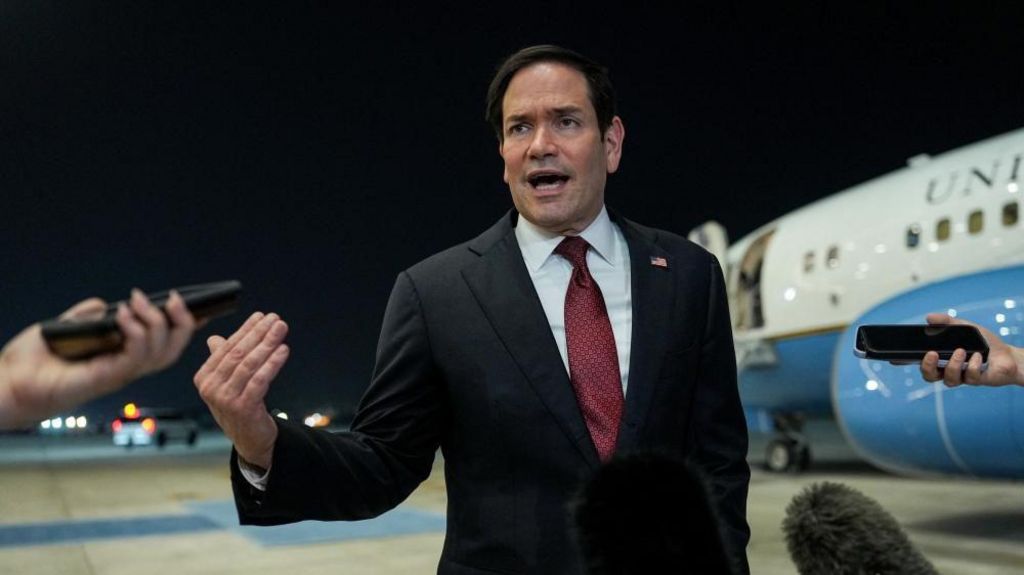
As diplomatic efforts to solidify the ceasefire continue, US Secretary of State Marco Rubio launched a tour of Gulf nations on Tuesday, landing first in Abu Dhabi, United Arab Emirates. Rubio will next travel to Kuwait and Bahrain, both of which host longstanding US military bases, to hold talks with regional leaders on the new agreement with Iran.
One of the top flashpoints in Rubio’s discussions is control and access to the Strait of Hormuz, the critical global chokepoint for energy shipments. Rubio reaffirmed US opposition to Iran’s recent push to impose tolls on vessels transiting the waterway, emphasizing that the Strait is classified as an international waterway under existing international law. “No country is allowed to charge tolls or fees on an international waterway,” Rubio told reporters upon arrival. “I don’t think we have anybody to convince around here in that regard. I think all the countries in this region would agree with us.”
The successful evacuation of stranded seafarers is directly dependent on the Strait of Hormuz remaining open and accessible to commercial traffic, a point Dominguez emphasized in his remarks on the operation. Dominguez called the evacuation deal a “decisive step towards restoring maritime security and bringing to an end the unacceptable attacks against civilian shipping”. He added that after months of hardship for thousands of innocent seafarers and widespread negative economic impacts across the globe, the interim peace agreement between the US and Iran is a welcome development.
Under the IMO’s evacuation plan, two temporary transit routes through the Strait have been established, and individual vessels will be contacted directly with customized navigation instructions, per a notice to mariners from Oman distributed by the IMO. The organization will also publish daily updates tracking the number of vessels that have safely exited the region.
The conflict upended global energy and commodity markets after Iran effectively closed the Strait of Hormuz following the start of US and Israeli military operations in February 2025. The closure pushed benchmark Brent crude oil prices above $100 per barrel and disrupted global shipments of energy and critical agricultural inputs including fertilizer.
New data from maritime intelligence firm Kpler shows that as of this week, at least 172 vessels have transited the reopened Strait, including 42 crossings on Saturday alone. However, daily transit volumes remain far below pre-conflict levels: the average before the outbreak of hostilities stood at roughly 138 crossings per day, and totals since the ceasefire was signed on June 17 have not come close to matching that pace. Ship tracking data analyzed by BBC Verify also indicates that more than 200 commercial tankers remain anchored and waiting inside the Strait as of Tuesday.