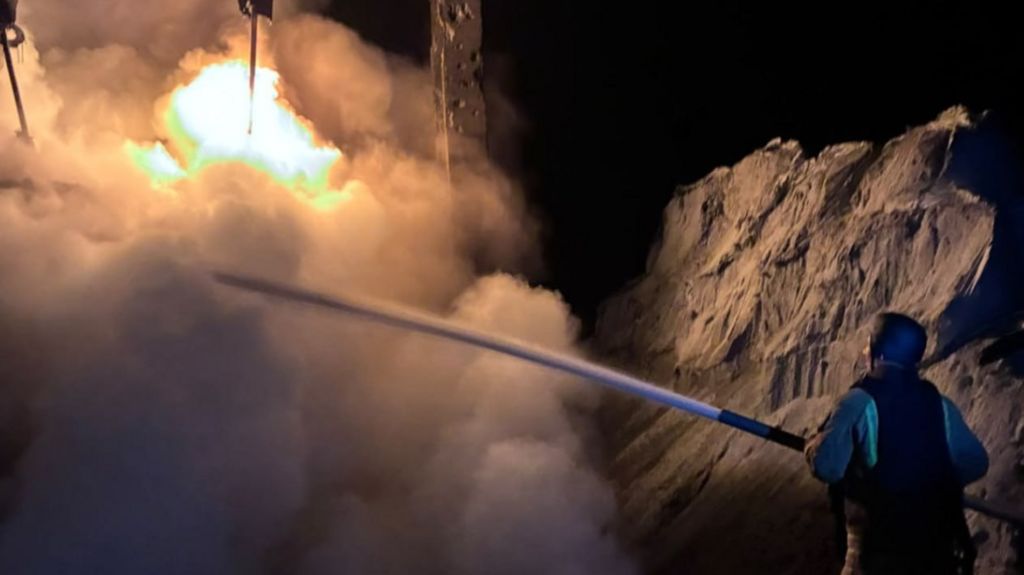
A top adviser to Ukrainian President Volodymyr Zelensky has made explosive claims that gaps in U.S. intelligence sharing about incoming Russian missile and drone attacks have already resulted in civilian deaths, amid a growing rift between Kyiv and the Trump administration over Ukraine’s war effort.
Serhii Beskrestnov, a key presidential adviser known by the call sign “Flash”, spoke exclusively to BBC, confirming that inconsistent and delayed U.S. intelligence has left Ukrainian officials unable to issue timely air raid warnings to at-risk populations. “It’s dangerous… I think it’s really very bad… People [have] already died,” Beskrestnov said, detailing that in multiple recent cases, U.S. warnings of Russian ballistic missile strikes arrived too late for civilians to reach shelter. Just Monday morning, Zelensky himself confirmed on social media that one of two overnight ballistic missile attacks on Kyiv came with no advance warning at all, while the second only gave residents minutes to find safety.
Beskrestnov’s claims contradict repeated public denials from Washington. The White House has repeatedly stated there have been no changes to intelligence sharing arrangements with Ukraine, while U.S. Secretary of State Marco Rubio said Monday that he was unaware of any pause in intelligence support, suggesting reports of disrupted sharing likely stemmed from an unreported software glitch on Ukraine’s own early warning system. This contradiction comes just one week after Kyiv first publicly reported a three-day pause in U.S. intelligence sharing, a disruption that coincided with a sharp diplomatic row between the Trump administration and Ukraine over Kyiv’s controversial deal to import Russian oil.
While Zelensky told NBC News over the weekend that intelligence sharing had been restored after the three-day halt, Beskrestnov pushed back on that framing, telling the BBC that American intelligence on incoming attacks remains incomplete and erratic. “Sometimes we receive this information before the attack, another time we do not,” he said, adding that in the overnight Monday attack, U.S. intelligence arrived just one minute before impact — too little time to activate a full public warning. He emphasized that other areas of U.S.-Ukrainian cooperation remain intact, and the problem is isolated to the air raid warning component of intelligence sharing.
Beyond intelligence sharing gaps, Beskrestnov also confirmed that ongoing restrictions to Ukraine’s access to Starlink and its military-focused subsidiary Starshield remain in place, with no clear explanation from U.S. stakeholders. Last week, Starlink imposed a 100mph speed limit on mobile units connected to Starshield, a service that Ukrainian military forces rely on for drone operations, helicopter communications, and frontline troop coordination. The restriction has directly limited Ukraine’s ability to intercept incoming Russian drones and launch mid-range strikes on Russian-occupied territory.
Starlink owner Elon Musk has previously stated that Starshield, a platform originally built for the U.S. Pentagon, falls under ultimate U.S. government control, implying Washington may have ordered the restrictions. President Trump has denied any involvement in the changes. Beskrestnov said Kyiv has received no clarity on who is responsible for the restrictions, adding that the simultaneous occurrence of intelligence sharing gaps and Starlink limitations is “probably” a deliberate pressure tactic to force Kyiv into negotiations with Moscow. “It’s probably the United States trying to say [to] us, ‘let’s have the conversation, negotiation with Russia, you should find the compromise’,” he told the BBC.
In response to the growing uncertainty over U.S. support, Beskrestnov confirmed that Ukrainian officials are already actively pursuing alternative communication systems to replace Starlink for both military and civilian use. While Ukraine operates its own domestic radar networks that can provide limited advance warning of incoming attacks, the capability is far from sufficient to replace U.S. intelligence. “Now we understand that something begins to happen with Starlink, and we’re not sure what will be the next step,” Beskrestnov said. “We understand that we should be prepared for some problems in future. And now we’re thinking about an alternative for Starlink, not only for air defence, for communication between our forces, between our staff, for civilians also, because we don’t know what we should expect in future regarding Starlink.”
When asked about the intelligence sharing dispute during a press availability Monday, Trump struck a critical tone toward Kyiv, saying “We’ve given a lot to Ukraine. They’ve given us nothing.” A senior anonymous White House official later reaffirmed that there have been no changes to intelligence sharing operations, noting that the Trump administration is focused on ending the war and has provided more total aid to Ukraine than any other country. The BBC has reached out to Starlink for comment on the restrictions, but has not yet received a response.
As diplomatic tensions simmer, Russian strikes against Ukrainian civilian targets continued Monday. Ukrainian officials reported that at least six people, including a toddler in a pram and an 11-year-old girl, were killed in a Russian drone strike on a park café in the Kharkiv region in northeast Ukraine. Fourteen additional people were injured in the attack, which Zelensky described as an “absolute atrocity”.