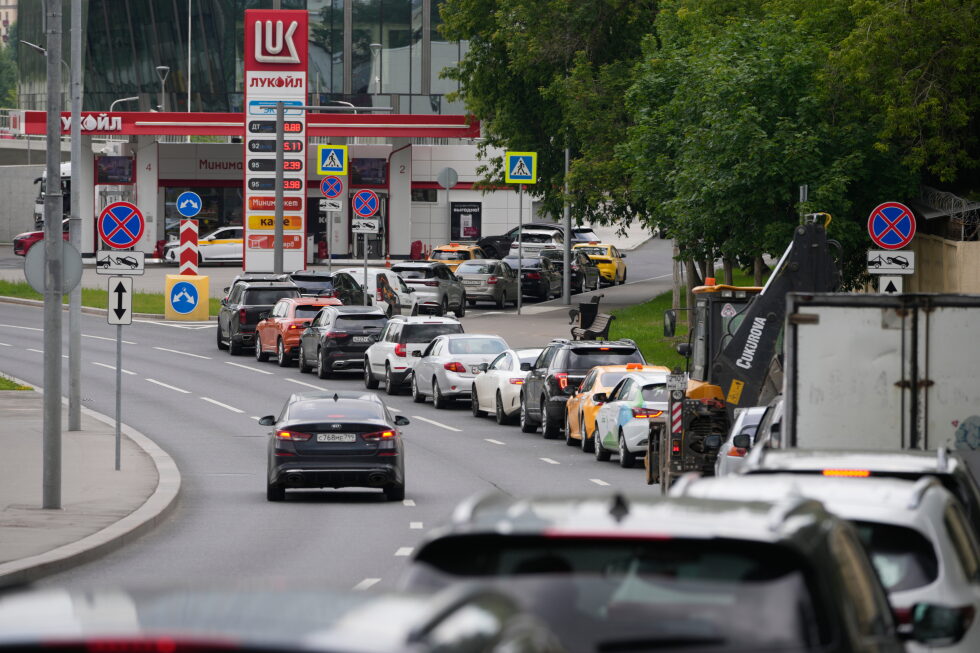
Across Russia’s vast territory, hours-long queues snake along roads outside gas stations, as growing public frustration and uncertainty over a crippling fuel crisis deepen in the wake of sustained Ukrainian drone and missile attacks targeting the country’s energy infrastructure. For a nation long ranked as one of the world’s top energy exporters, this unprecedented fuel shortage has brought the realities of Moscow’s full-scale invasion of Ukraine directly home to ordinary Russian citizens in a way few other wartime developments have.
Fuel rationing has now rolled out across more than half of Russia’s regions. Social media footage captures furious drivers staring down empty pumps, raging at spiking fuel prices, and waiting for hours just to fill their tanks. In the Siberian city of Irkutsk, the mayor even arranged for portable toilets to be deployed for stranded motorists stuck in multi-hour queues.
The crisis prompted a rare public acknowledgment of trouble from Russian President Vladimir Putin, who conceded in a televised address that “problems persist for both motorists and businesses,” adding that “there are still queues at petrol stations, and finding the right grade of petrol isn’t always easy.” Putin framed the shortages as non-critical and temporary, but that reassurance fell flat for many drivers, even in Moscow—Russia’s wealthiest capital, which is typically shielded from the economic shocks hitting the rest of the country.
“I think the situation is not very good,” one anonymous Moscow motorist told the Associated Press the day after Putin’s speech. “They say one thing on television, and in reality it’s another. … People are queueing everywhere.”
Ukrainian President Volodymyr Zelenskyy quickly seized on the disruption, writing on Telegram that “Putin can go on and on, claiming on TV that he supposedly has everything under control,” but ordinary Russians can see the war “has reached the point where even an oil state — a gas station, as Russia used to be called — is now facing gas shortages.”
Since March, an Associated Press tally counts more than 50 confirmed Ukrainian strikes on Russian oil refineries, storage depots, fuel terminals, and other energy assets across Russia and the illegally annexed Crimean Peninsula. Many facilities have been hit multiple times: the Tuapse refinery on the Black Sea coast has been struck four times alone.
Industry analysts confirm these strikes have gutted Russia’s domestic fuel production. Gary Peach, oil markets analyst at Energy Intelligence, reports that Russia’s crude oil processing for fuel fell 25% year-over-year in June, hitting 3.95 million barrels per day—the lowest volume recorded in more than 20 years. “The outages are extraordinary,” Peach noted. Gasoline output has dropped 17% from 2024 levels, falling to 850,000 barrels per day, a volume far below what Russia’s domestic market requires. Unlike many of its other energy products, Russia exports very little gasoline, meaning almost all reduced output hits domestic consumers directly.
Chris Weafer, CEO of consulting firm Macro-Advisory Ltd., estimates that roughly one-third of Russia’s total oil refining capacity is currently offline. His estimate draws on anecdotal reports and oil industry sources, as Russian refiners do not publicly disclose the full extent of attack-related damage.
The timing of the shortages is particularly damaging for the Russian economy, Weafer explained: the annual agricultural harvest season is now ramping up, which drives a sharp increase in domestic fuel demand across rural regions.
Ukrainian officials have framed the campaign of strikes on energy infrastructure as a deliberate strategy to weaken Russia’s war effort by disrupting military logistics and supply chains, undermining Moscow’s ability to conduct front-line assaults, and building domestic pressure on the Kremlin to end the invasion. A key target of the campaign has been Crimea, which Russia illegally seized from Ukraine in 2014 in a move unrecognized by the vast majority of the international community. Strikes on the peninsula earlier this year forced Moscow-installed authorities to implement full fuel rationing in May and halt all civilian fuel sales for a period; limited sales only resumed later in Sevastopol.
The strikes have also reached Russia’s two largest cities, creating embarrassing public setbacks for the Kremlin that spread widely across social media despite Russian government restrictions on publishing footage of attacks. On June 3, a major drone strike on a St. Petersburg oil terminal filled the sky with thick black smoke just as Putin prepared to open his annual international economic forum, an event designed to attract foreign investment to Russia. Two weeks later, on June 18, a similar large plume of smoke rose from the Moscow Oil Refinery on the capital’s outskirts, with greasy black fuel residue raining down on nearby residential areas.
By late June, some form of fuel rationing was in effect across more than half of Russia’s regions. Some regional authorities imposed strict across-the-board limits on all gas stations, while individual fuel chains implemented their own purchase caps in others. Russian officials have tried to pin the crisis on consumer hoarding and panic buying, urging motorists to only refill their tanks when necessary. To shore up domestic supplies, Moscow has already banned exports of gasoline and aviation fuel, and is currently considering a similar ban on diesel exports. Authorities are also even exploring importing fuel from other countries, with Kremlin spokesman Dmitry Peskov confirming that talks with unspecified foreign partners are “underway,” framing the potential imports as “another step toward stabilizing the market and aimed at reducing panic-buying.”
The shortages have even spread to distant Siberian regions where no local refineries have been targeted by Ukrainian strikes. In Omsk region, local business owner Viktor Shkurenko said the recent announcement of a 40-liter per-vehicle purchase limit came as a shock. “Nothing was bombed here. We have the biggest oil refinery in Siberia right here, and it gave us confidence that this fuel crisis won’t come to us,” he said, though he added that his business had not yet experienced disruptions refueling its work vehicles.
In Zabayakalye, a Siberian region east of Lake Baikal, local media reported that one garbage collection company suspended services and multiple public bus routes were cut back due to fuel shortages. In addition to deploying portable toilets for queueing motorists, Irkutsk city officials raised public transit fares this week, citing skyrocketing fuel costs. Pavel Kharitonenko, acting head of the Irkutsk branch of the opposition Yabloko party, told the AP he now chooses to walk or take public transit to avoid the chaos. “I don’t have the fuel, and I don’t want to queue at gas stations,” he said, adding that the Irkutsk region—home to a large Rosneft oil refinery—has faced severe shortages for days, with queues growing longer by the day.
Fixing the damage and resolving the shortages will be a slow, complicated process. Putin claims Russian gasoline stockpiles are only 4% lower than they were at this point last year, but Weafer says the core problem is a logistical misallocation: “reportedly, there are good supplies of fuel around the country. The problem is it’s in the wrong place.” Moving large volumes of fuel across Russia’s massive territory to reach shortage-hit regions “is not something that can be done overnight,” Weafer explained. “There should be enough, but it will take several weeks to get it from where it is to where it’s needed. It’s just a huge logistics operation to do that.”
Repairing attack-damaged refineries is even more challenging. Many of the specialized pieces of equipment damaged in strikes are imported, and international sanctions on Russia make sourcing replacements or spare parts extremely difficult and time-consuming. While Russian teams have managed to get some damaged facilities back online, Peach said, they rarely operate at full capacity. “But the extent of the damage this time is so extensive that they won’t get back to winter levels of refining this summer,” he noted. Some facility owners are choosing to delay major repairs until a ceasefire is reached, he added, because any restored infrastructure will just “get knocked down again” by future strikes.
Weafer estimates that repairing the Moscow Oil Refinery—which supplies roughly 40% of the fuel for Moscow and the surrounding region—will take at least three months. If there are no additional strikes on Russian energy infrastructure, he projects shortages will persist “probably throughout the summer,” as high agricultural demand will continue through September.