Deep in the heart of Kyiv, inside a Soviet-era office building overlooking the iconic Maidan square, Igor Smelyansky makes an impossible choice every single morning. Spread across the wall before him is a large-scale map of Ukraine, dotted with active conflict zones where Russian drone strikes and artillery barrages are a daily threat. Unlike military commanders who plan troop movements against enemy forces, Smelyansky plans the daily routes of his postal workers, weighing the urgent needs of vulnerable civilians against the very real risk of death or injury for his staff.
Smelyansky does not lead a military unit—he heads Ukrposhta, Ukraine’s national state postal service. In a country fractured by more than two years of full-scale war, the organization has evolved far beyond its traditional role of delivering letters and parcels to become a critical lifeline for millions of Ukrainians trapped in isolated frontline villages.
Today, Ukrposhta fulfills duties that no other institution can sustain in high-risk areas: it disburses hard-cash pensions to elderly residents who have no access to digital banking, processes utility bill payments for households cut off from online services, and transports desperately needed food and prescription medication to communities where local shops have been destroyed and travel to regional cities is prohibitively dangerous. For a vast rural nation grappling with the chaos of ongoing invasion, this postal network acts as invisible glue, holding communities together and sustaining the connection between isolated citizens and the Ukrainian state.
But that critical role has made Ukrposhta and its staff a deliberate target for Russian forces. In recent months, Russia has drastically increased strikes on postal facilities, including sorting offices, logistics hubs, and moving postal vehicles, with the Kremlin claiming the attacks are retaliation for Ukrainian strikes on Russian online retail platforms. Russia has repeatedly denied targeting civilian personnel and infrastructure, but official data from Ukrposhta tells a stark story: since the full-scale invasion began in 2022, more than 50 postal workers have been killed while on duty, hundreds of branches have been destroyed or damaged, and dozens of delivery vehicles have been reduced to rubble.
Smelyansky openly acknowledges the impossible dilemmas he faces with each day’s route planning. If he pulls his teams out of a high-risk village, residents face criticism from stranded locals who accuse the service of abandoning them. Many of these residents are poor, elderly, or unable to travel, and without Ukrposhta’s deliveries, they face hunger, lack of medication, and no access to their only source of income. But if he sends teams in, he puts their lives directly at risk. Even the logistics of delivery carry danger: an unannounced arrival can draw a crowd of residents waiting for pensions and supplies, creating an easy target for Russian drone operators. Pre-notifying residents carries its own risk, too—pro-Russian sympathizers in some border communities could leak the van’s route and schedule to enemy forces.
“Is it a danger? Absolutely,” Smelyansky said in an interview. “By attacking Ukrposhta, you put pressure on people… who are depending on the truck coming in. It’s not an accident, it’s deliberate.” He added that the service relies on agility to minimize risk: “If it’s too dangerous to go today, we won’t go. We’ll go tomorrow, or we’ll go somewhere else. The key is to be as agile as you can.”
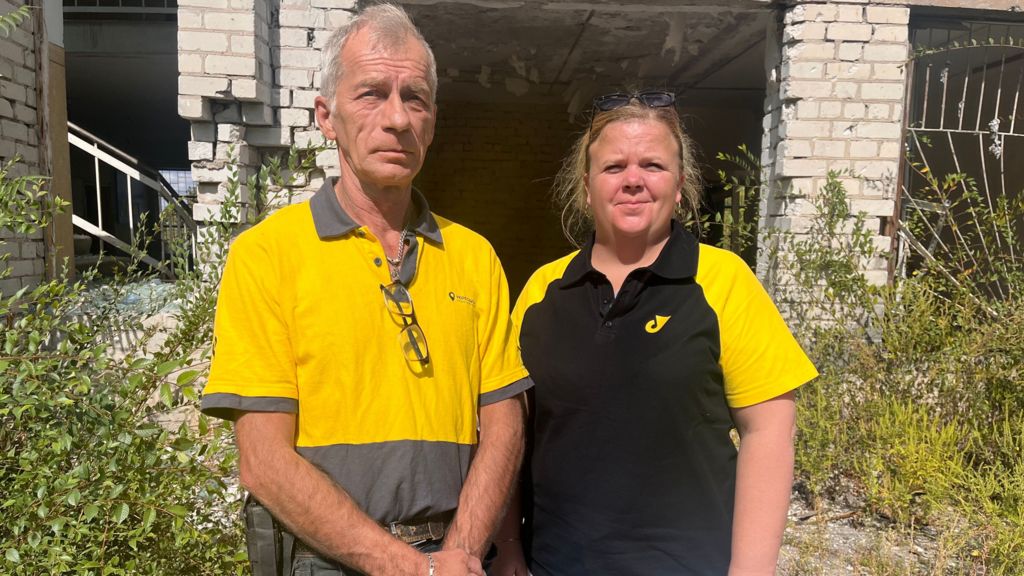
On the ground near Zaporizhzhia, just a short distance from the southern frontline, the human cost and unwavering commitment of Ukrposhta’s staff comes to life. Thirty-eight-year-old postmistress Kateryna Marynych has already lost everything to the war: her home was destroyed in the early days of the full-scale invasion, and her husband was killed in combat. She moved to the frontline region to rebuild her life, and spent two years running the local post office in the village of Lukasheve—until that too was destroyed by a Russian drone strike in March that targeted nearby Ukrainian military positions.
Now, Kateryna operates out of the back of a repurposed delivery van, traveling from village to village to serve residents. On a recent reporting trip, as soon as her van pulled off the dirt road into a small settlement, a steady line of elderly residents formed at the open window, where Kateryna sat handing out cash pensions and accepting utility bill payments, while her partner Slava handled parcel and food deliveries from the rear of the vehicle. For safety, Slava drives, carries a sidearm to protect the large amount of cash they carry, and both wear body armor when operating within range of frontline fighting. The van is also fitted with a special antenna that detects the small first-person-view attack drones that have become one of the biggest threats to civilians and personnel along the front. So far, they have spotted drones but avoided being targeted.
For the residents who depend on her, Kateryna’s weekly visits are more than just a practical necessity. “It’s a long way for us to travel to Zaporizhzhia. Especially now, at a time when there are attacks all around us. The fact that they come here is really nice,” said local resident Nadiia. Seventy-seven-year-old Oleksandrivna, who recently returned home after recovering from a stroke, put it more bluntly: “We would be stuffed! I am just out of hospital after a stroke. Where could I go for my medicine?” For 64-year-old Mykola, the visits also provide a rare social outlet: “It is very important. It’s one of the few joys of the month: you come out, have a chat with people, collect your pension, and go home.”
Kateryna says the bond between her and her customers is like family. After major Russian strikes on Zaporizhzhia, residents often call to check if she is safe, just as she checks on them after periods of heavy fighting. “They love me, they need me. They are waiting for me,” she said. “They are like a grandmother or grandfather to me. I hope they are proud of what I do.” When asked if she would consider leaving the dangerous role for a safer life further from the front, she shrugged off the question: “It is my work. If I can’t, who will do my job?”
Analysts point out that the deliberate targeting of Ukrposhta fits into a wider Russian strategy of escalating attacks on civilian infrastructure across Ukraine. As battlefield progress for Russian forces has stalled in eastern Ukraine, the Kremlin has turned to intensifying long-range drone and missile strikes on energy facilities, transport networks, border posts, and commercial sites, aiming to break civilian morale and pressure the Ukrainian government into concessions. For many Ukrainians, however, the work of Ukrposhta’s frontline postal workers demonstrates that Ukraine’s defense extends far beyond the military: the resilience of the nation is also sustained by ordinary civilians who keep showing up, every day, to support their most vulnerable neighbors.