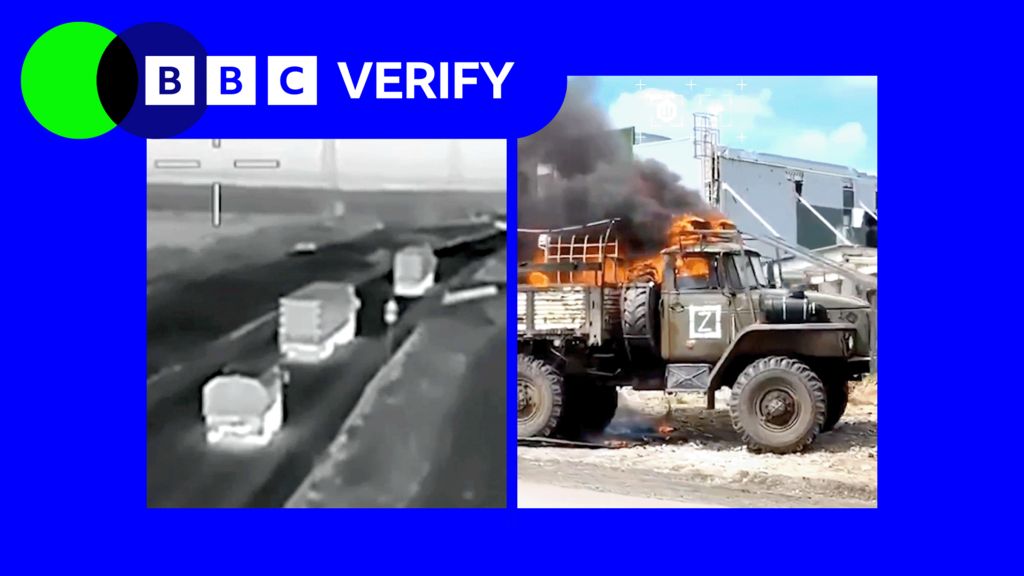
After years of static frontline momentum in Russia’s full-scale invasion of Ukraine, Kyiv has launched a stepped-up campaign targeting Russian military supply convoys along key routes connecting occupied territories to Russia and Crimea, leveraging cutting-edge artificial intelligence-enhanced drone technology to hit targets deeper behind enemy lines with greater precision. Multiple independent open-source and defense analysts have confirmed the growing scale and impact of Ukraine’s new “logistics lockdown” strategy.
BBC Verify has corroborated footage of at least 14 separate strikes carried out over the past week, targeting convoys transporting critical supplies including food, fuel, and ammunition along the high-priority southern supply corridors. Independent open-source collective GeoConfirmed has verified geolocation data showing destroyed and burned-out truck hulls and military vehicles at multiple sites along the route. Of the confirmed strikes, at least 10 occurred between the Russian border and the occupied port city of Mariupol, with one additional strike documented southwest of Melitopol, a key logistical hub for Russian forces in southern Ukraine.
Clément Molin, an analyst with the think tank Atum Mundi, confirmed to BBC Verify that he has verified the destruction of 150 Russian supply vehicles more than 20 kilometers behind the front line — a figure he estimates represents only around half of all actual strikes carried out in the campaign.
The backbone of Ukraine’s new campaign is the AI-enabled Hornet loitering munition system, which military analysts say represents a major technological leap over older drone models used by Kyiv earlier in the war. Nick Brown, a weapons specialist with defense intelligence firm Janes, explained that the Hornet system’s AI targeting module has been trained on thousands of hours of combat footage of Russian military vehicles collected over four years of war, allowing the drones to autonomously identify and prioritize valid targets. The drones also connect to operators via SpaceX’s Starlink satellite network, making them far more resistant to Russian electronic jamming than older systems. This combination of capabilities allows Ukraine to launch hundreds of the loitering munitions toward target areas more than 100 miles behind enemy lines, where they can independently seek out and engage Russian supply vehicles.
Ukraine’s Defense Minister Mykhailo Fedorov outlined the strategic goals of the new drone campaign this Wednesday, noting that the “logistics lockdown” strategy is designed to increase pressure on Russian forces in their rear areas and cut off the frontline Russian units from the sustained resupply they need to carry out offensive operations.
Cristian Vlas, a researcher with conflict monitoring organization Acled, told BBC Verify that the strikes have already forced Russian military command to adopt immediate tactical changes: the military has shortened the length of all supply convoys moving along key routes as a quick stopgap measure to reduce potential losses from drone attacks. Vlas added that Ukraine’s objectives extend beyond simply destroying supply trucks: the campaign also targets key Russian command posts and communications towers that enable frontline Russian units to coordinate operations and launch long-range drone and missile strikes from occupied Ukrainian territory. These assets are the backbone of Russia’s frontline combat capability, ensuring troops receive the food, fuel, and intelligence they need to maintain offensive pressure.
Robert Tollast, a land warfare expert at the London-based Royal United Service Institute, explained just how critical uninterrupted supply is to Russian frontline operations, noting that active combat brigades can require up to 1,000 tonnes of fuel, food, ammunition, and other essential supplies every single day. While Ukraine previously carried out long-range strike campaigns targeting Russian air defense systems, Tollast emphasized that the extended range and precision of the new AI drone campaign represents an entirely new level of threat to Russian logistics. “If you are cutting resupply, for example ammunition trucks 100km or more from the front using small drones, and then longer-range drones are going after larger logistical sites, this is a very serious problem for the Russians,” he said.
The new drone campaign has already shifted the momentum of frontline operations in Ukraine’s favor, according to recent analysis from the Institute for the Study of War (ISW). The think tank’s latest assessments mark the first time since 2023 that Ukraine has been recapturing more territory than it loses on a weekly basis, ending months of near-stalemate across the front line.
George Barros, an ISW analyst focusing on the Ukraine war, said that Kyiv’s innovative use of new technology proves the conflict is not locked in a permanent stalemate. Ukrainian forces are now able to carry out mechanized tactical maneuvers that were impossible just 12 months ago, thanks to the pressure created by the drone campaign. Barros added that as Ukraine’s intermediate-range strike campaign pushes Russian logistics hubs and forward operating bases further away from the front line, Russia’s ability to carry out infantry infiltration missions will continue to degrade, as these units lack the resupply to sustain persistent offensive actions. Ukraine’s “drone superiority” has even neutralized Russia’s traditional advantage of deploying overwhelming numbers of troops to the front line, Barros noted.
The impact of the campaign is already visible in Russian tactical adjustments: Ukraine’s 412th Nemesis Brigade, a specialist drone unit, confirmed this week that Russian commanders have restricted the movement of heavy military equipment across southern occupied Ukraine, and Russian convoys have begun diverting from paved main supply routes to travel across open fields and unimproved dirt roads to avoid drone detection. Even pro-Russian occupation authorities have imposed restrictions: Vladimir Saldo, the Russian-appointed head of occupied Kherson region, has ordered new limits on civilian traffic along the key southern supply route to reduce the risk of drone strikes on military convoys.
Despite Ukraine’s current battlefield advantage, Barros cautioned that the edge provided by the new AI drone technology is likely temporary. Russia will almost certainly develop effective countermeasures to blunt the drone campaign over time, meaning Ukraine’s international backers have a rare, narrow window to capitalize on the favorable battlefield dynamics while Kyiv holds the upper hand.