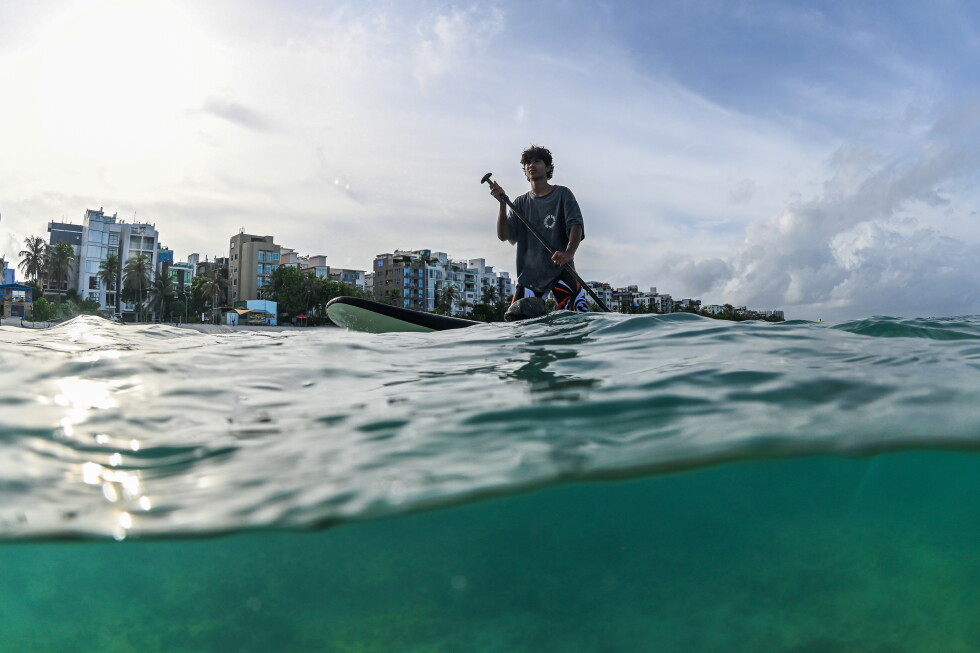
Scattered across the low-lying Indian Ocean archipelago of the Maldives, a new wave of youth-led environmental activism is pushing back against unregulated development and accelerating ecological damage, as young citizens confront the reality that climate collapse is not a distant future, but an immediate threat to their island homes.
In Addu City, a southern Maldivian community situated within a protected UNESCO Biosphere Reserve, nonprofit organization Project ThimaaVeshi – whose name translates to “self and surroundings” – has led high-profile direct action against a controversial land reclamation project that is clearing critical mangrove wetlands. In June 2026, a cohort of young activists paddled kayaks to the construction site and spray-painted the word “ECOCIDE” across a section of newly reclaimed land, drawing global attention to the destruction of a habitat that protects coastlines from erosion, supports endangered marine life, and stores carbon at rates far higher than most terrestrial forests.
What began as a small group of high school friends collaborating with the Addu City council has grown into a registered nonprofit movement. Twenty-one-year-old co-founder Yameen Maumoon recalled that the group started with nothing more than shared passion and collective ambition. Project ThimaaVeshi has since partnered with Veshi Saafu, a group of older local women also active in environmental advocacy, to amplify their campaign during World Environmental Day, documenting how unplanned development is degrading Addu’s wetlands and coral reefs.
Parallel movements have emerged in the crowded capital city of Male and its neighboring Hulhumale, where youth organizers are tackling the pervasive plastic waste that clogs public spaces, coastlines and nearshore waters. Ripple, a youth group currently pursuing formal registration, began when a circle of friends noticed trash piling up in their favorite gathering spots. Co-founder Mariyam Maasha Waheed recalled that the idea grew from a casual joke while playing Minecraft: the group decided to post cleanup content on TikTok, and their videos quickly went viral, turning a small informal initiative into a sustained movement. Today, Ripple hosts weekly community cleanups, partners with local surfing groups to remove discarded fishing gear and plastic from coral reefs, and runs recycling programs for the waste they collect.
The newest of these youth-led groups, Barnacles – also working toward official registration – centers its work on climate education and building youth leadership. Co-founder Yania Hussain Ishan first became engaged with environmental issues while researching a school presentation on nature protection. Ishan notes that widespread discourse around the climate emergency has left many young people feeling disempowered, so Barnacles works to frame environmental action as accessible, communal, and meaningful for all participants.
Across all three groups, a shared unifying belief drives their work: unlike previous generations, young Maldivians see firsthand that sea level rise, coastal erosion, plastic pollution, and development-driven ecosystem damage are not abstract threats – they are daily realities reshaping their country. Climate scientists project that 80% of the Maldives, a nation located south of India and Sri Lanka with an average elevation of just 1.5 meters above sea level, could become uninhabitable within 50 years due to rising ocean waters.
While the Maldivian government has publicly positioned itself as a global advocate for climate action given the country’s extreme vulnerability to sea level rise, officials have argued that short-term sacrifices are sometimes necessary to support economic development. Activists counter that existing environmental protections are being implemented far too slowly to save the country’s fragile ecosystems.
The youth activists have faced pushback from establishment figures, including government officials who have dismissed their work as naive and futile, arguing that their youth makes them too emotional to contribute meaningfully to environmental decision-making. Last year, Maldivian Climate Change Minister Ali Shareef publicly claimed at a forum that young people cannot be trusted with governance due to emotional bias.
Unfazed by the criticism, the activists acknowledge that small-scale cleanups and local protests cannot single-handedly solve the Maldives’ massive climate and development challenges. But they reject the idea that they must wait for large-scale systemic solutions to act, instead focusing on building a culture of environmental stewardship that will carry forward to future generations.
“We are deciding what kind of ancestors we will be,” Ishan said. “We are defending our home, our heritage and the right of every Maldivian child yet to be born to stand on these shores, look out at the sea and feel the same wonder and security that defines who we are.”
This reporting from the Associated Press is supported by funding from private philanthropic foundations, with AP retaining full editorial independence over all content.