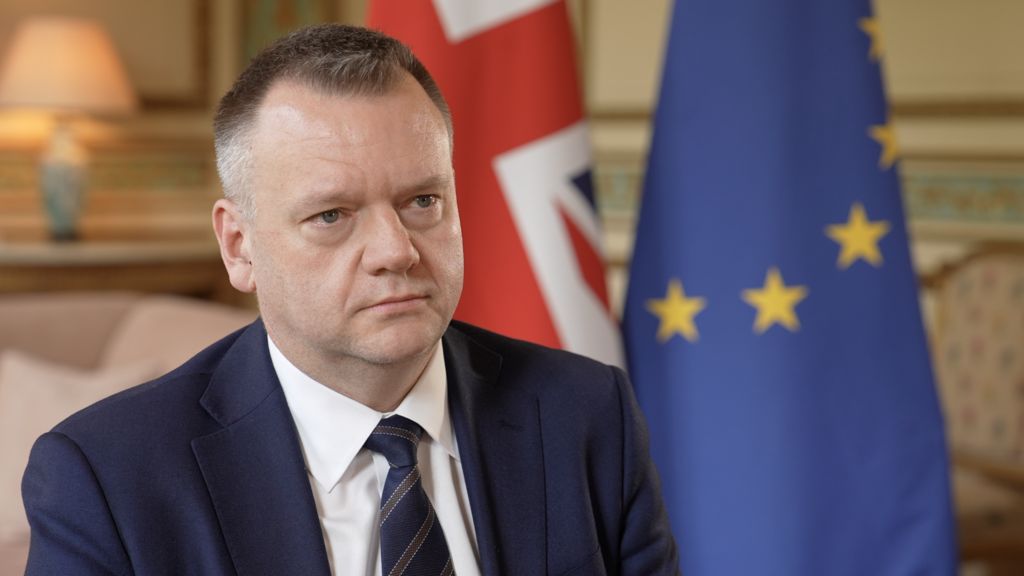
Against a backdrop of unprecedented global volatility, the United Kingdom has laid out a clear strategy to deepen practical cooperation with its European neighbors, guided by what the country’s EU Relations Minister Nick Thomas-Symonds calls an “ambitious and ruthlessly pragmatic” approach focused squarely on advancing UK national interests. Speaking exclusively to the BBC from the British ambassador’s Brussels residence, Thomas-Symonds framed the shift toward warmer UK-EU relations as a direct response to growing global instability, arguing that British voters have grown increasingly receptive to closer cross-channel collaboration amid mounting global threats. “We find ourselves in a dangerous situation in the world, and there is a particular imperative for closer ties right now, I find broad public support for this direction,” he noted.
Today’s geopolitical landscape paints a stark picture of the pressures driving this policy shift: Europe is entering its fifth year of the largest continental conflict since World War II in Ukraine, global energy markets are roiled by rising fuel prices and spillover tensions from tensions around the Strait of Hormuz, and the global economy remains under sustained strain. Meanwhile, longstanding diplomatic ties between the UK and its traditional closest ally, the United States, have deteriorated sharply in recent months, creating new incentives for London to align more closely with Brussels.
The push for deeper cooperation is already visible in the security and defence space, where the UK has taken a leading role in coordinating a unified European response to the war in Ukraine. Following a commitment from European leaders to increase the continent’s own defence capacity to Washington, London and Brussels are also moving forward with plans for joint arms procurement.
Beyond defence, the administration of Prime Minister Keir Starmer has prioritized unwinding the thick layers of post-Brexit red tape that have raised costs for UK businesses trading with the EU – the UK’s largest export market, nearly a decade after the original Brexit referendum. By the time of the second post-Brexit UK-EU summit scheduled for this summer (a final date has not yet been set), the UK government expects to conclude three key new agreements: a food and agricultural safety pact that will cut bureaucratic burdens for exporters shipping products such as meat to Northern Ireland and the EU bloc, a mutual carbon emissions trading arrangement, and a youth mobility program that allows British and European young people to study and work in each other’s territories for limited periods. This week, the two sides also formally confirmed the UK will rejoin the EU’s iconic Erasmus+ education exchange scheme, expanding study abroad opportunities for British youth across the bloc.
The Starmer government has been careful to stress that all new cooperation agreements respect the result of the 2016 Brexit referendum and the party’s manifesto red lines: the UK will not seek re-entry to the EU, its single market, or its customs union. This position has failed to satisfy critics on both sides of the Brexit divide, however.
Opponents of closer alignment, including the leadership of the Conservative Party and Reform UK, argue that any deeper cooperation requires the UK to adopt EU regulations without having a seat at the table when rules are written, turning Britain into a “rule-taker” rather than a rule-maker – directly contradicting the 2016 Leave campaign’s core promise to “take back control” from Brussels. Former UKIP leader Nigel Farage has gone as far as to label planned upcoming legislation to create a fast-track process for aligning UK regulation with future EU standards a “backdoor attempt to drag Britain back under EU control.” Conservative leader Kemi Badenoch has similarly accused the government of lacking transparency, arguing that if ministers want to rejoin the EU, they should state that goal openly.
On the other side of the debate, opposition parties including the Liberal Democrats and the Green Party argue that the government’s incremental approach does not go far enough to deliver the economic benefits of closer alignment that the UK desperately needs. Political analysts have summed up the government’s position as a awkward balancing act: caught between the economic imperatives of reducing trade barriers with the EU and the political constraints imposed by the narrow 2016 Brexit result and ongoing division over the issue.
All incremental cooperation agreements also come with a direct financial cost for British taxpayers, a reality the government has not shied away from. Rejoining Erasmus+ will cost UK taxpayers £570 million in its first year alone, while the UK’s participation in the EU’s Horizon science research program – agreed under the previous Conservative administration – costs £2.2 billion annually. Supporters of the arrangement note that two years after rejoining Horizon, the UK has become one of the program’s top beneficiaries, securing a disproportionate share of research grants and collaborative opportunities.
Thomas-Symonds has repeatedly emphasized that all cooperation will be strictly limited to areas that deliver clear net benefits to the UK, with no compromise on national interests. For example, he said the UK plans to pursue an independent regulatory path for artificial intelligence that diverges from Brussels’ approach, and has so far declined to join the EU’s SAFE defence loans scheme because the €2 billion (£1.7 billion) membership fee demanded by Brussels – roughly 10% of the UK’s entire annual defence budget – remains too high.
EU officials have made clear that the closer the UK seeks to get to the EU single market, the more it will be required to align with EU rules and accept core EU principles – a reality that creates ongoing friction. French MEP Nathalie Loiseau, a close ally of President Emmanuel Macron, confirmed that the EU’s core terms have not changed since the 2016 Brexit vote: the deeper the integration, the higher the requirement for regulatory alignment. In the most extreme scenario of near-single market access, the EU could demand the UK reinstate freedom of movement – a longstanding red line for the current UK government.
The ongoing negotiations over UK access to the EU’s internal electricity market highlight this tension. Thomas-Symonds describes energy market integration as a top national priority for the UK, a lesson learned after the dramatic energy price spikes following Russia’s 2022 full-scale invasion of Ukraine and recent market volatility caused by tanker disruptions in the Strait of Hormuz. Even so, Brussels has demanded that the UK contribute to the EU’s Cohesion Fund, a pot of money designed to support economic development in poorer EU regions, as a condition of accessing the electricity market. When asked if the UK would accept this demand, Thomas-Symonds brushed it off as merely the EU’s opening negotiating position, declining to elaborate further.
Another persistent criticism of the government’s current approach is its heavy focus on agreements for trade in goods, which critics argue will not deliver the widespread economic gains Chancellor Rachel Reeves has promised, given that the UK’s economy is overwhelmingly focused on services. The government pushes back on this, projecting that the new food safety and carbon trading agreements alone will add £9 billion to the UK economy by 2040 – a timeline that critics note is decades away.
The European Commission, the EU’s executive body that handles trade negotiations on behalf of member states, has also faced criticism from within the bloc. Several EU member states that maintain close trade and political ties with London have complained off the record that the commission is being unnecessarily rigid in its negotiations, and should show more flexibility to strike bespoke deals with the UK – especially given the shared security and economic threats the bloc faces from Russia, China, and increasingly, the United States, according to senior EU diplomats who spoke to the BBC.
When asked if the push for closer UK-EU ties amounted to an admission that the UK’s long-cherished “special relationship” with the United States was over, amid repeated public criticism of Starmer from US President Donald Trump over the UK’s refusal to join Washington’s conflict with Iran, Thomas-Symonds rejected the framing. “The special relationship is deep and enduring,” he said, adding that the UK does not have to choose between its European and transatlantic allies. Even so, the question remains: as the UK increasingly aligns its regulations with the EU across multiple sectors, it will become progressively more difficult to deliver on the core Brexit promise of striking independent free trade deals with third countries including the United States. Tensions have already flared: last May, Trump and Starmer agreed to a limited bilateral trade deal that modestly expanded agricultural access and cut punitive US tariffs on British car exports, but left broader 10% US tariffs on most British exports in place. This week, Trump even threatened to scrap even that limited deal entirely in retaliation for the UK’s refusal to back his Iran policy.
As negotiations progress, the UK government’s balancing act between domestic political constraints, economic imperatives, and shifting global alliances will only grow more challenging, with the outcome set to reshape Britain’s place in the world for decades to come.