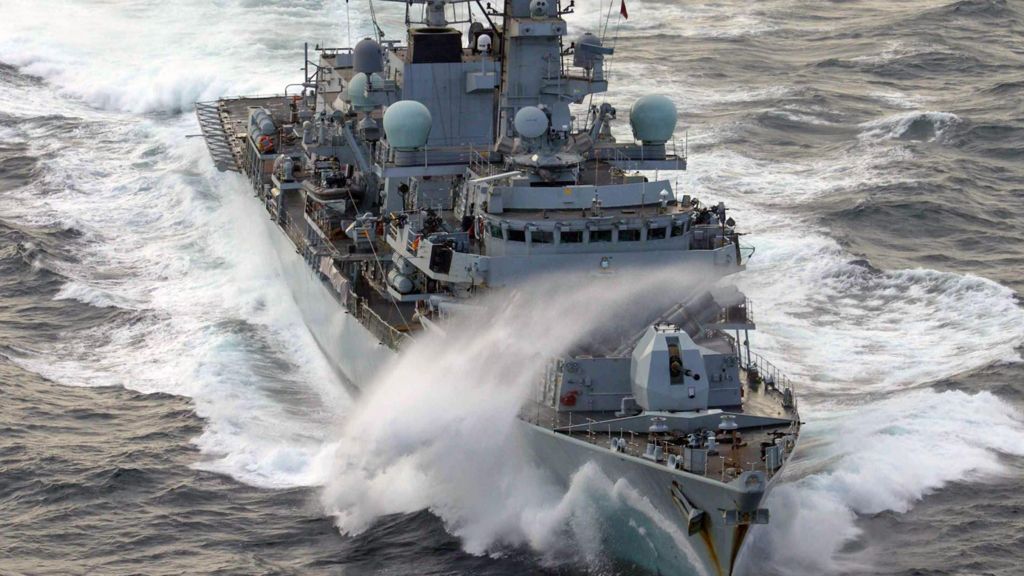
Tensions between the UK and Russia have escalated sharply after UK Defence Secretary John Healey publicly accused three Russian submarines of carrying out a covert surveillance operation targeting critical undersea cables and pipelines in waters north of the British mainland. In a press briefing held at Downing Street on Thursday, Healey said the incident represented a deliberate act of malign activity by Moscow, and confirmed British naval and air assets had been immediately deployed to intercept and monitor the Russian contingent, with no evidence of damage to UK Atlantic infrastructure found to date.
Addressing Russian President Vladimir Putin directly, Healey issued a stark public warning: “We see you. We see your activity over our cables and our pipelines, and you should know that any attempt to damage them will not be tolerated and will have serious consequences.” According to Healey’s account, Russia deployed one Akula-class attack submarine as a diversionary distraction, while two special-purpose spy submarines operated by Russia’s secretive GUGI deep-sea research directorate conducted surveillance of the undersea infrastructure networks. He added that the diversionary attack submarine returned to Russian waters after being tracked by British forces, while the two GUGI vessels remain in the wider region.
Moscow has rejected the UK’s allegations outright. In a report carried by Russia’s state-owned news agency Tass, the Russian Embassy in London stated that Russia “is not threatening underwater infrastructure, which is truly critical to the UK. We are not using aggressive rhetoric in this regard.”
To counter the Russian operation, the Royal Navy deployed the Type 23 frigate HMS St Albans, Royal Fleet Auxiliary fuel tanker RFA Tidespring, and anti-submarine Merlin helicopters to continuously track all three submarines. Norway also joined the monitoring effort, though Healey did not disclose details of contributions from other allied nations. “Our armed forces left [Russia] in no doubt that they were being monitored, that their movements were not covert, as President Putin planned, and that their attempted secret operation had been exposed,” Healey told reporters. “We watched them, we were able to track them, we dropped sonar buoys to demonstrate to them that we were monitoring every hour of their operation.”
Little known to the general public compared to Russia’s iconic KGB or domestic intelligence service FSB, GUGI – the Main Directorate for Deep Sea Research – is one of Moscow’s most formidable and secretive military units. Officially part of the Russian Navy, the agency operates with such a high level of classification that it reports directly to Russia’s defence minister and the president. Headquartered in St. Petersburg on the Baltic coast, GUGI maintains a key Arctic deployment base at Olenya Bay on the Kola Peninsula, which also hosts Russia’s strategic nuclear submarine fleet.
GUGI’s core mandate covers deep-water underwater surveillance, reconnaissance and sabotage operations. Global military analysts note that only the United States matches GUGI’s unique capability to operate advanced military hardware at extreme ocean depths. This hardware includes small uncrewed mini-submarines, which experts believe were the assets deployed by Russia during the recent operation near UK cable routes. These mini-subs can be launched covertly under cover of darkness from larger mother ships such as the Russian spy vessel Yantar, which has previously been spotted operating near critical infrastructure in the English Channel. The systems have the technical capability to cut undersea cables, or tap into them to intercept data traffic passing through the networks.
This type of activity falls under the framework of modern hybrid warfare: hostile acts carried out by a state that fall short of a clearly attributable, lethal attack that would trigger a formal declaration of war. UK and NATO military planners have long raised concerns that widespread covert Russian surveillance of Western undersea infrastructure is intended to give Moscow a strategic advantage in the event of a future open conflict. If hostilities were to break out, the Kremlin could activate pre-positioned devices to sever or disrupt critical data and energy networks, causing widespread disruption to civilian and military operations.
Healey argued that Putin chose to launch the operation at a moment when global attention is heavily focused on the ongoing war in the Middle East, and reaffirmed that Russia remains the “primary threat to UK security.” While acknowledging the persistent threat Moscow poses, Healey expressed confidence in UK forces’ ability to track future Russian activity and expose any covert operations that threaten British national interests.
Prime Minister Keir Starmer echoed Healey’s stance, saying he was “determined to protect the British people from paying the price for Putin’s aggression in their household bills.” He added that the UK would not “shy away from taking action and exposing Russia’s destabilising activity that seeks to test our resolve.”
The incident has quickly become a point of domestic political debate in the UK. Opposition Conservative Party leader Kemi Badenoch called on Starmer to immediately publish the government’s long-promised Defence Investment Plan, posting on social media platform X that “We stand shoulder to shoulder on Russian aggression. To be strong abroad we need clarity on spending at home. Without the investment plan, Starmer’s strategy is just words.” Reform UK leader Nigel Farage, referencing recent reports of Russian navy vessels escorting Russian oil tankers through the English Channel, claimed “If we have learnt one thing in the last month, it is that we do not have an operational Royal Navy at any level in this country and that for us needs to be a massive wake-up call.”
Some retired defence officials have also questioned the UK’s ability to counter persistent Russian threats. John Foreman, a retired Royal Navy officer and former UK defence attaché to Moscow, told the BBC that “the rhetoric is a bit tired by now. We’re well aware of the Russian threat. The question is whether we’re doing something about it.” Foreman pointed to the recent decommissioning of two Royal Fleet Auxiliary tankers, RFA Wave Knight and RFA Wave Ruler, as evidence that the UK is “hard-pressed” to maintain maritime security. “I don’t know how we are going to dig ourselves out of this nadir of maritime security that we have found ourselves in,” he said.
Undersea cables and pipelines are among the most critical but overlooked pieces of global infrastructure. More than 600 undersea cables crisscross the world’s oceans spanning more than 870,000 miles, carrying global internet traffic and electrical power between continents, with landing points often located in remote, lightly protected coastal areas. For the UK specifically, the infrastructure is existential to daily life: roughly 60 undersea cables come ashore at multiple points along the UK coast, with concentrations in East Anglia and South West England, and more than 90% of the country’s daily internet traffic relies on these systems. The UK also depends on North Sea undersea gas pipelines, most notably the 724-mile Langeled pipeline connecting Norway to the UK, for 77% of its gas imports.
Military analysts say the challenge of countering GUGI operations is significant. Dr Sidharth Kaushal, a sea power researcher at the Royal United Services Institute (RUSI), explained that GUGI’s deep-diving mini-submarines are purpose-built to avoid detection, with engineered reductions in acoustic noise, water displacement and magnetic signature that make them “complex targets” for anti-submarine forces. Kaushal told BBC Verify that it is likely the Russian submarines were still able to gather useful intelligence on the UK’s cable network despite continuous monitoring by the Royal Navy, noting that the UK’s ability to restrict such operations during peacetime is “limited” – particularly as military monitoring activity in international waters is legally permitted. Even so, Kaushal added that the British operation was not without benefit: by tracking the Russian deployment, the Royal Navy likely gathered valuable intelligence on Russian tactics, network mapping priorities, and may even have been able to recover any surveillance equipment left behind by the Russian units.
This incident aligns with a broader pattern of Russian hybrid activity that the BBC first exposed in 2025, when it reported that Russia was waging a campaign of hybrid warfare against the UK and Western Europe intended to pressure Western nations to end their military support for Ukraine.