Fresh political and social unrest has erupted in the United Kingdom following the sentencing of an 18-year-old’s killer, after clashes broke out between protesters and police at a demonstration in the southern coastal city of Southampton this week.
The fatal December 2024 stabbing of Henry Nowak, a white teenager, has roiled national discourse in recent weeks after his killer, 23-year-old Vickrum Digwa — a Sikh man — was convicted of murder and sentenced to life in prison with a minimum 21-year term on Monday. The case ignited outrage after it was revealed that when responding to the scene, officers initially treated the wounded Nowak as a suspect rather than a victim, after Digwa falsely claimed he had been the target of a racist attack by Nowak. Police body camera footage released after sentencing shows Nowak, who was handcuffed as he lay dying, repeatedly telling officers he had been stabbed and could not breathe, only to be dismissed by responding personnel. The judge in the trial explicitly rejected Digwa’s unsubstantiated racism claim, ruling there was no evidence Nowak made any racist remarks before the attack.
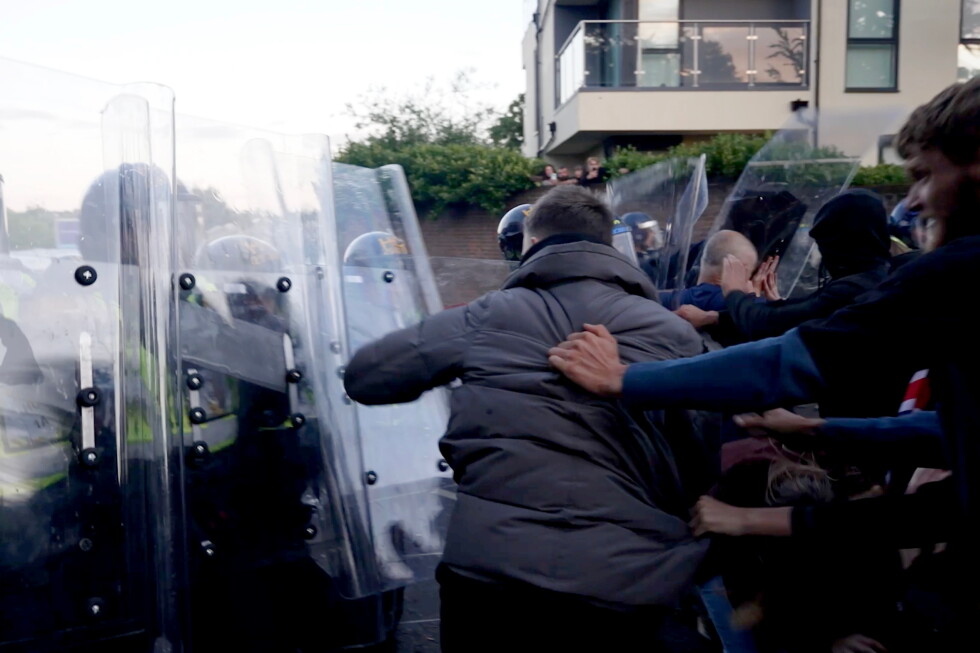
In the aftermath of the sentencing, hundreds of protesters gathered in Southampton on Tuesday to demand answers over the handling of Nowak’s death. But the demonstration quickly turned violent, as a subset of attendees hurled chairs, metal cans, rocks and flares at responding police officers. The incident has deepened an already bitter national debate over policing, knife crime, and systemic bias, after far-right political actors and activists seized on the case to push claims that the UK justice system is inherently biased against white people. That narrative has gained traction among far-right circles, who have weaponized the case to push the popular far-right talking point of “two-tier policing,” which falsely claims law enforcement disproportionately favors ethnic minority groups over white Britons.
Britain’s newly appointed Home Secretary Shabana Mahmood swiftly condemned the Tuesday violence, labeling it “completely unacceptable.” In a statement following the clashes, Mahmood emphasized that the Nowak family itself had already called on the public not to allow Henry’s death to be twisted to fuel further societal division. “There can be no justification for hijacking this tragedy to stir up violence and disorder,” Mahmood said. “Those responsible can expect to face the full force of the law.”
Prime Minister Keir Starmer echoed that condemnation, while also acknowledging the legitimate public concern over the police handling of the case. Starmer told reporters he was “sickened” by the newly released police body camera footage, and confirmed there are pressing unanswered questions about how unproven accusations of racism shaped officers’ on-scene decision-making. The Independent Office for Police Conduct, the national watchdog that probes alleged police misconduct, has launched a full investigation into the actions of officers from the Hampshire and Isle of Wight Constabulary, who responded to the stabbing. In a move to address systemic gaps exposed by the incident, the National Police Chiefs’ Council has also announced it will conduct a full review of national anti-bias training and guidance for officers.
Notably, the victim’s own family has pushed back against efforts to frame the case through a racial or religious lens. Mark Nowak, Henry’s father, said in a statement after the sentencing that his son’s death should not be used to stoke division, and that the family’s priority is pushing for safer streets across the UK rather than fomenting hatred. “This case is not about racism or religion,” he emphasized.
That appeal has not stopped high-profile far-right figures from exploiting the tragedy for political gain. Nigel Farage, leader of the anti-immigration Reform UK party, used the sentencing to double down on the two-tier policing narrative Tuesday, urging supporters to respond to the incident with “pure cold rage” and claiming “white lives matter just as much as Black lives.” X (formerly Twitter) owner Elon Musk and notorious British far-right activist Tommy Robinson have also amplified baseless claims of systemic anti-white bias to their massive online audiences, stoking further public anger. The case has also reignited a fringe political push to ban Sikhs from carrying kirpans, the ceremonial religious dagger many Sikh people wear as a symbol of faith. The trial judge confirmed that while Digwa carried a small traditional kirpan, the weapon used to kill Nowak was an 8-inch sheathed dagger separate from the ceremonial item.
The unrest comes as UK political parties grapple with rising far-right influence ahead of upcoming local elections, with critics warning that the exploitation of Nowak’s death risks deepening racial and religious division across the country at a time of already heightened social tension.