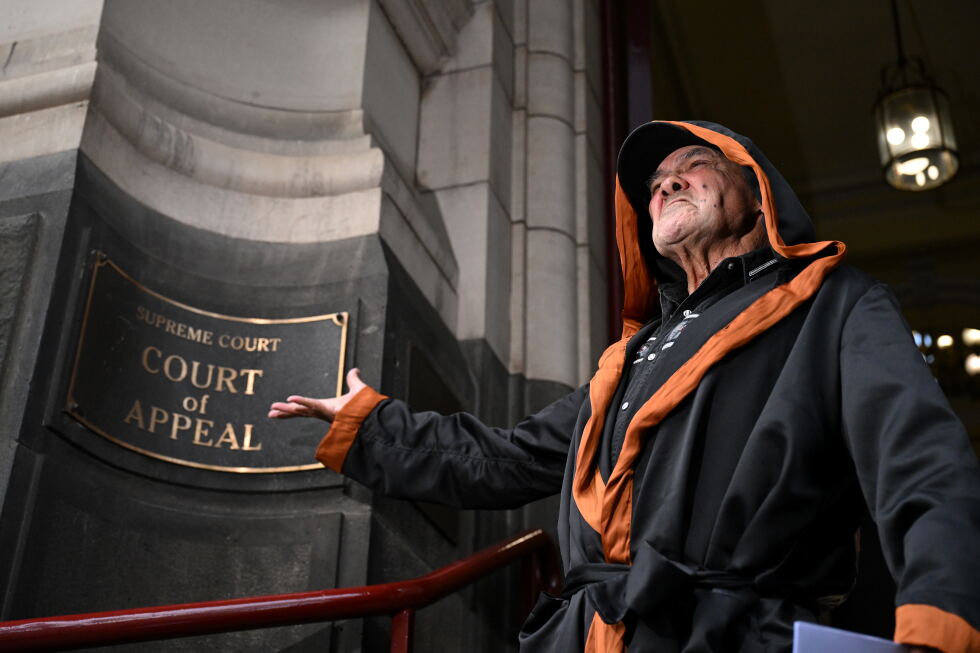
MELBOURNE, Australia — A landmark legal bid by a senior Indigenous Australian activist to pursue a private genocide prosecution against Britain’s King Charles III, who also serves as Australia’s ceremonial head of state, moved to the state’s highest appeals court Wednesday, where three judges deferred their decision to a later date.
The 68-year-old claimant, widely known by his community honorific Uncle Robbie Thorpe, brought the appeal to Victoria’s Supreme Court of Appeal after two lower courts dismissed his original filing in the Melbourne Magistrates’ Court. Thorpe’s legal argument centers on the claim that King Charles, alongside the Australian federal government and its national institutions, perpetuates ongoing genocide against Indigenous Australians through entrenched systemic disadvantage across socioeconomic sectors, a status that has left Indigenous communities the most marginalized demographic group in the country.
Official Australian demographic data bears out the stark inequalities Thorpe highlights: Indigenous people make up just 4% of the national population, yet have significantly lower life expectancies, higher rates of chronic health conditions, disproportionate rates of incarceration and double the unemployment rate of non-Indigenous Australians.
Speaking to reporters from The Associated Press ahead of Wednesday’s hearing, Thorpe signaled that if his domestic legal challenges are exhausted without success, he will escalate the case to the International Criminal Court (ICC) in The Hague, Netherlands, invoking the UN Genocide Convention to pursue the claim.
“It’s clear that they’re unwilling, unable, reluctant to deal with these international legal issues like genocide,” Thorpe told the AP, referencing Australian judicial institutions. During his address to the appellate panel, Thorpe emphasized that compounding systemic disadvantage is resulting in preventable deaths of Indigenous people across the country. “The Crown is responsible for all this mess,” he said. “Australia’s got away with genocide of Aboriginal people since [British colonizers] arrived here.”
The legal roots of the claim stretch back to 1788, when the British Empire began its colonization of the Australian continent, seizing traditional Indigenous lands without any formal treaty with the native peoples. Colonial policies systematically targeted Indigenous culture: native languages were banned, traditional cultural practices were criminalized as part of a forced assimilation campaign to convert Indigenous people to Christianity and Western social norms, and an estimated 100,000 Indigenous children were forcibly removed from their families over more than a century in policies that have since been universally discredited as genocide.
For Wednesday’s hearing, Thorpe wore a traditional possum-skin coat and carried a feather from a wedge-tailed eagle, a sacred totem for many Indigenous Australian communities. He asked the court to address him as Uncle Robbie, or by his traditional tribal name Djuran Bunjileenee — a request granted by presiding Justice Karin Emerton. Court documents formally name the defendant as Charles Philip Arthur George Windsor.
Thorpe’s legal team bases the prosecution on three overlapping legal frameworks: Indigenous law that has operated on the Australian continent for more than 65,000 years, Victorian state common law, and Australian federal criminal law. When lower courts dismissed the case last year, judges ruled that local magistrates lack jurisdiction to consider Indigenous law, that genocide is not codified as an offense under Australian common law, and that any federal genocide prosecution requires formal approval from the federal attorney-general, which has not been granted.
After a two-hour hearing Wednesday, Justice Emerton confirmed the three-judge panel would issue its ruling at an unspecified future date. If Thorpe’s appeal fails here, his last domestic legal recourse is to bring the case before Australia’s High Court. If that effort also fails, he will move forward with his plan to file the prosecution with the ICC in The Hague.