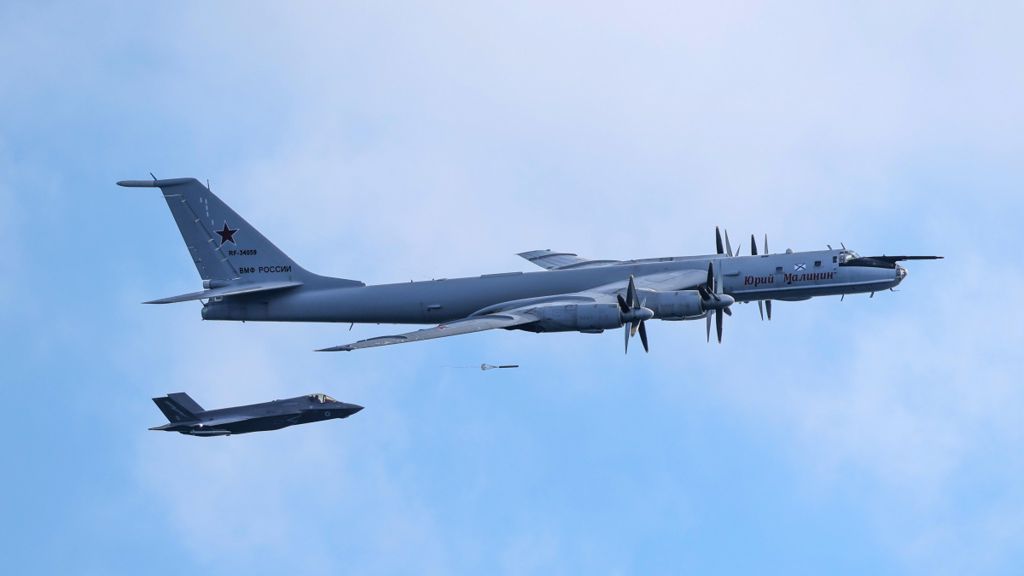
In a fresh escalation of Russian military probing near NATO assets in the North Atlantic, the United Kingdom’s Ministry of Defence (MoD) has confirmed that British fighter jets intercepted a Russian maritime patrol aircraft that repeatedly approached a UK-led carrier strike group operating in the Norwegian Sea.
According to official MoD statements, the incident, which unfolded Thursday, saw a Russian Bear-F patrol aircraft fly at low altitude and come unnecessarily close to the UK’s flagship aircraft carrier HMS Prince of Wales. Military intelligence assessments indicate the Russian aircraft dropped 10 sonobuoys into international waters during the encounter. These floating monitoring devices are designed to use acoustic technology to detect submarines and surface naval vessels, a capability clearly aimed at gathering intelligence on the strike group’s operations.
Before the interception, British defense personnel attempted to hail the Russian aircraft on standardized international emergency and communication frequencies, but the plane’s crew did not respond to any calls. Following this lack of communication, two F-35 stealth fighter jets were launched from the deck of the HMS Prince of Wales to intercept and escort the Russian patrol aircraft away from the strike group’s operating area.
The MoD has condemned Moscow’s actions during the incident as both unsafe and unprofessional, noting that the unresponsive, close-proximity flight created unnecessary risks for all vessels and aircraft operating in the area. This encounter comes against a sharply deteriorating backdrop of Russian-UK military tensions, just weeks after Royal Marines boarded and seized a Russian shadow fleet oil tanker operating in the English Channel over sanctions violations.
The UK-led Carrier Strike Group 2026 is currently deployed to the region off the coast of Iceland under overall NATO command, carrying 1,500 British military personnel. Alongside the HMS Prince of Wales, the task force includes the Type 45 guided missile destroyer HMS Duncan, a squadron of F-35 stealth jets, Merlin anti-submarine warfare helicopters, Wildcat attack and reconnaissance helicopters, and is supported by the Royal Fleet Auxiliary replenishment tanker RFA Tidespring.
Speaking during a visit to the HMS Prince of Wales over the weekend, UK Defence Secretary Dan Jarvis emphasized the growing breadth of Russian threats facing NATO and the UK. “We should be clear-eyed about the fact that the threat from Russia exists in every domain, under the water, on the water, on the land, in the sky, in space and in cyberspace as well,” Jarvis told Channel 4 News during the visit.
His comments echo stark warnings issued by the UK’s top military leadership just last month. In June, Chief of the Defence Staff Sir Richard Knighton told the BBC that Russia has engaged in consistent probing and challenging of NATO and UK defense lines, with the Kremlin deliberately raising the stakes of these interactions to a level that increases the risk of an accidental crossing of a red line that could trigger a broader conflict. Knighton noted that the current level of risk and threat facing the UK is greater than at any point since the end of the Cold War.