For decades through the 2010s, global economic observers widely regarded China’s economy as uniquely recession-resistant. Surviving both the 2008 global financial crisis and the 2015 domestic stock market crash and capital outflow event without recording a single quarter of negative growth, the country’s macroeconomic management strategy drew widespread fascination. As early as the late 2010s, analysts noted that Beijing had developed a distinct third tool for economic stabilization beyond the conventional monetary and fiscal policies used by most Western economies.
Standard counter-cyclical policy relies on two levers: monetary policy, which cuts interest rates to encourage private borrowing and investment, and fiscal policy, which directs government spending directly to public projects to boost employment and aggregate demand. China, however, adds a third mechanism: direct credit policy. Leveraging state control over the country’s banking system, Beijing can order state-owned banks to expand lending rapidly during downturns, then rein in credit once growth stabilizes. When extended loans eventually default, the government steps in to remove nonperforming assets from bank balance sheets, allowing the system to continue lending and supporting growth that eventually reduces the relative size of public debt.
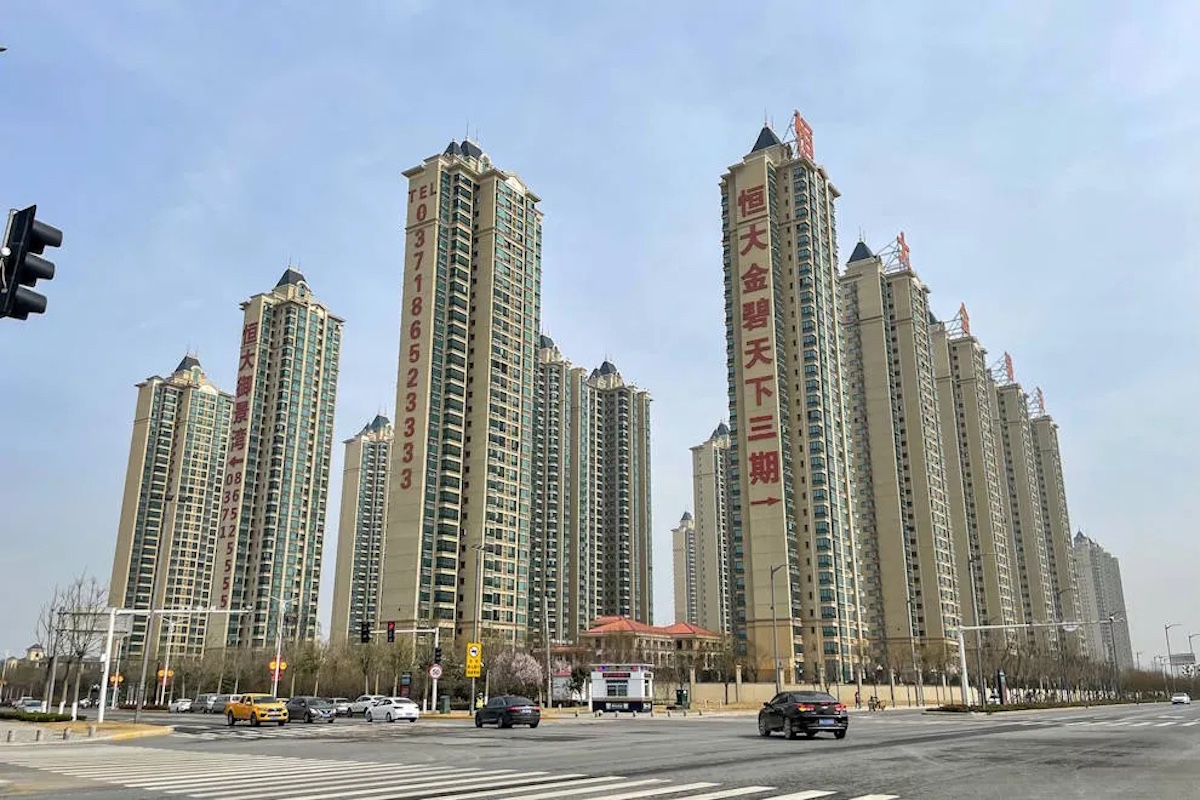
Throughout the 2010s, this strategy relied heavily on directing new credit to the real estate sector, fueling what remains the largest property construction and price boom in modern history. That era of endless expansion came to an abrupt end in late 2021, when the default of industry giant Evergrande triggered a wave of bankruptcies and missed debt payments across the entire sector. Since then, property prices have fallen continuously, and housing construction activity has plummeted sharply, according to Bloomberg data.
Yet official GDP growth figures never dipped below 3% even as the property crash unfolded. Mirroring its 2009 and 2015 playbook, Beijing ordered its state-controlled banking system to replace slowing real estate lending with a surge of new loans to manufacturing and industrial firms. The shift succeeded in keeping headline growth stable, leading some proponents of China’s managed market model to declare the strategy a resounding success. In a July 2026 social media post, economist Isabella M. Weber noted that many Wall Street analysts had predicted a 2008-style “Lehman moment” for China in 2021, but the bubble defused without a total financial collapse, arguing that this demonstrated an advantage of state-managed markets over unregulated free markets.
Critics have long warned that this approach carries steep long-term costs: repeated credit-directed stimulus funnels capital to unproductive, politically favored firms, dragging down aggregate productivity growth. This pattern played out in the 2010s, when massive lending to real estate companies diverted resources from more productive sectors. Now, economists warn that the 2022-2024 wave of industrial lending could leave a lasting overhang of “zombie companies” that hoard labor and capital without generating meaningful economic output.
Supporters of Beijing’s approach push back against these warnings, arguing that long-term costs are unproven, productivity is difficult to measure accurately, and any structural issues can be addressed later. They frame the outcome as a victory for China’s policy goals: successfully pivoting the economy away from excessive reliance on real estate development without triggering a broad economic contraction. Proponents of expanded state economic control in other countries have also held up China’s performance as evidence of the benefits of greater government intervention in markets.
However, a closer look at labor market data and independent growth estimates tells a more complicated story. Despite official claims of continued stable growth, China did experience a sharp economic downturn following the property crash, and underlying growth remains far weaker than headline figures suggest.
The first red flag appears in China’s labor market. In 2023, Beijing revised its methodology for calculating youth unemployment to use a narrower definition, after official figures hit record highs. Even with the methodological change, the youth unemployment trend has still moved upward. Official overall unemployment figures show only a small increase, but independent analysts note that these numbers are incomplete: they exclude migrant workers from rural areas, workers who have dropped out of the labor force, and people waiting to start new jobs. Alternative indicators, such as the non-manufacturing employment purchasing managers index, have remained consistently below pre-pandemic levels since the crash, and the migrant worker population has not grown at all since the COVID-19 pandemic. Record numbers of young people are now opting to pursue postgraduate education or civil service roles rather than entering the open job market, masking the true scale of weak labor demand.
Even official GDP data contradicts claims that China avoided any quarterly contraction. China typically reports growth on a year-over-year basis, unlike the quarterly sequential reporting used in the U.S. and most other major economies. Official figures show that China’s economy contracted by 0.8% quarter-over-quarter in the second quarter of 2022, equal to an annualized contraction of more than 3% — a figure that was originally reported as a much steeper 9.3% contraction before being revised downward. Even official data confirms that current trend growth is roughly 2 percentage points lower than it was immediately before the pandemic.
Numerous independent analyses suggest that even the revised official figures overstate growth, due to a long-standing practice of “smoothing” GDP numbers: official statistics understate growth in strong years and overstate it in weak years to present a more stable picture of economic performance. A 2016 academic study found that this practice has resulted in official data overstating actual growth by a substantial margin since 2002. Following the 2021 property crash, multiple independent research groups have reached similar conclusions.
The Rhodium Group, a leading independent research firm focused on China, used alternative data sources to estimate that China’s economy actually contracted between 0.3% and 0.8% in 2022, compared to the official 3% growth figure, and grew only 1.5% to 2% in 2023, far below the official 5.2% reported. The Bank of Finland found that growth effectively stalled in 2022, and Capital Economics concluded that China did experience a full recession that year, even though growth has picked up moderately since. Adding to evidence of weak demand, China has slipped into deflation, with consumer prices falling into negative territory — a classic indicator of insufficient aggregate demand in a slowing economy.
It is important to acknowledge that China’s credit-based stabilization policy represents a meaningful innovation in macroeconomic management that merits further study from policymakers around the world. Beijing succeeded in preventing the property crash from spiraling into a total financial collapse, a feat that many analysts once considered unlikely. Even so, triumphal claims that China has eliminated the business cycle and avoided any recessionary pain from the property bust do not hold up to scrutiny. Long-term productivity costs remain a major risk, and even in the short term, the downturn has been far deeper than official figures suggest. If China remains on a trajectory of permanently lower trend growth, the practice of smoothing official growth numbers will eventually become unsustainable, as there will not be enough strong growth in good years to offset the inflated numbers reported during downturns.