A pivotal NATO summit convening this week in Ankara, Turkey, stands poised to reshape the 75-year-old transatlantic alliance’s strategic direction, as leaders gather to address a planned drawdown of United States military forces in Europe and chart a course for the bloc’s next evolution, dubbed NATO 3.0.
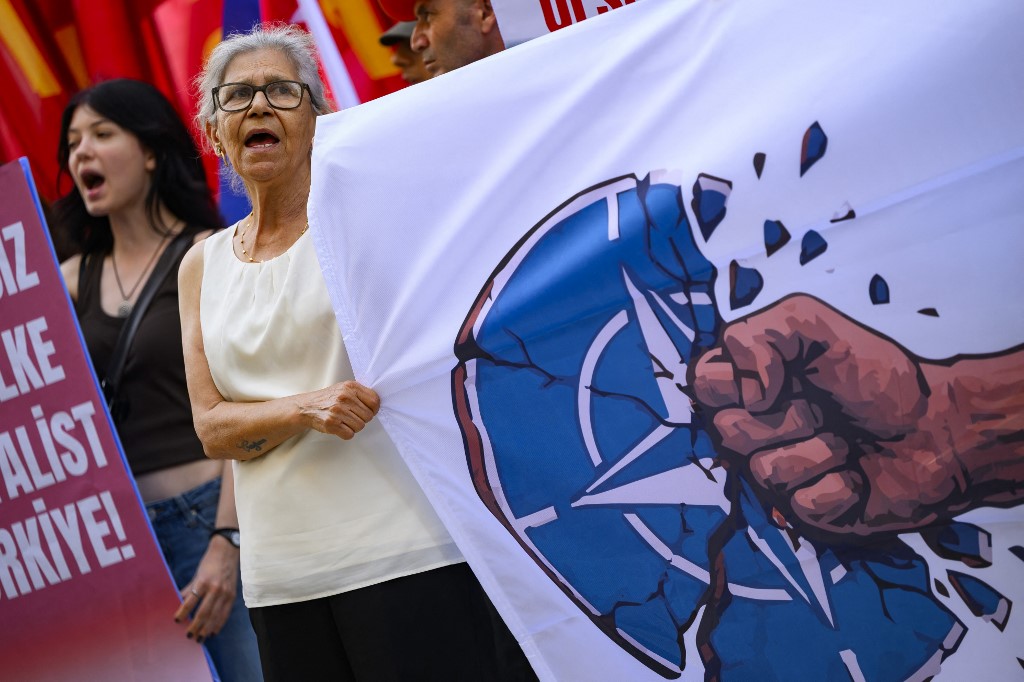
US President Donald Trump is set to join alliance heads of state and government in the Turkish capital, where tensions are already expected to emerge over negotiations to shrink America’s long-standing military footprint on the continent. Ahead of the high-stakes gathering, Turkish authorities have launched a sweeping effort to spruce up Ankara: city workers have planted thousands of decorative flowers, resurfaced damaged arterial roads, and erected large fabric banners to cover aging, poorly maintained structures that line major summit routes. Starting Tuesday, the city will implement a two-day partial lockdown to secure the event, and security officials have detained dozens of people they identify as potential protest organizers, including members of left-wing groups, environmental activists, and pro-Palestinian demonstrators, to prevent unplanned disruptions described by officials as “public nuisances.”
For the Turkish government, the summit represents far more than a security meeting: it is a high-profile global marketing opportunity to tie Turkey’s booming domestic defense industry to Western supply chains and highlight the country’s growing industrial capabilities. Turkey has rapidly expanded its defense manufacturing footprint in recent years, emerging as a leading global exporter of armed drones, advanced ammunition, and naval vessels, with defense exports projected to hit $10 billion in 2025. Ankara’s existing alignment with NATO’s industrial standards also positions the country to capitalize on any expansion of the alliance’s European defense output, a factor that has softened criticism from Western allies of President Recep Tayyip Erdogan’s increasingly hardline crackdown on domestic political opposition. European leaders have opted to set aside concerns over democratic backsliding in Turkey in exchange for Ankara’s commitment to contribute troops from NATO’s second-largest standing military (second only to the United States) and help jumpstart a continent-wide revival of European defense production.
The summit’s central agenda item revolves around the alliance’s new strategic framework, already labeled NATO 3.0 by alliance insiders. The concept builds on two prior eras of alliance adaptation: the post-Cold War restructuring that defined the original NATO 1.0, and the shift to counter-terrorism readiness that followed the September 11 attacks, known as NATO 2.0. The updated framework prioritizes three core goals: upgrading allied military capabilities, modernizing cross-bloc defense industrial infrastructure, and redistributing the burden of collective defense as the United States reorients its global military focus toward countering China.
The Pentagon has already announced a six-month review to determine which conventional forces, aircraft, and capabilities it will withdraw from European bases. While the full details of the drawdown have not been made public, anonymous military sources shared specifics with Reuters outlining steep cuts to US assets allocated to NATO: the number of F-15 and F-15E fighter jets available to the alliance will drop by a third to 99, the fleet of MQ-4 and MQ-9 Reaper surveillance and strike drones will be halved to 12, KC-135 and KC-46 refueling aircraft will be reduced from 79 to 63, and only one strategic bomber and one aircraft carrier will be assigned to NATO operations, down from the prior commitment of two each.
Despite the reductions, NATO’s top commander, US Air Force General Alexus Grynkewich, confirmed last week that European allies have already moved to fill nearly all the capability gaps left by the US drawdown. Multiple European diplomats told Middle East Eye that the summit will formalize a strengthening of NATO’s European pillar, with member states set to pledge deeper industrial cooperation, expanded weapons production, and increased operational commitments to the alliance.
Long-time European affairs journalist Guldener Sonumut, based in Turkey, notes that the shift will require structural changes to NATO’s command architecture. As the US steps back from conventional defense responsibilities, those roles will increasingly fall to European allies and Canada, while Washington retains control over strategic command and core planning functions. “This will require changes in Nato’s command structure, with the US retaining strategic command and planning leadership while Europeans take on more operational responsibilities,” Sonumut wrote in a weekend column.
The summit also marks a turning point for the alliance’s defense industrial cooperation. NATO’s long-standing Standardisation Agreements (Stanag) are expected to remain the central governing framework for allied military equipment, a move that blocks the European Union from developing separate, standalone defense standards. The outcome is a major win for Turkey’s growing defense sector, which already designs and manufactures all its military hardware to meet NATO Stanag requirements. A dedicated defense-industry forum will be held on the summit’s opening day, where dozens of multinational defense cooperation agreements are set to be signed, covering sectors from multidomain operational capabilities to space-based intelligence gathering.
Yahya Bostan, a columnist for Turkish daily Yeni Safak, argued last week that years of debate between Turkey and European powers over Ankara’s place in a post-US drawdown European security architecture have ended with a clear consensus: Turkey’s role remains firmly within the NATO alliance. Instead of building a new independent security framework, Bostan says European nations will instead increase defense spending and deepen collaboration under the NATO umbrella alongside Turkey.
On the nuclear security front, analysts expect the US to reaffirm its role as the alliance’s primary nuclear security guarantor, potentially expanding the number of NATO member states allowed to host dual-capable weapons systems — platforms that can deploy both conventional and nuclear warheads. Currently, only five NATO allies, including Turkey, are permitted to host such systems, and Finland’s parliament has already passed legislation to approve hosting the weapons, clearing the way for its inclusion in the expanded scheme.
European Commission President Ursula von der Leyen and NATO Secretary-General Mark Rutte framed the summit’s collaborative vision in a joint op-ed published over the weekend in *The Economist*. “This is a true endeavour on both sides of the Atlantic. Our defences are unmatched when we leverage assets, expertise and innovative capabilities from California to Kyiv, Copenhagen to Warsaw, Oslo to Ankara,” they wrote. “The only way to get there is through co-operation: combining the efforts of countries and industries, allies and partners.” Off the record, European diplomats have already acknowledged Erdogan’s key role in convincing Trump to attend the summit in Ankara, and say they are counting on the Turkish leader to reinforce the value of continued US engagement with the alliance for the Trump administration.