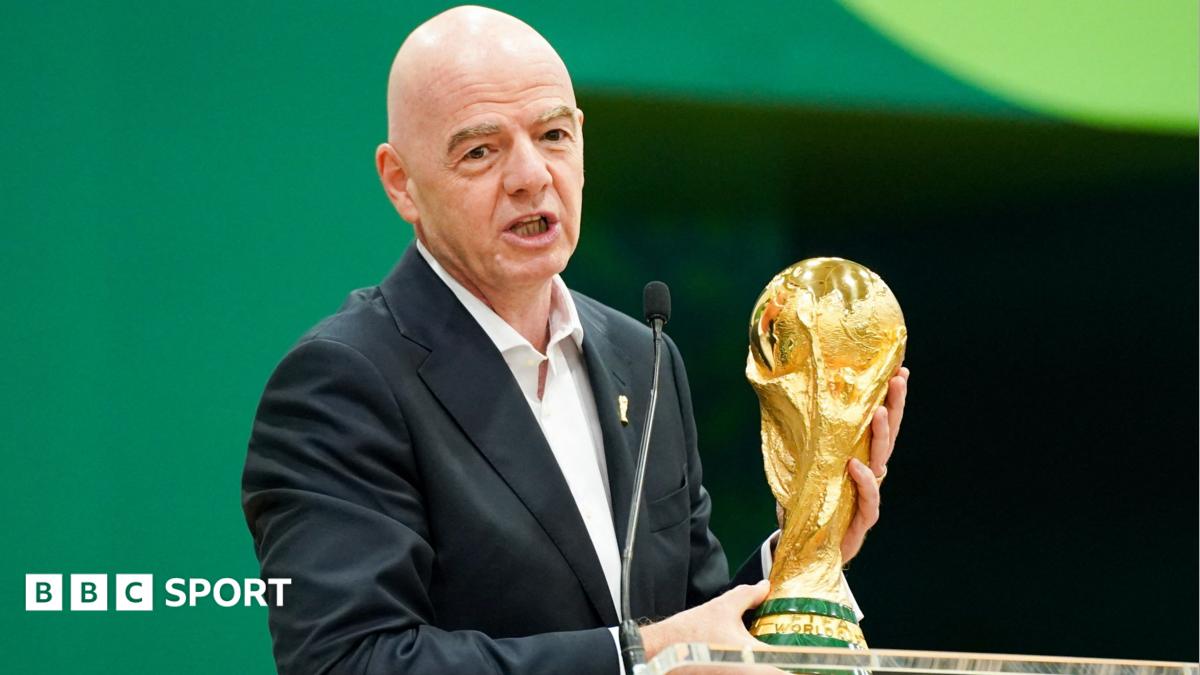
The rift at the top of global football has deepened dramatically after European football’s governing body Uefa announced it has lost all confidence in Fifa president Gianni Infantino, in the wake of the abrupt scrapping of a controversial private investment plan for the body’s top competitions.
Infantino, who has held the role of Fifa president since February 2016 and is currently seeking a fourth term in office ahead of the Fifa Congress scheduled for next March, confirmed on Saturday that the governing body would no longer move forward with the proposal to sell minority stakes in a new commercial subsidiary that would manage Fifa’s flagship tournaments including the men’s World Cup. The plan, which was first leaked to media earlier the same week, would have created Fifa Forward Enterprise (FFE), allowing external private investors to acquire non-controlling shares in the entity.
Behind the proposal, developed with analysis from investment bank JP Morgan, was the argument that the World Cup – the world’s most widely viewed global sporting event – was currently under-monetized by Fifa. The plan projected that expanded tournaments would deliver an increased payout of up to €24 million (£20.5 million) per member association by the 2035-2039 cycle. Critics quickly pointed out that the proposal made no mention of investment or development for the women’s game, and the lead investor group was set to be led by Thrive Eternal, an American venture capital firm founded by Joshua Kushner, brother of former US President Donald Trump’s son-in-law Jared Kushner. The New York Post, which first broke the news of the plan’s withdrawal, reported that the entire ordeal had become a “brand nightmare” for Kushner.
Opposition to the proposal spread rapidly across global football confederations within days. Uefa held a vote on Thursday, announcing it would boycott all future World Cups if the plan moved forward, stating that the World Cup “cannot be treated as an investment product”. Concacaf, the governing body for North, Central American and Caribbean football which hosted the 2024 men’s World Cup this summer, confirmed its members rejected the plan, with anonymous sources adding that the vast majority of regional associations had already lost confidence in Infantino. The Asian Football Confederation also joined the opposition, voicing solidarity with Uefa and Concacaf.
Internal opposition also grew inside Fifa itself. Chief operating officer Kevin Lamour admitted that the governing body’s own administration had been “deceived” about the project. Carlos Cordeiro, Infantino’s senior adviser on global strategy and governance, resigned in protest, calling the proposal “a bad deal for football” that would “mortgage football’s future”.
Shortly after Fifa confirmed the plan’s withdrawal, Uefa released a scathing, lengthy statement that marked one of the most severe public attacks ever launched against a sitting Fifa president. While the body welcomed the scrapping of the plan as “a victory for the whole game”, it went on to withdraw its confidence from Infantino’s entire leadership, noting that the move reflected the views of many other members of the global football family beyond Europe.
Uefa directly called out Infantino for breaking 2016 campaign promises he made when first running for Fifa president, when he pledged that Fifa would operate with full transparency, and that Fifa’s funds belonged to member associations and must only be used for the development of global football. “On both these promises, he has failed to deliver. The shabby, back room, opaque deal he hatched and tried to force through were anything but transparent,” the statement read.
The European body added that it would not tolerate “secret schemes of fast-track timescales cooked up by faceless individuals and of dubious benefit to the game”, calling for all individuals responsible for the proposal to be identified and held accountable. Uefa also announced it would work with member associations and other confederations to implement new safeguards to prevent similar attempted deals from moving forward in the future, and will propose reforms to Fifa’s existing Forward resource distribution programme to unlock idle funds held in Fifa’s bank accounts for grassroots football development. “We don’t need to sell off the family silver to pay for it,” the statement noted. “This is a victory for the whole game. But it must not be the end of the story. The proposal has gone. The task of rebuilding trust in Fifa has only just begun.”
Chief football reporter Simon Stone notes that any hope Infantino held of limiting reputational damage from the failed plan has been entirely destroyed by Uefa’s open attack. While the Asian Football Confederation framed its criticism in more diplomatic terms, Uefa’s rebuke was unvarnished and harsh, using language like “shabby” and “opaque” to condemn the process. As of Monday morning, Fifa and Infantino have not issued any public response to Uefa’s statement. With the 2026 presidential election just months away, Infantino is now facing unprecedented pressure, with no visible public support rising to counter the widespread opposition across the sport’s leading governing bodies.