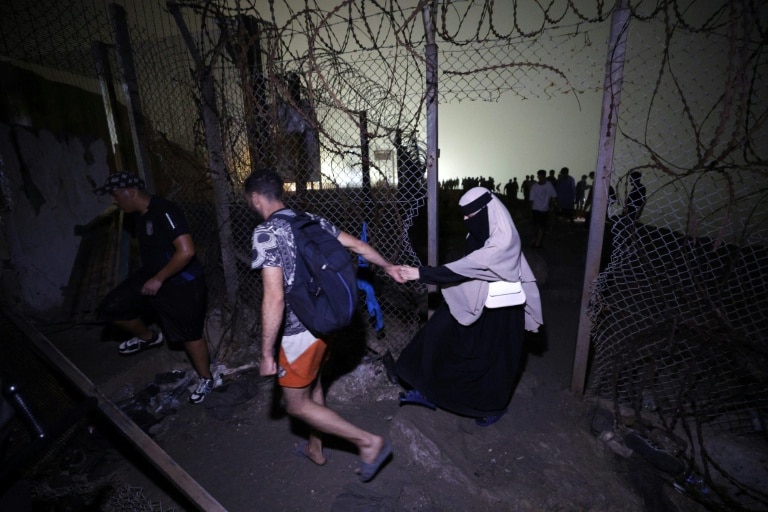
A sudden, unprecedented wave of migration into Spain’s North African territory of Ceuta has sparked political upheaval across the European Union, with most of the 60,000 new arrivals having returned to neighboring Morocco by the end of the first week of the crisis. The mass crossing, which unfolded over just a few days, has reignited long-simmering divisions over EU border policy and exposed rifts between member states over how to handle irregular migration. By Friday evening, Spanish interior ministry data confirmed that more than 48,000 migrants had already crossed back into Morocco, with remaining arrivals steadily escorted out by Spanish security forces over the following day. AFP correspondents on the ground observed Spanish soldiers and police monitoring the border crossings closely, guiding any migrants who lingered on coastal paths back across the boundary without incident. To enter Ceuta, the vast majority of migrants swam around a small, partially submerged border barrier that extends into the Mediterranean Sea. The dangerous crossing claimed at least 34 lives, according to official tallies. For many of the migrants, the journey was driven by a desperate search for opportunity or family reunion. Nineteen-year-old Senegalese migrant Souleil Boyan told AFP that his only goal was to reach mainland Europe to find work and build a stable life. “We all know that in Africa there isn’t much opportunity,” Boyan explained as he waited for processing at a Ceuta migrant center alongside dozens of other sub-Saharan African arrivals. Forty-two-year-old Moroccan migrant Soufian, who works 12-hour daily shifts as a security guard for just 10 euros ($12) a day, said he crossed to see his ill mother who lives in Madrid. “Even though there’s no food, nothing at all, I’ll endure anything to see my mother,” he said, adding that for most migrants, the draw of a better future that is unavailable in their home countries is motivation enough to attempt the dangerous crossing. Soufian added that crossing took mere minutes after he learned the border had become passable from a friend, as his coastal hometown of Martil sits less than 40 kilometers from Ceuta. The unexpected mass influx triggered immediate political panic across the EU, with several member states moving quickly to tighten their own border controls with Spain. France ramped up checks along its shared border with Spain, announcing it would increase its police and gendarme presence fivefold to 334 officers by Saturday. Italy went further, suspending its participation in the Schengen Area’s visa-free free movement agreement with Spain for a period of one month. Multiple EU governments have even floated proposals to suspend Spain’s full membership in the Schengen zone in response to the crisis, though Spanish Foreign Minister Arancha González Laya has insisted the integrity of the border-free zone remains fully guaranteed. Spanish Prime Minister Pedro Sánchez blasted what he called the “selfish” response from some EU member states in a formal letter sent to the leaders of the European Commission and European Council, and called for an emergency video summit of the bloc’s interior ministers to address the crisis. Spain had already deployed hundreds of additional troops, police officers, drones, patrol boats, and divers to the centuries-old Spanish outpost to manage the surge. In the overnight hours leading into Saturday, AFP journalists saw dozens of migrants sleeping on Ceuta’s beaches and wandering the city’s coastal streets after crossing. At the border crossing, many departing migrants bid casual “adios” to Spanish officers before crossing back into Morocco. Scattered buoys and flippers left behind by migrants who swam the border still littered the shoreline and floated in shallow water near the fence, while security personnel patrolled the fog-shrouded coastal waters in rigid inflatable boats. To prevent future unauthorized crossings, Spanish authorities have already installed a new 500-meter pneumatic barrier near the main border post to reinforce perimeter security. The root cause of the sudden mass migration surge remains unclear, as Moroccan authorities have yet to release an official statement on the event. Ceuta, which spans just 18.5 square kilometers, and the nearby Spanish enclave of Melilla make up the EU’s only two land borders with the African continent. Past mass migration surges into Ceuta have coincided with diplomatic tensions between Spain and Morocco, including a 2021 incident that saw more than 10,000 migrants cross into the enclave over just 48 hours.