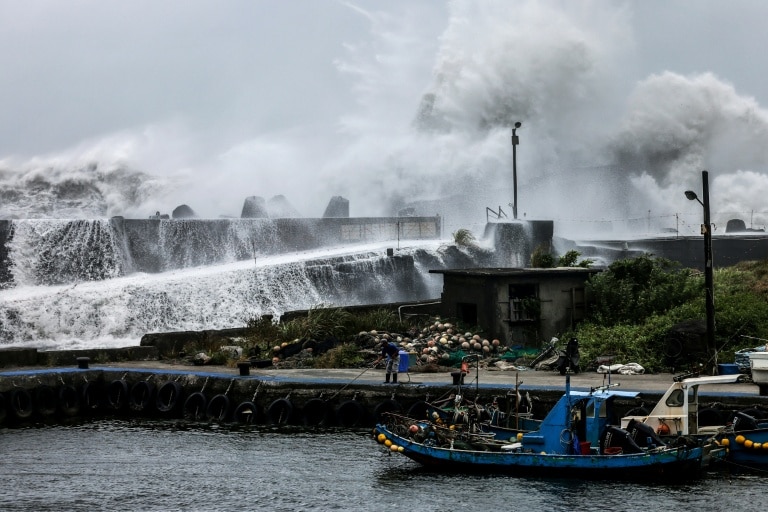
A powerful typhoon that carved a destructive path across the Pacific has made landfall in eastern China, forcing nearly 2 million people across multiple regions to abandon their homes for safer ground in one of the largest pre-storm evacuation efforts in recent years. Typhoon Bavi came ashore around 11:20 pm local time Saturday in Yuhuan, a city in China’s coastal Zhejiang province, carrying maximum sustained winds of 144 kilometers per hour, according to the provincial meteorological observatory in a report carried by China’s official Xinhua News Agency.
Before reaching the Chinese mainland, the storm system already left a wake of disruption across northern Taiwan and Japan’s remote southwestern Ryukyu Islands, toppling urban trees, cutting electrical power to tens of thousands of households, and forcing widespread shutdowns of businesses and transport links. The landfall comes as China has already faced a week of devastating extreme weather across its central and southern regions, where earlier storms killed at least 39 people, swelled dozens of rivers past flood stages, and caused a reservoir dam to collapse.
Meteorologists forecast Bavi will continue tracking northwest after landfall, gradually weakening as it moves inland. As of Saturday morning, Chinese authorities had already relocated 1.72 million residents in high-risk zones to emergency shelters. In anticipation of the storm’s arrival, Zhejiang suspended all in-person classes, non-essential work, public transport and outdoor events, canceling more than 400 flights and dozens of intercity train services to minimize risk.
Wenzhou, a major Zhejiang metropolis home to nearly 10 million people, emphasized in an official statement that its full-scale, proactive mobilization left no resource spared, with all efforts focused on preparing for the worst possible outcome. Footage from state broadcaster CCTV showed local residents reinforcing shop shutters with wooden planks and applying protective tape to windows, as forecasters warned Bavi would bring exceptionally heavy rainfall to eastern Zhejiang and neighboring northeastern Fujian province.
Further north, torrential pre-emptive rainfall prompted Beijing authorities to evacuate more than 100,000 residents, as the capital increased water discharge flows from the strategic Miyun Reservoir to create extra storage capacity for incoming floodwaters. State media reports show an additional 130,000 residents have been evacuated across Fujian, while roughly 34,000 people left high-risk and coastal areas of Shanghai.
In northern Taiwan, streets sat largely empty as businesses remained closed for a second consecutive day, battered by strong wind and heavy rain. The storm forced the evacuation of more than 14,000 residents across the island, canceled hundreds of flights, and left more than 170,000 households without power. Taiwan’s Central Weather Administration warned of extremely torrential rain across northern sections of the island and dangerous coastal waves reaching up to 10 meters as Bavi passed just north of Taiwan’s coastline.
The storm system’s origins stretch back to earlier this week, when it made landfall in Guam and the Northern Marianas as a powerful super typhoon before weakening to a standard typhoon as it moved west across the Pacific. The death toll from Bavi has already climbed to 18 in the Philippines, where the storm triggered deadly landslides and flooding, mostly on the southern island of Mindanao. Nearly 11,000 Filipinos have fled their homes, dozens of ports remain closed, and more than 300 vessels have been forced to seek shelter in safe harbors.
In Japan, thousands of households and public facilities across Okinawa Prefecture lost power when Bavi pounded the southwestern islands, with the Miyako region suffering the worst damage. Japanese carriers canceled dozens of domestic flights, disrupting travel plans for more than 26,000 passengers.
Climate scientists have linked the increasing intensity of tropical storms like Bavi to rising ocean temperatures. Last week, the European Union’s Copernicus Marine Service confirmed that oceans globally recorded their hottest June on record, with projections that new temperature records will be set in the coming months. Warmer ocean waters fuel more rapid intensification of tropical cyclones and add more moisture to storm systems, which translates to heavier rainfall when they make landfall. This year’s weather has been further amplified by the return of El Niño, a natural climate pattern that warms Pacific surface temperatures and occurs every two to seven years.
Initially, forecasters predicted Bavi would become the strongest typhoon to hit Taiwan in more than 30 years, but CWA senior forecaster Jason Cheng noted the storm’s strong wind radius has since shrunk to 350 kilometers. The shifted forecast and scaled-back impact left some Taiwanese residents frustrated with the early government warnings that prompted widespread shutdowns. “Look at how it caused people to scramble for groceries and clear out supermarket shelves. Honestly, there hasn’t even been much wind or rain these past two days,” said Li, a breakfast shop owner in the northern coastal city of Keelung.