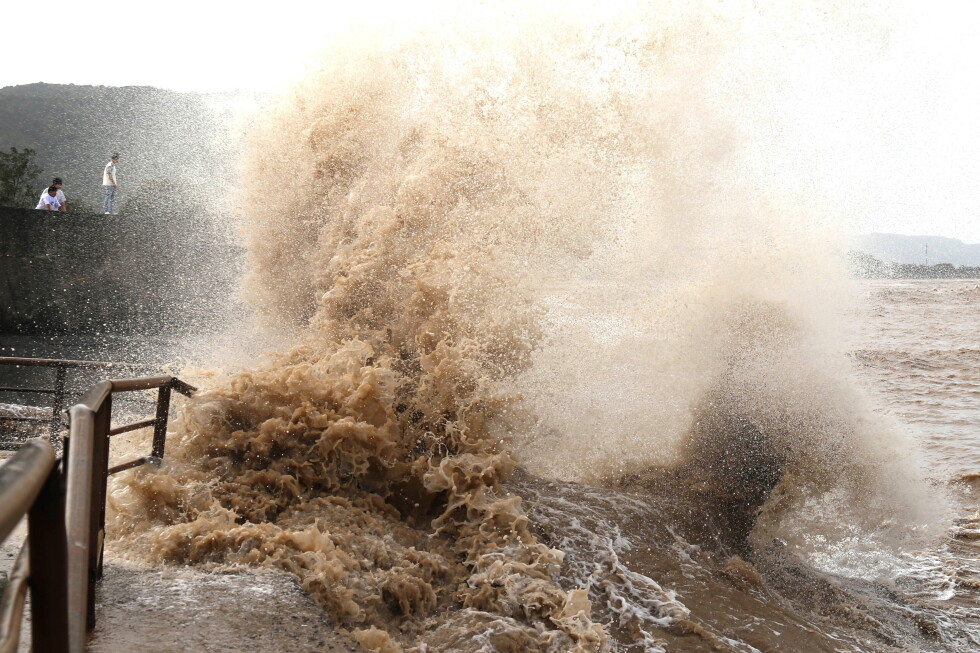
BEIJING – In the wake of its landfall in China’s eastern coastal province of Zhejiang, Typhoon Bavi has downgraded from a typhoon to a severe tropical storm, though the system continues to batter large swathes of eastern China with gale-force winds and torrential downpours as of Sunday.
China’s National Meteorological Center confirmed the storm’s weakening in the early hours of Sunday, reporting that maximum sustained winds near the system’s center clocked in at roughly 101 kilometers per hour (63 miles per hour). Meteorologists project the storm will continue tracking northwestward across the eastern half of the country in the coming days.
Before reaching mainland China, Bavi passed just north of Taiwan on Saturday without making a direct landing on the island. Even so, the storm’s outer bands brought hazardous conditions that left more than 130 people injured across Taiwan, according to the island’s fire department. As of 7 a.m. Sunday, the agency confirmed 134 injuries, most of which occurred when residents fell from motorcycles or bicycles amid strong winds or on rain-slicked roadways.
The National Meteorological Center has warned that hazardous wind and rain conditions will continue to disrupt daily life across dozens of major eastern Chinese cities through Sunday, prompting widespread emergency preparations from regional authorities. State media reports confirm that Shanghai has evacuated more than 290,000 residents from low-lying coastal and flood-prone areas, while Zhejiang authorities have relocated roughly 2.2 million at-risk residents to emergency shelters. Neighboring Fujian province has also evacuated more than 180,000 people to avoid storm-related harm.
Air travel across the Shanghai region has been heavily impacted by the storm. Official state news outlet Xinhua News Agency reports that the city’s two major international airports – Pudong International Airport and Hongqiao International Airport – have canceled approximately 653 incoming and outgoing flights as of Sunday, with more schedule adjustments possible as the storm progresses.
In Yueqing, a coastal Zhejiang city directly in the path of Bavi’s landfall, storm damage has already been extensively documented. State broadcaster CCTV reports that more than 1,300 trees were toppled by the storm’s strong winds, with at least 700 of those trees completely uprooted from city streets and green spaces.