Against the backdrop of the tightly controlled desert nation of Turkmenistan, one of the world’s most closed countries, the annual Akhal-Teke horse beauty pageant unfolds as a uniquely vivid display of national and political culture. On the arena floor of the capital Ashgabat’s modern equestrian complex, trainers in ornate traditional uniforms trimmed with white fur headgear lead stallions draped in gold ornamentation around the stage, watched by thousands of attendees and presided over by current President Serdar Berdymukhamedov, the son of former leader and self-styled ‘Father of the Nation’ Gurbanguly Berdymukhamedov.
AFP journalists were granted rare access to the 2024 pageant, a privilege rarely extended to foreign media in the authoritarian Central Asian state. As crowds of men in identical tracksuits waved national flags and clapped in synchronized rhythm, sand-colored stallion Hankerven – adorned with gemstone jewelry and a hand-woven traditional Turkmen carpet – took home the competition’s top honor. For local breeders and citizens, the pageant is far more than a livestock event: it is a celebration of the breed that sits at the core of modern Turkmen national identity.
“There are no beauty contests for women in Turkmenistan but there are for horses,” explained 70-year-old veteran breeder Ashir during an interview at his stud farm just outside Ashgabat. “We Turkmen are known for our carpets and horses. That is why our flag features carpet motifs and our coat of arms depicts the Akhal-Teke.”
The fervent state-sponsored focus on Akhal-Tekes, an ancient breed on the global endangered list, is largely rooted in the lifelong passion of former president Gurbanguly Berdymukhamedov, who has built the cult of the horse alongside pervasive personality cults for himself and his son, who inherited the presidency in 2022. Political criticism of the ruling father-son dynasty is banned in Turkmenistan, an energy-rich former Soviet republic that human rights monitors rank among the most isolated nations on Earth, alongside North Korea and Afghanistan.
Gurbanguly, an avid equestrian, has written multiple books celebrating the Akhal-Teke breed and even recorded a viral rap song dedicated to his favorite foal, Rovach. In the lyrics, he gushes: “You are like the wind at daybreak, you are like a cherished vision. You are an inspiration… more precious than gold.” Another of his personal horses holds a Guinness World Record for the fastest 10-meter dash on hind legs, completed in just 4.19 seconds.
State-run media regularly frames Akhal-Teke conservation and breeding as a “strategic national priority” and the “unshakeable foundation of Turkmen national identity.” The country’s official 2026 motto has already been set as “Independent neutral Turkmenistan is the homeland of purposeful winged horses,” and the breed is widely known by the reverent nickname “heavenly horses,” a title drawn from an ancient myth of an Akhal-Teke outracing a falcon in a legendary contest.
With only an estimated 4,000 to 7,000 Akhal-Tekes alive worldwide, the vast majority reside in state-run Turkmen stud farms. A senior official from the State Organisation for Turkmen Horses confirmed to AFP that the breed remains “on the brink of extinction,” but credited the ruling leadership’s intense personal interest with securing its future. A major milestone for the breed came when UNESCO added the “art of Akhal-Teke horse breeding and traditions of horses’ decoration” to its Intangible Cultural Heritage List, a win that state officials call a “major achievement of national cultural policy.”
Widely celebrated for their athleticism adapted to Turkmenistan’s harsh desert climate, Akhal-Tekes excel in endurance riding, dressage, and show jumping. Retired 66-year-old veterinarian Sapargeldy, who spoke to AFP on condition of not sharing his surname, described the breed’s distinctive physical traits: “large size, long legs, well-developed musculature, slender and elegant head set on a long, straight neck, expressive eyes, high withers and sturdy hooves.” The breed’s most famous feature, he added, is its unique metallic sheen in sunlight, caused by fine, hollow-core hairs that reflect light differently than other equine breeds.
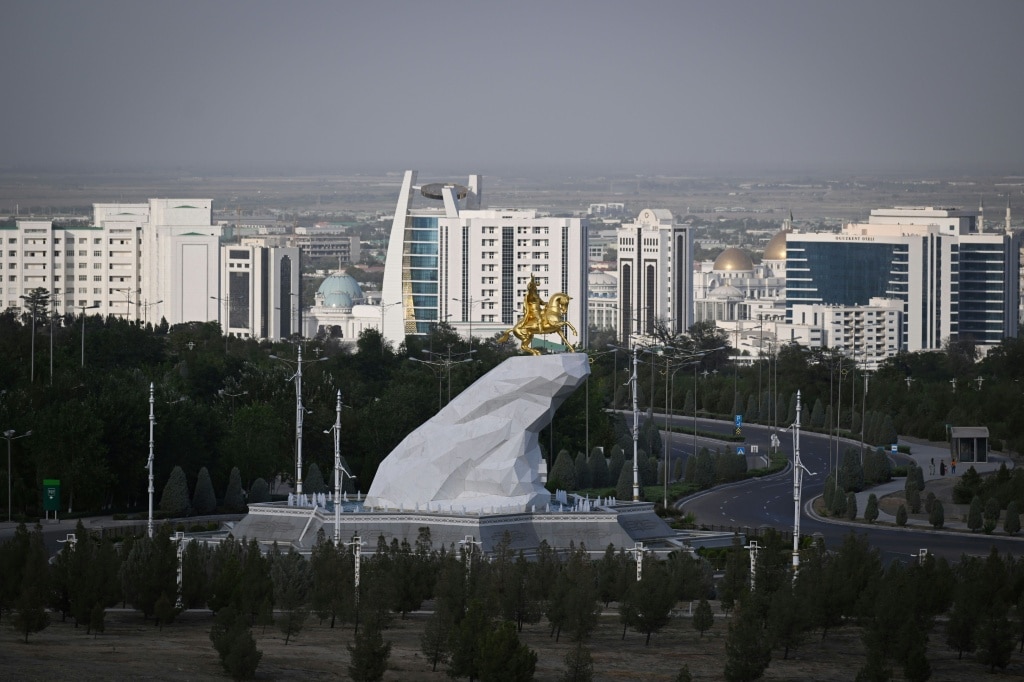
The Turkmen government traces its celebration of the Akhal-Teke back to pre-colonial nomadic traditions, when tribes roamed the Central Asian desert before the Russian Empire conquered the region in the 19th century. But in modern Turkmenistan, the horse cult is deeply intertwined with the ruling regime’s politics: monuments to Akhal-Tekes dot every major city, and in 2023 Gurbanguly unveiled a 43-meter-tall golden statue depicting himself riding an Akhal-Teke in a pose modeled after Napoleon Bonaparte.
The breed also plays a central role in Turkmenistan’s limited diplomatic engagement with the world. When rare high-level foreign dignitaries visit the isolated country, they are often gifted a purebred Akhal-Teke as a gesture of goodwill. Past recipients include former French President Francois Mitterrand, Russian President Vladimir Putin, and Chinese President Xi Jinping.