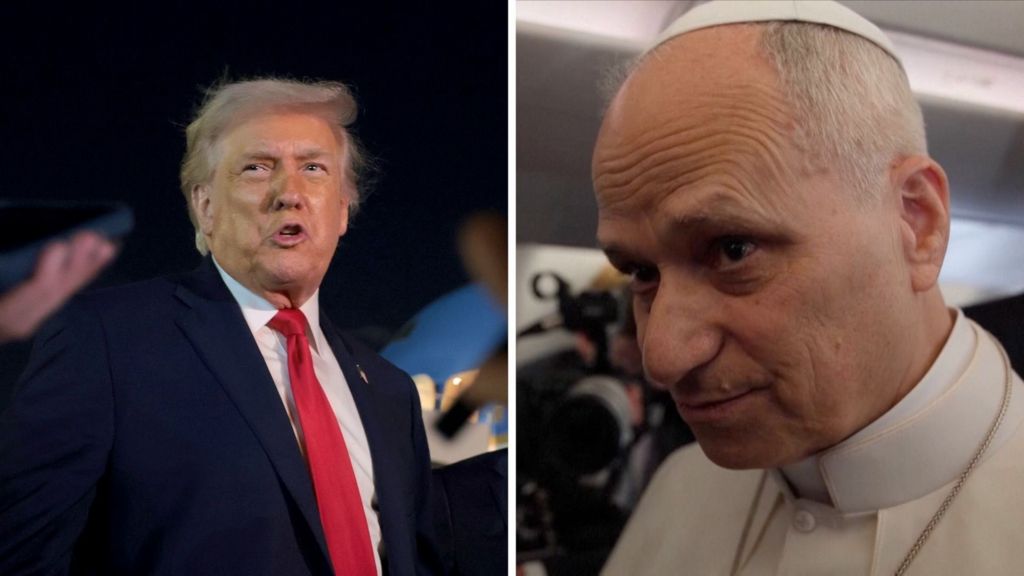
For years, tensions have simmered between former President Donald Trump and senior leaders of the Catholic Church, rooted in his hardline immigration stances that have long drawn condemnation from church officials. This divide has already split the U.S. Catholic hierarchy from right-leaning rank-and-file believers for months. But over the past 48 hours, a new and unprecedented backlash has erupted, triggered by Trump’s blistering public attack on Pope Leo and his sharing of an AI-generated image depicting Trump as a Christ-like figure. What makes this moment remarkable is that the harshest criticism is coming not from liberal opponents, but from Trump’s once-loyal conservative Catholic allies. Their discontent stretches far beyond the public spat with the pope: it is rooted in deep moral opposition to the six-week-old Iran war, a conflict that has crystallized a quiet but dramatic shift in opinion among conservative Catholic supporters of the president. One of the most striking breaks comes from Bishop Joseph Strickland, a long-time stalwart Trump backer who has repeatedly aligned himself with the president’s political movement. Just last year, Strickland took part in a prayer service to “consecrate” Trump’s Mar-a-Lago estate; in 2024, he delivered the keynote address at the Conservative Political Action Conference (CPAC) where Trump was the guest of honor, and in 2020, he spoke at a rally of Trump supporters pushing to overturn the presidential election results. His unwavering public support for Trump, and his open clashes with the late Pope Francis, even contributed to his removal from his post as Bishop of Tyler, Texas. Now, facing conflicting stances from the White House and the Vatican on the Iran war and broader Middle East instability, Strickland has broken ranks with the administration in a rare public rebuke. “I do not believe this conflict meets the criteria of a just war. I stand with the Holy Father and his call for peace. This is not about politics. It’s about moral truth,” Strickland told the BBC, noting that the massive scale of death and suffering inflicted on innocent Iranian civilians rules out any framing of the war as just. He has gone further, challenging the White House’s handling of the conflict and urging other Catholics to join him in speaking out. “It becomes very dark when religion is used to justify immoral behaviour… using religion to justify especially dropping bombs is contradicting what the faith is about,” he said. When asked about Trump’s attack on Pope Leo and the controversial AI-generated image—dubbed “AI Jesus” by observers, which Trump claims he believed depicted a doctor, not Jesus—Strickland said it was his moral duty to remind the president of a core passage from the Gospel of Matthew, which teaches that ultimate authority belongs to Christ, not any human leader. “When world leaders forget this truth, all are in peril,” he added. This shifting alignment among conservative Catholics carries notable political risk for Trump, who grew his support among this demographic during the 2024 presidential election. Pew Research Center data paints a complex picture of Catholic voting patterns: racial identity played a major role, with 62% of white Catholic voters supporting Trump, compared to 37% backing Kamala Harris, while 41% of Hispanic Catholics supported Trump and 58% backed Harris. Overall, the data shows a gradual shift toward the Republican Party among U.S. Catholics as a whole, but deep, persistent divides remain. Greg Smith, senior associate director of religion research at Pew, notes that historically, for most U.S. Catholics, political identity often outweighs religious affiliation when shaping public outlook, with voters splitting sharply along party lines. U.S. Catholics have long been polarized on divisive cultural issues such as abortion and immigration, making a rare cross-ideological convergence between left and right Catholic leaders on the Iran war all the more unusual. Pew polling also reflects this new dynamic: while the late Pope Francis was far more popular among Catholic Democrats than Republicans, Pope Leo currently holds high approval among Catholics on both sides of the political aisle. Unlike Francis, a progressive who often alienated traditionalists through measures such as restrictions on the Latin Mass (moves Pope Leo has since reversed), Leo has built broad goodwill across factions. Peter Wolfgang, executive director of the Family Institute of Connecticut and a leading voice of U.S. Catholic conservatism, argues that the pope is not immune to fair criticism. “The Pope is the Pope, we owe him a certain amount of deference, but I don’t think that Catholicism wants the obedience of cadavers. We are living, thinking persons,” he said. Wolfgang, who shifted from a cautious pragmatic supporter of Trump to an enthusiastic backer focused on overturning abortion rights and defending hardline mass deportation policies aligned with the Catholic nationalism of figures like JD Vance, is now sharply critical of Trump’s treatment of Pope Leo. “President Trump does not understand how Catholicism works. The Pope is not merely a head of state, he is the Vicar of Christ. Attacks on him are received as attacks on the Church itself. The more he attacks the Pope the more his support will drop among his Catholic voters,” Wolfgang told the BBC. Wolfgang notes that when Catholic bishops criticized Trump’s immigration policies, his faith led him to push back against those bishops—but that same faith now compels him to oppose the Iran war. “When President Trump is out there talking about ending Iranian civilisation, or Secretary Hegseth is out there making some bloodthirsty prayer that is unrecognizable to Catholics, then it’s completely natural for conservative Catholics to line up behind Pope Leo,” he said. His reference is to a controversial prayer delivered by U.S. Secretary of Defence Pete Hegseth at a Pentagon worship service shortly after the first U.S. and Israeli strikes on Iran, in which he called for “overwhelming violence” and “justice executed swiftly and without remorse.” While Wolfgang typically directs his sharpest criticism at the Catholic left, he acknowledges that the Iran issue has partially unified opposing factions, driven largely by the clear, uncompromising anti-war messaging from Pope Leo. In an unprecedented show of cross-faction opposition, no senior U.S. Catholic clergy has publicly come out in support of the Iran war. Even Robert Barron, Bishop of Winona-Rochester and a long-time Trump ally, joined the criticism, demanding that Trump apologize to Pope Leo for his angry verbal attack—a demand Trump has rejected. Steven Greydanus, a deacon and prominent commentator on the liberal wing of the U.S. Catholic Church, also notes this unusual convergence of opinion. Greydanus argues that one key factor driving the backlash is the White House’s twisting of the long-held theological principle of Just War Theory, which outlines strict moral criteria for when a war is justified and how it must be conducted. He also attributes the unified opposition to the stark contrast between Trump’s aggressive rhetoric and Pope Leo’s calm, healing public posture. “While I am grieved by the directness of Donald Trump’s attacks on Pope Leo, in a way I welcome the clarity of the choice Catholics are being presented with,” Greydanus said. Vatican officials have pushed back against framing the conflict as a personal rivalry between Pope Leo and Trump, emphasizing that the pope is drawing on his faith to oppose the logic of war itself. When Trump warned that “a whole civilisation would die” in Iran, however, Pope Leo responded directly, calling the threat “truly unacceptable.” “There is an important difference between challenging a man and challenging the principle that makes war possible,” said Reverend Antonio Spadaro SJ, Undersecretary for the Vatican’s Dicastery for Culture and Education. Speaking to the BBC, Spadaro explained that while quiet dialogue continues behind the scenes in centers of global power, the pope felt compelled to make public statements against the conflict to “mark the moral limit” of what is acceptable morally. When asked about the unprecedented cross-faction unity among U.S. Catholics backing Pope Leo’s anti-war stance, Spadaro acknowledged that the pope does not unify all Catholics, but that he has succeeded in moving the broader Catholic debate beyond rigid partisan lines. Political analysts remain puzzled by Trump’s decision to share the AI-generated image, which was always certain to alienate a key bloc of his supporters. In an unusual move, Trump eventually backed down and removed the post from his social media. Questions also persist about the motivation behind his public tirade against Pope Leo, with many observers arguing it was an attempt to weaken and delegitimize the pope’s strong anti-war opposition. But as Spadaro points out, Trump’s attack implicitly confirms the power of the pope’s moral voice. “If Leo were irrelevant, he would not deserve a word. Instead, he is invoked, named, opposed—a sign that his words matter,” Spadaro said. Many ordinary American Catholics have echoed the call for unity around moral principles, with one common refrain echoing Bishop Strickland’s opening prayer: “I pray they come together” around the shared values of peace and respect for the teachings of the faith.
Trump’s rift with Pope is playing out in public – it’s costing him valuable support