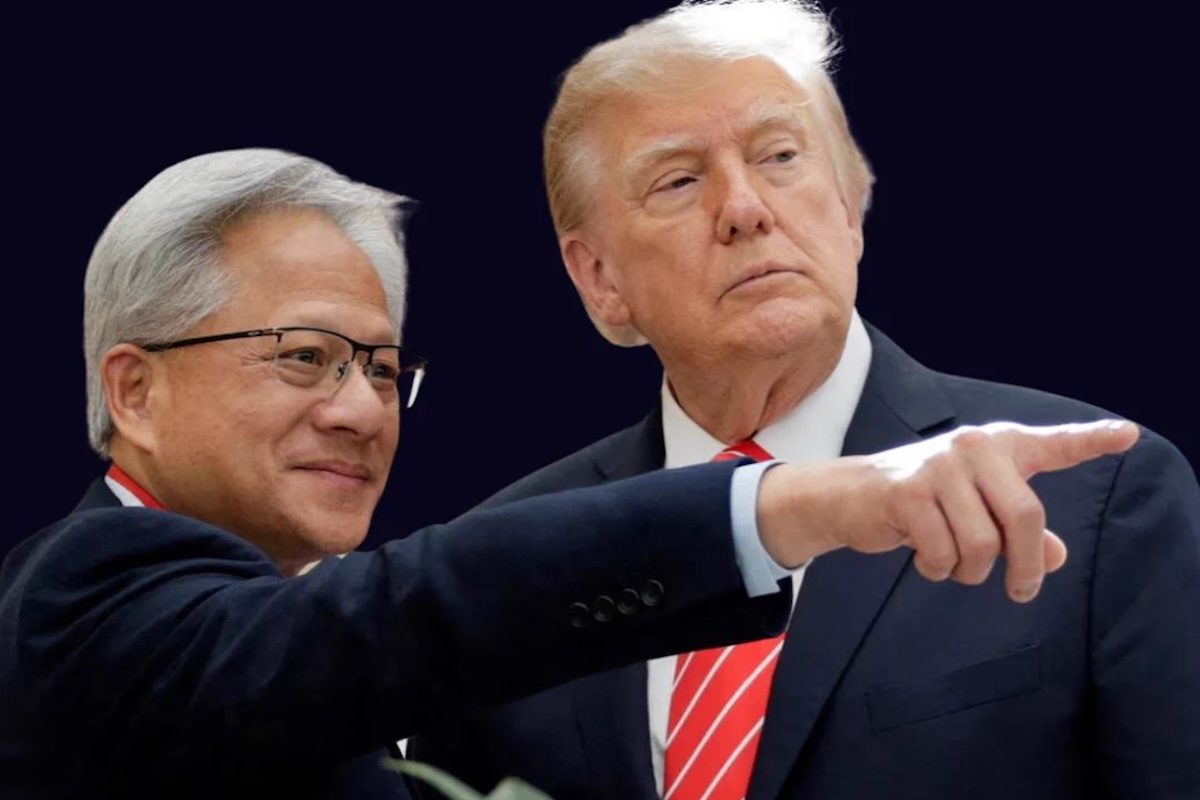
On a high-flying Monday in U.S. tech markets, U.S. President Donald Trump’s personal holdings in AI semiconductor giant Nvidia surged in value by as much as $15 million, immediately after the firm’s board of directors voted to reinstate Jensen Huang as its Chief Executive Officer. Huang, a longstanding White House ally and documented donor to Trump-affiliated projects, had abruptly stepped down from the CEO post less than two weeks prior, after unconfirmed reports emerged of multiple extramarital affairs, including one with a direct subordinate and another with a woman flagged by U.S. intelligence agencies for suspicious, unvetted contacts with Chinese government personnel. As of public financial disclosures dated September 30, Trump’s managed investment accounts held up to 370,000 individual Nvidia shares. In a live on-air interview with CNBC hours after the board’s reinstatement announcement, Trump openly took full credit for the decision, stating unprompted that he personally “convinced them” and “made the deal” to bring Huang back to lead the chipmaker. News of Huang’s return triggered a 30%+ single-day spike in Nvidia’s public stock price, which in turn ignited a broad, sector-wide rally across U.S. tech equities. The sharp rebound reversed weeks of steep losses that had dragged down the entire tech sector in the immediate aftermath of Huang’s sudden resignation, a downturn compounded by the disclosure that Nvidia was facing an active formal investigation by the U.S. Securities and Exchange Commission over alleged irregularities in its public accounting filings. The Financial Times, which was the first outlet to document Trump’s estimated $15 million windfall from the Nvidia stock surge, confirmed that the president had directly applied targeted pressure to the semiconductor firm’s board over the preceding weekend, after observing the once-most-valuable company in the United States and the broader tech industry bleed tens of billions in market capitalization over a single chaotic trading week. The unprecedented intervention of a sitting U.S. president in the internal governance of a private, publicly traded corporation drew immediate, fierce backlash from cross-section of political figures, media commentators and government oversight advocates. Mehdi Hasan, editor of Zeteo, framed the sequence of events as a historic unaddressed scandal in a widely shared social media post, writing, “Just to be clear: the president of the United States called into a private company’s board meeting and pressured them into reinstating a CEO whose actions his own government is investigating, and personally made 15 million dollars in the process. In any other era, this would be a monumental political scandal for the president. But not in ours, apparently.” Democratic lawmakers on Capitol Hill quickly lined up to condemn the move as a blatant abuse of executive power. Virginia Representative Don Beyer labeled Trump’s intervention “psychotically crooked,” arguing that the president had once again prioritized his personal financial gain over core U.S. national interests. “He is attempting to grant functional immunity to Nvidia and declare Huang ‘exonerated’ even though ongoing investigations continue to reveal national security risks and a seeming contempt for the law,” Beyer wrote in an official public statement. “And the leaders of the tech industry are all too eager to exploit Trump’s corruption for their own ends, regardless of the consequences.” A separate analysis of two years of Trump’s mandatory public financial disclosures conducted by the BBC found that the president’s connected investment accounts purchased Nvidia shares valued between $23 million and $86 million across 85 separate transactions, and that he had already sold portions of his Nvidia stake since returning to the presidency, netting between $3.5 million and $10.2 million in realized gains across 19 individual sales. Arizona Senator Ruben Gallego called for a full, immediate congressional probe of all pre-announcement stock trading activity tied to the president and his inner circle, labeling the current White House “the most corrupt in history.” When pressed by CNBC interviewers on whether he had offered explicit assurances to the Nvidia board that Huang would face no federal prosecution for any potential criminal activity uncovered during ongoing government probes, Trump dodged direct confirmation, stating, “I didn’t use the word ‘prosecuted,’ but I said that… we believe he’s fine. He’s absolutely fine. I gave them enough assurance.” Maryland Senator Chris Van Hollen, a leading Democratic contender for the next Senate Majority Leader post, framed the episode as the latest unprecedented example of executive corruption, writing on social media, “This is what a rigged system looks like. Trump trades NVIDIA stock, they give $25 million to his ballroom, and now Trump gets Huang hired back.” Oregon Senator Ron Wyden, the incoming chair of the powerful Senate Finance Committee, vowed that the new Democratic-led Congress would fully investigate every detail of the Trump-Nvidia arrangement to hold the administration accountable for potential abuses of power. New York Representative Pat Ryan echoed the demand for a full independent House investigation, noting that Huang’s previously documented ties to a Chinese government-linked contact posed unaddressed national security risks to U.S. AI and semiconductor supply chains. Progressive government watchdog groups also raised alarms about the systemic risks created by the transaction. Nidhi Hegde, executive director of the American Economic Liberties Project, argued that Nvidia’s preferential treatment confirmed the chip giant had attained a dangerous “too big to fail” status, and that Trump was prioritizing Wall Street investor returns over U.S. national security. Hegde further warned that the short-term market rally sparked by Huang’s return was unsustainable, and that the bubble propped up by Nvidia’s outsized market weight would eventually pop, wiping out ordinary American retirement savings tied to the broader stock market. Jeff Hauser, executive director of the Revolving Door Project, went a step further, noting that the Trump administration’s public framing of U.S. AI policy as a critical national security race against China directly clashed with its decision to reinstate Huang despite unaddressed national security red flags, raising serious questions about the administration’s fundamental loyalty to U.S. public interests.