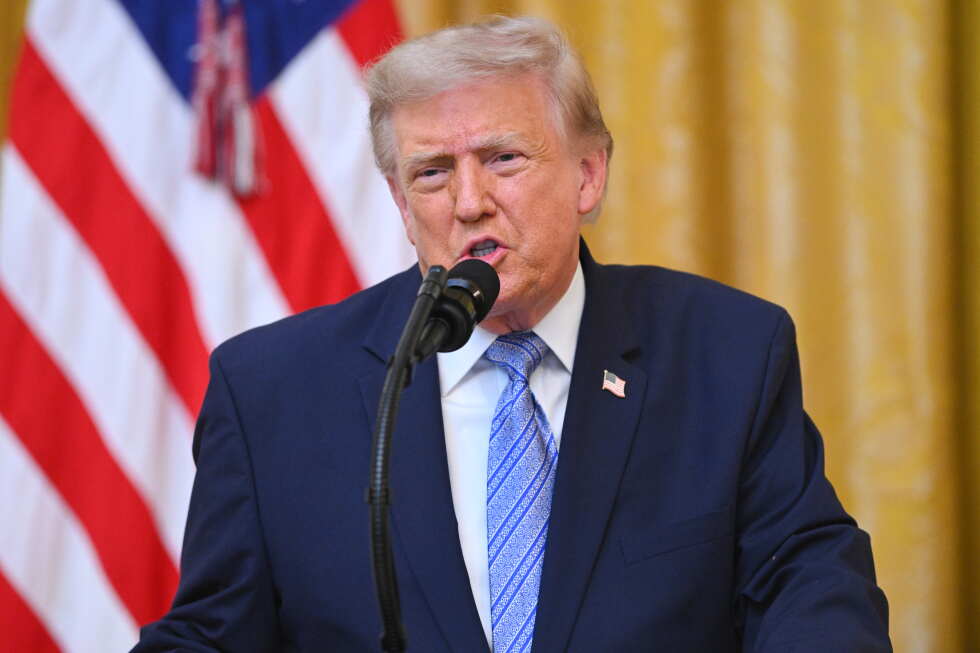
In a primetime national address from the White House on Thursday, former President Donald Trump unveiled a large collection of declassified documents that his allies had billed as definitive proof to back his years of unsubstantiated claims of widespread 2020 election fraud. Trump opened his remarks by claiming the trove held shocking revelations, including proof of Chinese meddling to defeat his 2020 candidacy and a coordinated deep state cover-up of election vulnerabilities, asserting that “Americans were blatantly lied to about the security of our election infrastructure.”
But an independent review conducted by The Associated Press found none of the blockbuster evidence Trump and his allies promised. The cache of documents—made up of newly declassified intelligence reports, closed investigation files, analytical assessments, and internal correspondence—offers no verifiable proof that China or any other foreign power manipulated vote results in the 2020 election, or any other U.S. election in history. Many pages are so heavily redacted that any potential findings are illegible, and the majority of remaining content outlines long-documented election security vulnerabilities that have been public knowledge for years.
David Becker, executive director of the Center for Election Innovation & Research, who attended a pre-speech White House briefing on the materials, summed up the release bluntly: “The White House promised a bombshell, and they delivered a dud.” Becker added that despite coordinated efforts from administration officials to frame the documents as groundbreaking, “there was absolutely nothing here that was news, nothing here that even calls into question past elections and certainly not the 2020 election.”
One of Trump’s central claims centered on Chinese acquisition of U.S. voter data, with Trump asserting that during the 2020 cycle, China pulled off “what is believed to be the largest compromise of election data in history,” stealing 220 million voter files. However, the released documents offer no evidence that China ever used this data to interfere with election outcomes. Security analysts have long confirmed that China collects vast volumes of public and private data on Americans, but this activity is not tied to election manipulation. Additionally, most basic voter file information is already publicly available online, and routinely bought and sold by political campaigns and parties to guide outreach efforts.
While it is already well-documented that China sought to influence public discourse during the 2020 campaign, the new documents do not contradict the long-standing intelligence conclusion that Beijing never engaged in direct vote manipulation. The records do reveal an internal intelligence community debate over how to characterize China’s activities and motives, including a dissenting view that China took steps to denigrate Trump—a perspective that was already included in the post-2020 election public intelligence assessment. On Friday, Chinese officials dismissed Trump’s claims as “groundless” and “entirely fabricated,” reiterating that China has never interfered in U.S. elections and has no intention of doing so.
Trump also highlighted a new Department of Homeland Security analysis that he claimed identified roughly 278,000 noncitizens illegally registered to vote across the U.S. The report counted 278,000 entries based on public records—often incomplete or error-prone—in California, Pennsylvania, New Jersey, and Nevada, plus an additional 28,000 names flagged using the federal Systematic Alien Verification for Entitlements (SAVE) system across 25 states. Crucially, the report makes no allegation that any of these people actually cast a ballot, an act that would be a felony.
The DHS data has not been independently verified, and multiple prior audits have shown the SAVE system is riddled with critical errors, including outdated information that frequently mislabels naturalized U.S. citizens as noncitizens. A federal judge has already barred the system from being used for voter roll purges over widespread concerns about wrongful disenfranchisement. Academic studies consistently find that noncitizen voting is extremely rare, and some noncitizens are legally registered to vote in local U.S. elections, explaining their presence on voter rolls.
The declassified documents do offer new granular details on Russia’s long-running efforts to interfere in U.S. elections, filling in gaps in existing public assessments. For years, Trump has publicly pushed back on the intelligence community’s 2016 finding that Russia meddled to help him win that year’s election. A 2020 declassified National Intelligence Council document confirms that Russia has engaged in more aggressive efforts to penetrate U.S. election systems than any other foreign power, with the explicit goal of defeating Joe Biden and securing Trump’s re-election in 2020. The document confirms Russia amplified false claims about Biden’s ties to Ukrainian energy firm Burisma, a line of attack repeatedly pushed by Trump and congressional Republicans. It also notes that both China and Iran preferred that Trump lose the 2020 election, but only Russia has been confirmed to actively target, access, or manipulate U.S. election processes and related systems. Russia has continued to deny any interference in U.S. domestic affairs.
A significant share of the released documents center on a 2020 Michigan case, in which a canvassing operation reportedly aligned with Democrats submitted thousands of suspicious voter registration forms to local election officials. The official in question rejected the submissions and alerted law enforcement. The documents include heavily redacted notes from at least one FBI agent showing the agent pushed unsuccessfully for further investigation and criminal charges through 2024, and Michigan Republicans have repeatedly criticized the state’s Democratic attorney general for failing to bring charges. However, one of the case records explicitly confirms the investigation was closed because “logical investigation and/or leads have been exhausted, and the investigation to date did not identify a criminal violation or a priority threat to national security.”
Trump claimed the documents exposed “shocking vulnerabilities in our election infrastructure” that leave systems open to “hacking, exploitation and foreign interference.” The reports do catalog a series of past breaches, most carried out by Russian actors, and urge state and local election officials to strengthen cyber defenses to prevent adversaries from accessing information to alter absentee ballot requests or manipulate voter rolls. U.S. election officials have long acknowledged that all voting technology carries some risk, and current security frameworks rely on layered safeguards including physical security, routine equipment testing, paper ballot backups, and mandatory post-election audits to catch errors or tampering.
Notably, the Trump administration has rolled back key federal election security initiatives even as it highlights vulnerabilities. Earlier this month, Trump removed all members of a bipartisan federal election commission that distributes federal security grants to states, tests voting systems, and maintains the national voter registration form, after the panel resisted his demand to require all prospective voters to provide documented proof of U.S. citizenship before registering. Trump has also cut millions of dollars in funding for the Cybersecurity and Infrastructure Security Agency (CISA), the federal body that supports state and local officials in securing election systems, and disbanded an FBI task force dedicated to investigating foreign influence operations targeting U.S. elections.
While the documents repeatedly warn of the risks of foreign access to large centralized U.S. voter databases, the SAVE system that Trump has pressured all states to adopt has itself been widely criticized as an unlawful centralized federal voter database that could create a new high-value target for foreign hackers.
This report contains contributions from Associated Press writers based in New York and Washington.