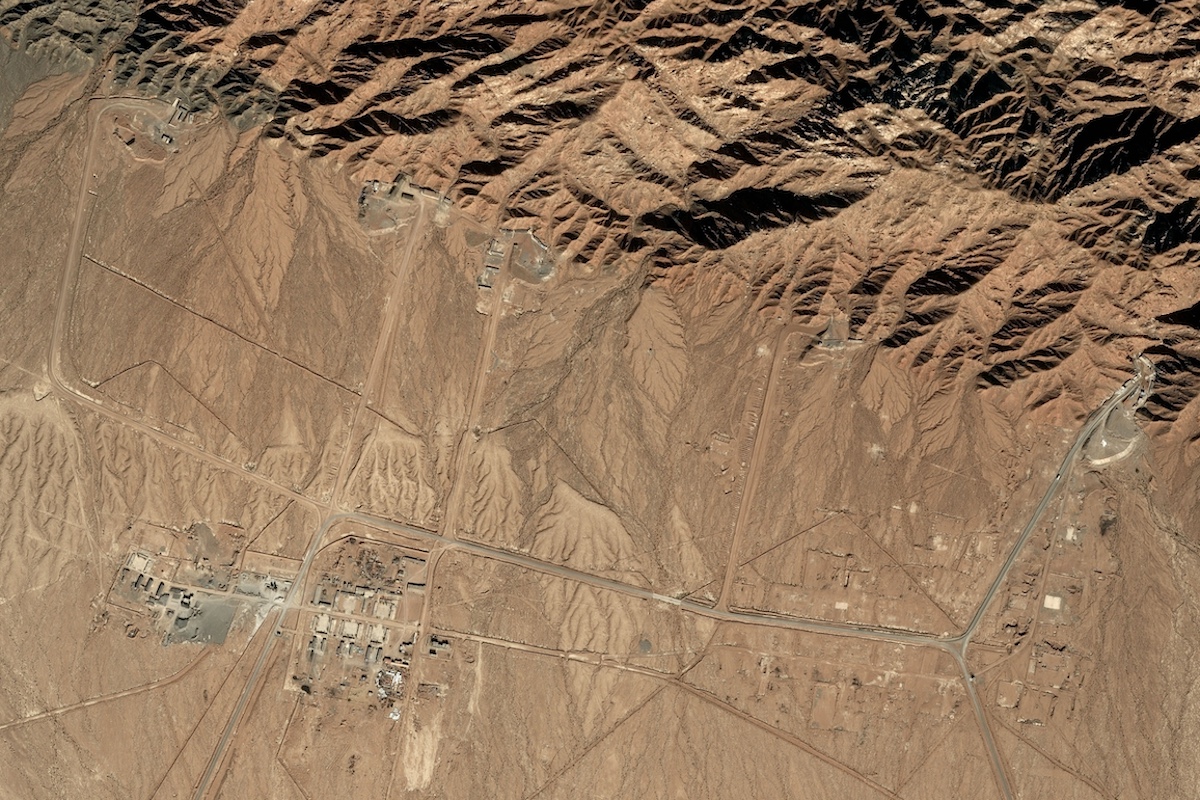
A deepening diplomatic standoff rooted in unproven U.S. allegations of secret Chinese nuclear testing and rapid nuclear arsenal growth has reignited a fraught domestic debate in the United States over whether to end its 30-year pause on explosive nuclear testing. Multiple independent media outlets have documented how this friction has intensified on the sidelines of high-level diplomatic engagement, coming amid a period of sharp strategic competition ahead of key summit talks between U.S. President Donald Trump and Chinese President Xi Jinping.
U.S. diplomatic officials have raised the allegations in closed-door bilateral discussions held on the margins of multilateral forums in Geneva, New York, and Casablanca, focusing claims on China’s Lop Nur testing facility in northwest China, where Washington accuses Beijing of violating the 1996 Comprehensive Nuclear-Test-Ban Treaty (CTBT). The formal accusation was first delivered publicly by U.S. delegates at the Conference on Disarmament in February 2026, shortly after the expiration of the New START arms control treaty between the U.S. and Russia. In that accusation, Washington claimed China carried out a low-yield underground nuclear test in June 2020, using a technique called cavity decoupling to hide the blast’s seismic signature from global monitoring networks.
Complementing these accusations, declassified geospatial satellite intelligence has documented large-scale infrastructure upgrades at seven separate Chinese nuclear-related sites across the country. These upgrades cover activities ranging from plutonium pit fabrication at Pingtong and blast effect testing at Zitong to nuclear fuel reprocessing in Jiuquan, Jinta, and Guangyuan, as well as a major expansion of laser fusion research facilities in Mianyang. Notably, analysts point out that China’s Mianyang laser complex operates similarly to the U.S. National Ignition Facility at Lawrence Livermore National Laboratory, where the vast majority of laser tests are used for stockpile stewardship – a practice permitted under international nuclear rules that allows nations to model thermonuclear weapon performance without conducting live underground detonations.
Even so, the combination of alleged covert testing and infrastructure expansion has supported a rapid expansion of China’s nuclear arsenal, which now stands at more than 600 operational warheads and is projected to grow to 1,500 deployable warheads by 2035, according to U.S. defense estimates. In response, Washington has pushed Beijing to adopt new confidence-building and verification measures, including expanded access for independent seismic and radiological detection at Chinese sites. President Trump has also issued a clear warning that if China does not address U.S. concerns and halt alleged violations, the U.S. will resume its own explosive nuclear testing on what he called an “equal basis” to match China’s activity.
Beijing has consistently rejected all U.S. accusations, denying that it conducts any unauthorized explosive nuclear tests or pursues an offensive nuclear arms race. China maintains its long-standing defensive “no first use” nuclear policy, and has refused to accept binding caps on its arsenal, arguing that the massive existing disparity between China’s smaller stockpile and the far larger arsenals held by the U.S. and Russia means any equal cap would unfairly lock in U.S. strategic dominance.
Crucially, independent arms control analysts have raised significant technical skepticism about the validity of U.S. claims. In an August 2026 research report published by the German Institute for International and Security Affairs (SWP), analyst Philipp Rombach concluded that U.S. accusations remain unconfirmed due to fundamental limitations in global monitoring capabilities. While Rombach acknowledged that a magnitude 2.75 seismic tremor recorded at Lop Nur in June 2020 matched the waveform pattern expected from a cavity-decoupled underground blast, the CTBT Organization’s global International Monitoring System is only calibrated to reliably confirm detonations equal to or above 500 to 1,000 tons of TNT equivalent. As nuclear testing technology advances, micro-yield experiments have become even harder to distinguish from natural seismic background noise, and the U.S. has refused to release its underlying sensor data to independent observers to protect its intelligence gathering methods. This means there is no way to separate ambiguous micro-yield detonations from permitted hydrodynamic experiments or routine industrial blasting that also produce seismic activity. Many analysts argue that without verifiable, transparent data, these unproven allegations may be a tactical tool to pressure China into trilateral arms control talks or to build domestic political support for the U.S. to resume its own nuclear testing.
From a Chinese strategic perspective, arms control analyst Tianjiao Jiang outlined in a 2026 article for the Arms Control Association (ACA) that U.S. strategy is designed to draw China into trilateral arms control negotiations alongside Russia to cap China’s growing arsenal before it reaches the projected 2025 1,500-warhead level, allowing the U.S. to avoid the strategic risk of facing two peer nuclear adversaries at the same time. Jiang explained that while U.S. coercive leverage has pushed forward limited incremental agreements on risk reduction, such as pre-notification of missile tests and bilateral crisis communication hotlines, the broader U.S. framework is fundamentally counterproductive. The approach fails to address China’s core demand for mutual recognition of strategic vulnerability, ignores the massive asymmetry in existing arsenal sizes, and pairs arms control demands with major expansions of U.S. missile defense systems such as the Golden Dome program.
Tong Zhao, a senior fellow at the Carnegie Endowment for International Peace, echoed this skepticism in a September 2026 report. Zhao noted that while U.S. strategy correctly identifies areas of feasible operational cooperation, such as reciprocal limits on theater-range strike systems in the Western Pacific and mutual inspection protocols for co-orbital space weapons, these opportunities are undermined by Washington’s broader strategic doctrine. By clinging to a policy of open-ended escalation dominance and maintaining deliberate ambiguity about first use of nuclear weapons to offset shifts in regional conventional military power, Zhao argues that the U.S. has adopted a coercive, unilateral “America First” posture that confirms China’s worst-case security fears, trapping both nations in a classic security dilemma where escalating preparations for conflict only increase the risk of confrontation.
Beyond the bilateral standoff, the escalating dispute over China’s nuclear program has reignited a fierce domestic debate in the U.S. over whether Washington should end its decades-long moratorium on explosive nuclear testing. Proponents of resuming testing, such as Heritage Foundation analyst Robert Peters, argued in a January 2026 article that the U.S. must restart live testing to confirm that its rapidly aging nuclear stockpile remains functional and credible as a deterrent. Peters pointed out that while China and Russia have both fielded newly designed nuclear weapon systems, the youngest warhead in the U.S. arsenal is 36 years old. The entire U.S. deterrent relies on decades-old plutonium pits that were never tested for multi-decade service life, and as the plutonium naturally degrades, it creates structural changes that could undermine weapon performance. A February 2024 report from the U.S. Government Accountability Office (GAO) supported this concern, noting that radioactive decay produces helium bubbles and chemical byproducts within the plutonium metal that alter the material’s structural strength and disrupt how the weapon core compresses during the high-explosive implosion that triggers a nuclear detonation. The GAO warned that these changes could lead to unacceptably low explosive yield in a weapon’s primary stage, potentially preventing it from generating enough force to trigger the secondary stage and achieve the warhead’s designed military output.
However, critics of resuming testing argue that ending the moratorium would cause far more harm than good to U.S. national security. Leading nuclear scientist Siegfried Hecker argued in a November 2025 Foreign Affairs article that restarting explosive testing would primarily benefit China and Russia. Hecker noted that a U.S. exit from the moratorium would allow China to rapidly validate next-generation weapon designs for its expanding arsenal, and let Russia refine new strategic delivery systems. China and Russia would be able to resume large-scale testing operations far faster than the U.S., which has not maintained active testing infrastructure at scale since the 1990s. Instead of resolving U.S. plutonium pit production bottlenecks, Hecker argued that a U.S. return to testing would dismantle decades of global nonproliferation norms, spark a new multi-front nuclear arms race, and encourage other nuclear-armed states to conduct their own tests.
In the end, the shifting nature of modern nuclear research – where much of the work once done in live tests now moves into permitted large-scale laser fusion research facilities – demonstrates that the line between legal laboratory stockpile stewardship and unauthorized explosive testing is a political agreement, not a clear, unambiguous physical boundary. If weapons laboratories conclude that live explosive testing is necessary to verify the safety and yield of aging warheads, this issue must be resolved through transparent, multilateral negotiation between the U.S., China, and Russia. Rather than using unproven allegations of low-yield testing as cover to unilaterally end the global testing moratorium, the three major nuclear powers must negotiate an updated, mutually verified agreement that sets clear physical boundaries for permitted laboratory simulations and subcritical experiments, before unchecked distrust unravels the entire global arms control framework.