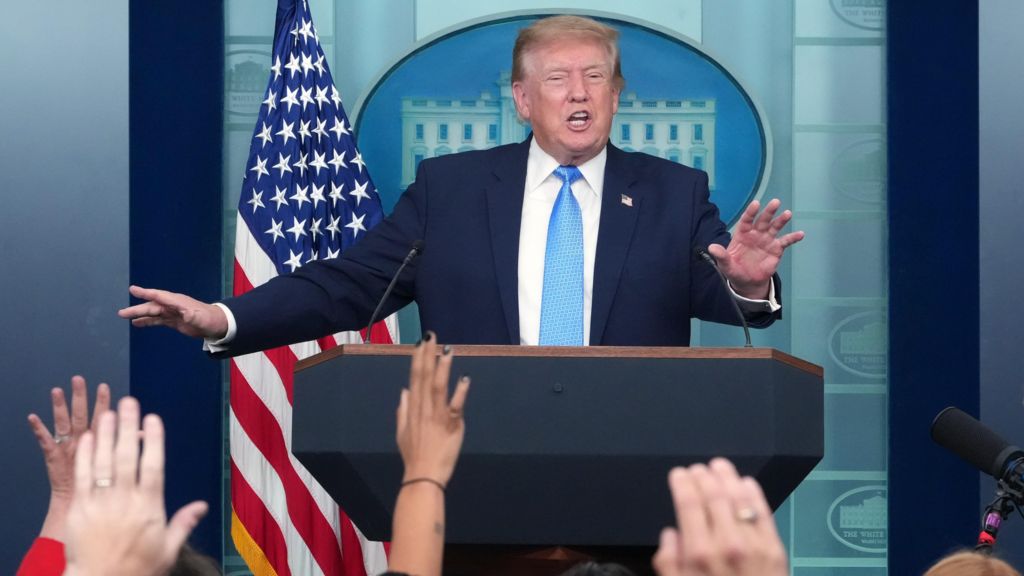
From the White House briefing room on Monday, U.S. President Donald Trump delivered a landmark update on the ongoing Iran conflict, asserting that the military phase of the months-long standoff is functionally concluded, with constructive diplomatic tailwinds pushing toward a near-term ceasefire.
Trump noted that current U.S. operations in the region are maintaining the existing status quo, a posture he framed as a direct request from Iran’s neighboring Gulf states. While he emphasized that fresh direct U.S. strikes on Iranian targets are “highly unlikely” at this stage, he confirmed that U.S. military assets remain fully prepared to respond immediately if unforeseen shifts in the security landscape demand action.
The president declined to issue a formal public declaration of a full end to hostilities, explaining that the U.S. must remain vigilant to shield its regional partners from potential residual Iranian aggression. He specifically cited the ongoing U.S. naval blockade of Iranian ports as a critical measure enhancing collective regional security, and highlighted that his earlier Oval Office meeting with Qatari Prime Minister Sheikh Mohammed bin Abdul Rahman Al Thani had yielded exceptionally productive conversations centered on finalizing a peace framework. The Qatari prime minister later shared on social platform X that his talks with Trump and Vice-President JD Vance had focused on forging a formal peace deal to bring long-term stability to the Middle East.
Since the conflict erupted following joint U.S.-Israeli strikes in February, all formal peace brokering between Washington and Tehran has proceeded via indirect shuttle diplomacy led by third-party mediators including Qatar, Saudi Arabia and the United Arab Emirates. All three of these U.S. Gulf allies have faced direct Iranian strikes during the conflict, alongside persistent threats of additional attacks that have triggered widespread, costly disruptions to regional commercial air travel.
This is not the first time Trump has characterized the Iran war as militarily exhausted, but the current political context marks a stark shift from prior statements. The announcement comes immediately after a disappointing Republican showing in last week’s midterm elections, a outcome that senior GOP figures including Vice-President Vance have explicitly attributed to public dissatisfaction with the administration’s handling of the Iran conflict. In a Sunday broadcast interview with 60 Minutes, Trump had already signaled his reluctance to pursue further military escalation, noting he saw no current justification for expanding hostilities. In the lead-up to the midterm vote, Trump had confirmed U.S. forces carried out limited “minor strikes” on an Iranian island located in the strategically vital Strait of Hormuz.
The lingering domestic political fallout from the war has already spilled over into congressional infighting: on Monday, prominent Republican Congressman Thomas Massie launched a scathing public condemnation of U.S. Defense Secretary Pete Hegseth over the handling of the Iran campaign, and formally filed a request for a House of Representatives vote to impeach him. Trump has moved to fully back Hegseth, dismissing Massie’s impeachment push as a total “sham,” while Hegseth himself has stated he faces no anxiety over the pending threat. Though the impeachment effort is projected to fail in the current Republican-controlled Congress, which retains its majority only until January, Democratic leadership has already confirmed they intend to move forward with impeaching Hegseth as soon as the new congressional session begins, when they will hold majority control of both the House and Senate. Iranian government officials have for months repeatedly voiced deep skepticism of the Trump administration’s public pledges to swiftly resolve the long-running conflict.
Trump says Iran war is ‘effectively over’ militarily with further strikes unlikely