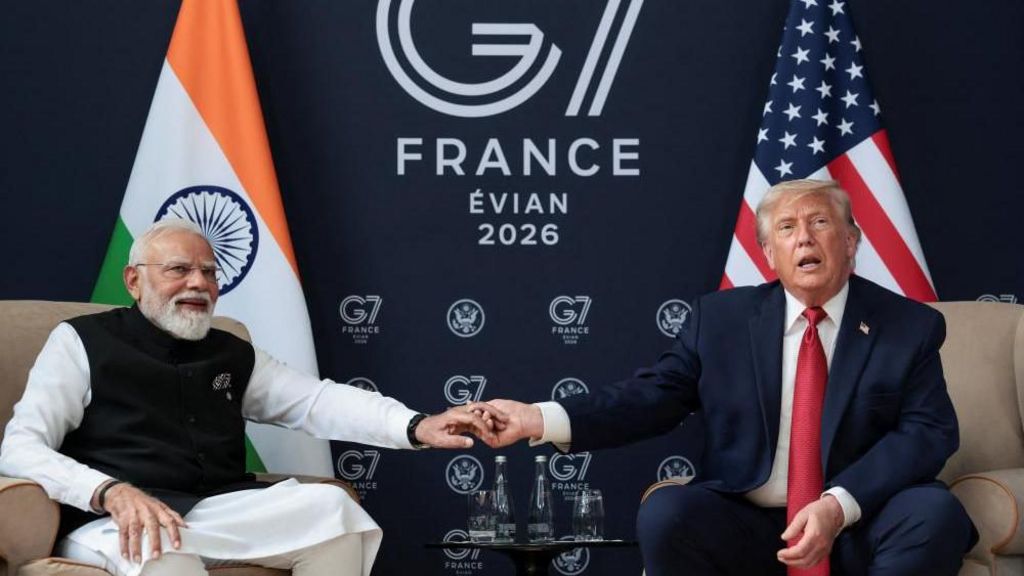
At a bilateral meeting on the sidelines of the G7 summit in France, U.S. President Donald Trump has pledged a future visit to India, marking a notable softening of strained bilateral ties that have been roiled by trade disputes, a deadly recent naval incident, and geopolitical disagreements over the past year. Trump told reporters the trip would occur “sometime in the future”, adding that the two nations are now nearing a final agreement on a comprehensive bilateral trade deal after months of stop-start negotiations.
Bilateral relations hit a low point last year when Trump first announced sweeping new tariffs on Indian imports, and tensions escalated sharply just one week before the G7 meeting, when three Indian sailors were killed in a U.S. military strike in the Gulf of Oman. The strike targeted a tanker Washington accused of violating its blockade on Iranian ports, and the incident triggered immediate diplomatic pushback from New Delhi, which summoned a senior U.S. envoy twice to protest the killing and the risk to Indian crew members working on vessels transiting the region. During their G7 talks, Indian Prime Minister Narendra Modi raised the urgent issue of maritime safety for Indian seafarers operating in the Strait of Hormuz, a critical global energy chokepoint that has been disrupted by ongoing regional conflict.
The trade negotiations, which have dragged on for more than a year, hit another recent snag after the U.S. announced plans for new import tariffs targeting nations deemed insufficiently active in combating forced labor, a list that includes India. Despite the setback, Trump praised Modi as a “tough negotiator” during his post-meeting press remarks and reaffirmed his commitment to travel to India, a request New Delhi has pressed for several months. The visit could potentially include a multilateral gathering with leaders from Japan and Australia, according to prior Indian diplomatic outreach.
On the topic of defense cooperation, Trump made an unusual, conditional pledge of U.S. military support: “If anybody attacks that man [Modi], we’re going to be there… Now, if there’s a new leader, I’m not sure about it.” The comment drew note for its informal framing, marking a departure from standard official alliance commitments.
Domestically, Modi has faced growing criticism from Indian opposition parties, who have accused the prime minister of failing to issue a direct condemnation of the U.S. strike that killed the three sailors and pressed him to raise the incident forcefully with Trump during their summit meeting. In his public address to G7 leaders on Tuesday, Modi referenced the deaths of “several Indian civilians” amid Middle East tensions and called for urgent global action to guarantee the safety of commercial seafarers. “Today the world does not suffer from a shortage of resources; it suffers from a shortage of trust. And the future of our partnerships depends on building this trust,” Modi said, a comment many Indian political commentators have linked directly to the ongoing friction in bilateral ties with Washington.
For India, regional instability in the Gulf carries steep economic stakes: the country imports roughly 90% of its crude oil, and the ongoing disruption to shipping through the Strait of Hormuz — which normally carries around 20% of global oil and gas supplies — has already put significant upward pressure on Indian energy costs. Even if the strait returns to full normal operations quickly, industry analysts warn global energy supplies could take months to rebalance and stabilize after prolonged disruption.
The G7 meeting marks a clear tonal shift from the pair’s last formal bilateral encounter, when Modi traveled to Washington for a notably frosty White House meeting in February of last year. Looking ahead, senior trade officials from both nations are set to convene in New Delhi next week to wrap up what India’s commerce secretary has called the “final touches” of a new trade agreement.
Trade talks between the two nations have been fraught from the start. India was among the first countries to open trade negotiations with the Trump administration after it took office, but repeated disagreements over tariff levels and market access have slowed progress. At the height of trade tensions, the U.S. imposed tariffs as high as 50% on select Indian goods, before rolling rates back to 18% after the two sides reached an interim trade deal in February. Most recently, the U.S. Supreme Court ruled many of Trump’s unilateral tariffs illegal, cutting the current rate to 10%. It remains unclear whether the proposed new forced labor-related tariffs will ever be implemented, with no formal timeline for enforcement released to date.
Beyond trade and the Gulf incident, multiple other sources of friction have lingered over the past year. New Delhi took strong offense last year after Trump claimed he had brokered a ceasefire between India and Pakistan during a border conflict, and repeated his offer to mediate the long-running Kashmir dispute — a territory claimed by both India and Pakistan, and a core Indian national priority that New Delhi has long insisted is an exclusively internal matter, with no room for third-party mediation. Modi communicated this position “strongly” to Trump during their 2025 meeting, but in the months since, Pakistan has cultivated closer ties with the Trump administration, even stepping into a role as an intermediary between Washington, Tehran, and Arab capitals. Additional tensions have stemmed from the Trump administration’s broader crackdown on immigration, including new restrictions on the H-1B visa program that has long served as a primary pathway for skilled Indian workers to live and work in the United States.