The global race for artificial intelligence dominance has sparked a fiery public debate over whether rapid innovation should be slowed by mandatory safety safeguards, with U.S. leaders, top tech executives, and cross-party political figures taking starkly opposing positions on the future of the transformative technology.
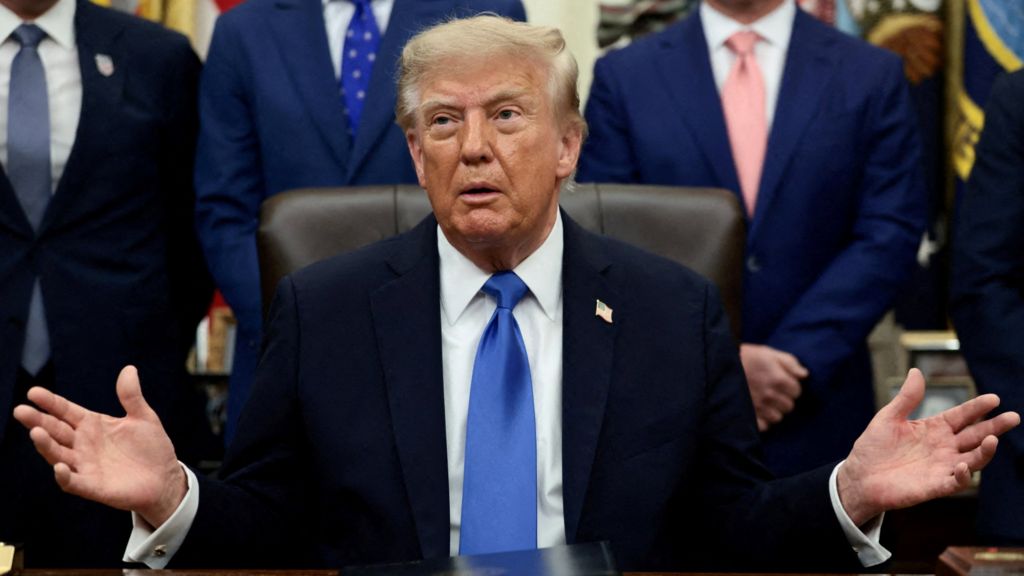
Speaking out on Monday, former U.S. President Donald Trump pushed back against a rising tide of safety concerns, dismissing warnings about AI risks as a coordinated “hoax” in a series of social media posts. Trump drew parallels between AI safety conversations and what he has repeatedly labeled the “Global Warming Scam”, falsely claiming the narrative was manufactured by what he called the “Radical Left Dumocrats”. The former president, who branded himself the “Hoax Buster”, also linked AI safety concerns to the investigation into Russian 2016 election interference that he dismisses as a political witch hunt. He went further to claim that “there is a SICK conspiracy going on against AI and Data Centers, and the only one that is happy about it is China”, adding, “WHOEVER WINS AI, WINS!” In a separate post, Trump argued that the only “guardrails” the technology requires is a “strong and smart” president, a clear reference to himself.
Beijing pushed back against the implications of Trump’s remarks, with Chinese state media pointing out that Washington’s growing anxiety over China’s rapid AI progress has skewed its domestic AI policy priorities. “They know that China has become a strong competitor in AI, and worry that if the US slows down development or tightens regulation, China could catch up even faster,” explained Xin Qiang, a professor of American Studies at Shanghai’s Fudan University, in an interview with the *Global Times*.
Trump’s dismissive comments come amid a cascade of new warnings from within the AI industry itself about the existential risks unregulated development could pose to humanity. The conversation gained new momentum after a viral post from Jacob Coxon, a former AI researcher at leading AI firm Anthropic who left the company over its refusal to slow development, pushed the debate into the mainstream. Anthropic scientist Evan Hubinger followed up by stating publicly that he estimates the chance of AI causing human extinction within the next 10 years exceeds 10%.
This weekend, Anthropic CEO Dario Amodei doubled down on his longstanding call to slow the pace of advanced AI development and introduce tighter third-party monitoring, though he stressed that any regulatory changes must not compromise U.S. commercial AI advantage. Jack Clark, co-founder of Anthropic, added to these calls during an interview with the BBC, arguing that mandatory third-party-verified “kill switches” to shut down dangerous AI systems should be required for all companies operating in the space. Clark noted that most major AI labs, including Anthropic, already have internal mechanisms to pull the plug on rogue systems, but lawmakers should codify this requirement into law to create uniform safety standards. Amodei’s call for an industry-wide slowdown has already been backed by the leaders of two other major AI players: OpenAI CEO Sam Altman and xAI founder Elon Musk, both of whom support mandatory regulation and independent monitoring of cutting-edge model development.
On the same day Trump published his posts, Microsoft became the latest major tech company to lay out its approach to AI guardrails, publishing a framework for what it calls “humanist AI” that centers human oversight of advanced systems. Microsoft AI CEO Mustafa Suleyman told CNBC the company had been developing the guidance for months and chose to release it amid the intensifying public debate over AI risks.
The growing bipartisan divide over AI safety has produced an unlikely political alignment: former Trump chief strategist Steve Bannon, a hardline conservative, and veteran progressive U.S. Senator Bernie Sanders will share the stage at Tuesday’s “Pro-Human Assembly” in Washington D.C., an event dedicated to rethinking U.S. AI policy to center human needs. Sanders laid out his urgent position last week in an interview with BBC’s *Newsnight*, saying, “we have got to do something immediately to stop the uncontrolled growth of AI. You’ve got the existential threat of the possibility of humanity being wiped out.”
The volatility of the debate spilled over into global markets on Monday, as investors priced in the risk of regulatory action that could slow AI development and cut into tech company profits. A wave of selling hit shares of leading AI and tech firms, dragging down valuations across the sector as market participants weighed the potential for new industry restrictions. As the conversation continues to escalate, the split between those calling for urgent safeguards and those who frame safety regulations as a threat to U.S. competitiveness has become one of the most contentious technology and policy issues of the decade.