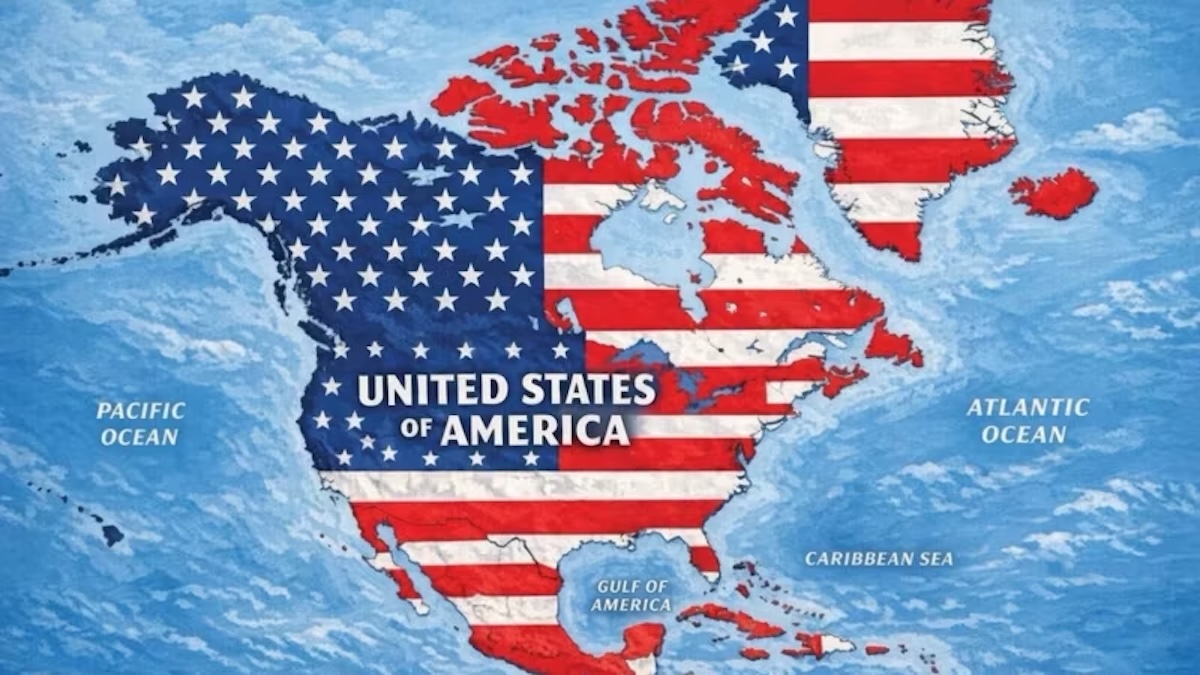
As U.S. midterm elections approach in just two months, a provocative social media post from sitting U.S. President Donald Trump has ignited widespread international and domestic backlash over what critics call an open embrace of imperial expansion. Trump, who is already serving his second term, has built a pattern of aggressive foreign policy that has raised alarm across the globe, and his latest post on Truth Social has escalated those concerns dramatically.
The post features a map that overlays the U.S. flag not only over the contiguous United States but also on Canada, Greenland, Iceland, Mexico, and multiple nations across Central America and the Caribbean. This visual has been quickly labeled the “Donroe Doctrine” by commentators, a tongue-in-cheek but ominous reference to the 19th-century Monroe Doctrine that framed the Americas as a U.S. sphere of influence—updated here to signal direct territorial ambition.
Political leaders and public figures across the ideological spectrum have rushed to condemn the post. Congressman Jonathan Jackson, a Democrat from Illinois, was among the first to speak out, saying simply, “this is unacceptable.” Journalist Stephen Robinson noted on X that any other world leader who shared a comparable map would be forced to issue an immediate apology and step down from office.
Amy McGrath, a retired U.S. Marine Corps fighter pilot and former Democratic Senate candidate from Kentucky, framed the issue as a double standard. She asked, “What would we do and say if the Chinese president posted a map of China taking over the Western Pacific?” Former Swedish Prime Minister Carl Bildt, co-chair of the European Council on Foreign Relations, echoed this point, asking, “What would happen if Xi Jinping posted a map where [China] has taken over all of East Asia, and [President Vladimir] Putin one of [Russia] having absorbed all of Western Europe? It would have been seen as either insane or dangerous—or both.”
While many on social media have labeled Trump “absolutely bonkers” and “f*cking insane” over the post, some analysts argue the map is a deliberate signal of Trump’s actual intentions, not a random outburst. Dr. Brian Goldman, a Canadian emergency physician, author, and broadcaster, pushed back on the mental health framing, saying: “That’s not insanity. That’s intention.” Democratic strategist Michelle Kinney agreed, noting, “As always, he is telling us what the plan is. We must take it seriously.”
Melanie D’Arrigo, executive director of the Campaign for New York Health, connected the post to broader domestic policy trends, arguing that “the reason why Republicans attack education is so that people don’t recognize the history that repeats itself.” Mexican President Sheinbaum, while not mentioning Trump or the map directly, issued a firm rebuke of the implied territorial ambition in a post on Monday: “We reaffirm that Mexico neither is nor will be a colony or protectorate of any foreign country. Proudly we are a free, independent, and sovereign nation.”
The map post is just the latest in a string of provocative content Trump has shared on his social media platforms. Progressive influencer Harry Sisson has cataloged a series of posts from Sunday that included AI-generated images and other maps, leading him to conclude the president is “having a mental health episode online” and to call for Trump’s removal from office via the 25th Amendment. “This man is unwell. 25th Amendment NOW,” Sisson said.
Other recent provocative posts from Trump include a suggestion to rename Lake Ontario amid tense ongoing trade negotiations with Canada, and a proposal to rebrand New Mexico as “New America.” New Mexico’s Democratic Governor Michelle Lujan Grisham pushed back hard on that idea, saying her state’s name “isn’t up for debate – it’s been ours since before the United States existed.”
She also connected Trump’s map posts to what she called a distraction from failed domestic and foreign policy. “What is up for debate? Who’s showing up for working families,” she said. “While the president tries to distract Americans from his disastrous war in Iran, gas prices keep soaring. Americans are also spending more at the grocery store, losing access to healthcare and wondering if they’ll ever be able to afford a home. While the White House wastes time coloring on maps, Nuevo México is busy doing the work.”
Critics point out that the map post aligns with a pattern of aggressive foreign policy actions Trump has taken during his second term already. Beyond the ongoing illegal war in Iran, which has led Iran to restrict shipping traffic through the critical Strait of Hormuz, Trump has invaded Venezuela to abduct President Nicolás Maduro and seize control of the country’s vast oil reserves. He has become the most war-prone U.S. commander-in-chief in modern history, ordering bombing campaigns in more countries than any of his predecessors, and his administration has killed more than 225 people by blowing up boats allegedly carrying drug smuggling cargo through international waters.
Trump has also openly threatened to seize control of the Panama Canal, and has raised the prospect of military strikes against other nations in the Western Hemisphere, including Colombia and Mexico. In response to the Strait of Hormuz shipping disruptions, Trump has floated the idea of declaring the critical waterway U.S. territory and renaming it after himself. He has already renamed the Gulf of Mexico the “Gulf of America” and pushed to rename the John F. Kennedy Center for the Performing Arts in Washington, D.C. to include his own name.
With midterm elections just weeks away, congressional Democrats have ramped up their criticism of Trump’s so-called Donroe Doctrine. Last month, a delegation of progressive congressional lawmakers and candidates traveled to Uruguay for the third Pan-American Congress. After the gathering, Congressman Jesús “Chuy” García, a Democrat from Illinois, stressed that “progressives reject the violent, imperialistic Donroe Doctrine, and believe in a foreign policy rooted in cooperation, diplomacy, and sovereign equality.”