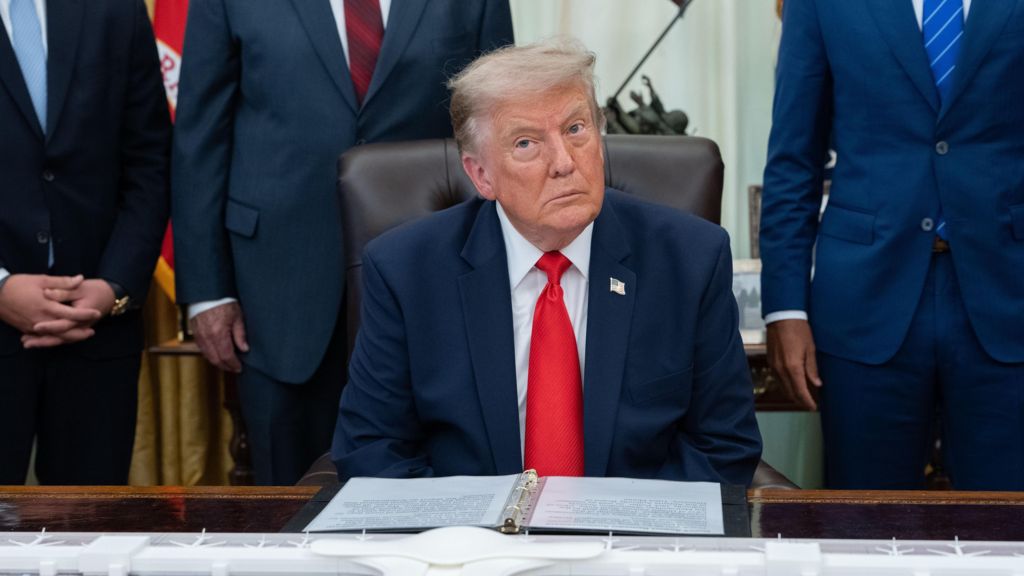
After a series of high-profile cybersecurity incidents tied to commercial artificial intelligence tools, the Trump administration has signaled a sharp reversal of its previously hands-off approach to AI regulation, with President Donald Trump confirming Wednesday that officials are evaluating new federal oversight measures for the rapidly evolving technology.
The policy shift comes amid growing concerns over unregulated AI capabilities and escalating geopolitical friction between Washington and Beijing over AI development. Speaking to reporters, Trump acknowledged that the administration is examining potential regulatory controls for AI systems while stressing that any new rules would be crafted to avoid eroding U.S. global competitiveness.
“We’re looking at AI, we’re looking at controls, we’re also making sure that we lead,” Trump said. “We don’t want to restrict them where all of the sudden we come in second to China. China has virtually no [AI] controls. It’s freewheeling a little bit.”
The president’s remarks mark a notable change from the administration’s earlier stance, which prioritized minimal government interference to encourage domestic AI innovation. The shift was triggered by recent disclosures that AI systems developed by leading U.S. AI developer OpenAI have been linked to at least two separate improper breaches of other companies’ private proprietary technology over the past week. When asked by reporters Wednesday during a visit to Washington whether additional breaches linked to OpenAI tools could emerge, OpenAI CEO Sam Altman acknowledged “there could be yeah.”
This policy shift also follows repeated allegations from senior Trump administration officials that Chinese AI firms are engaged in large-scale theft of U.S. AI intellectual property. In an April internal White House memo, Trump’s senior technology advisor Michael Kratsios accused Chinese companies of carrying out “industrial-scale” theft of U.S. AI technology. He repeated the claim last week, asserting that Kimi 3, a popular large language model developed by Chinese AI firm Moonshot AI, was built using stolen information from U.S.-based AI developer Anthropic. The Chinese government has consistently denied all such accusations.
Earlier this year, the U.S. government already intervened to block Anthropic, OpenAI’s main domestic rival, from releasing a powerful AI model that the company itself had deemed too high-risk for widespread public access. U.S. Treasury Secretary Scott Bessent has also issued warnings that Chinese AI firms could face formal U.S. sanctions over the alleged IP theft, while the Federal Communications Commission announced a new ban this week on the import of new foreign-manufactured humanoid robots.
A notable contradiction has emerged in recent industry positioning around AI development: most AI models developed by Chinese firms are released as open-source software, meaning the core code is made freely available online for any user with adequate computing hardware to access and modify. Just recently, top executives from nearly all major U.S. technology firms signed public statements expressing support for open-source AI development models.
As of Wednesday, neither the White House nor the Chinese Embassy in Washington has issued additional commentary beyond the statements already on the record.