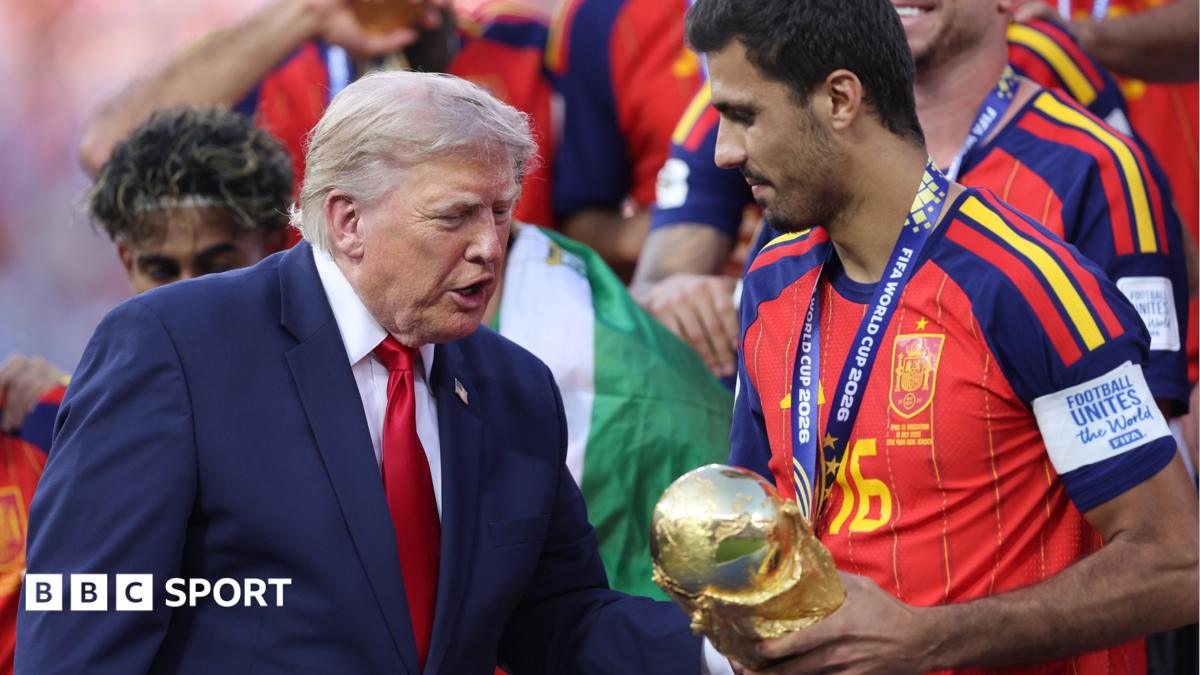
The 2026 FIFA World Cup final, co-hosted across the United States, Mexico and Canada, will not enter history as a classic display of on-pitch football, but it will be remembered for a dramatic array of off-pitch events, celebrity appearances and political controversy that dominated headlines from the New York New Jersey Stadium. After 120 minutes of play, Spain claimed their second-ever World Cup crown, securing a 1-0 victory over Argentina courtesy of a Ferran Torres strike in extra time. Beyond the winning goal, there was little action on the pitch that captured global attention – but the surrounding narrative of the match gave audiences plenty to discuss.
The most high-profile talking point of the tournament’s closing match was the attendance of former US President Donald Trump, who had not attended a single match throughout the three-nation event before the final. Trump arrived at the stadium in dramatic fashion, one of three helicopters that circled the venue before landing, and took his seat alongside FIFA President Gianni Infantino roughly 20 minutes before kickoff, in time to watch the pre-match closing ceremony featuring performances from Robbie Williams and Nicole Scherzinger.
Trump’s presence had already sparked controversy earlier in the tournament, after he admitted to contacting Infantino to request a review of a red card issued to US striker Folarin Balogun. The resulting decision to overturn Balogun’s suspension allowed the player to feature in the United States’ round of 16 defeat to Belgium, a decision that drew widespread criticism across global football circles.
Tensions around Trump’s attendance carried into the trophy ceremony, where the former president joined Infantino to hand out medals to both squads. Crowds inside the stadium booed as the pair walked on stage, and Argentina defender Cristian Romero was photographed walking straight past Trump without shaking his hand after receiving his runner-up medal from Infantino. Unlike his appearance at the 2025 Club World Cup final, where he lingered on stage long after the planned presentation ended, Trump left the stage shortly after the trophy was handed to Spain’s captain, allowing the winning squad to claim their moment of celebration without interruption.
Beyond political controversy, the 2026 final made history for its unprecedentedly extended half-time break, styled after the blockbuster half-time shows seen at the NFL’s Super Bowl. Stretched to 27 minutes – the longest half-time interval in World Cup history – the break featured a star-studded mini-concert headlined by global music icons including Madonna, BTS, Coldplay, Shakira (whose track *Dai Dai* served as the official 2026 World Cup anthem) and Justin Bieber. Bieber delivered a toned-down acoustic rendition of *Everything Hallelujah* following a cameo nod to hit series *Ted Lasso*, switching pace from the high-energy performances that opened the show.
The extended break drew mixed reactions from fans and pundits alike, with former England striker Wayne Rooney offering a blunt assessment from the BBC’s *Match of the Day* studio. “I thought it was crap,” Rooney said. “I thought the performances were bad. The timings were bad. Just let us play football.”
The pre-match build-up also featured A-list celebrity appearances, with Hollywood star Tom Cruise delivering a dramatic opening speech before kickoff, while daytime fireworks displays were held before the match, during half-time and after the trophy presentation to mark the historic occasion. Despite the glitz and glamour of the event, spectators and media faced significant chaos outside the stadium ahead of kickoff. Heightened security measures overseen by the US Secret Service – implemented due to Trump’s attendance – led to massive queues outside the venue gates, which opened four hours before kickoff to accommodate the extra checks.
Confusion over designated access routes left some media personnel shuffling between different entrances and re-joining lengthy queues multiple times, while more stringent bag searches than seen at previous tournament matches added to wait times. Organizers eventually managed to ease congestion before kickoff, and the match got underway on schedule with no delays.
The final marked a historic milestone for 19-year-old Spanish winger Lamine Yamal, who became one of the youngest players ever to win a World Cup winner’s medal, while the result ended a disappointing tournament for Argentina, where fans and pundits widely criticized the squad for failing to support star player Lionel Messi in his bid for a second World Cup title. For neutrals and organisers, the 2026 final will be remembered less for the 90-plus minutes of football, and more as a landmark example of the growing intersection of sport, entertainment and global politics in the modern World Cup era.