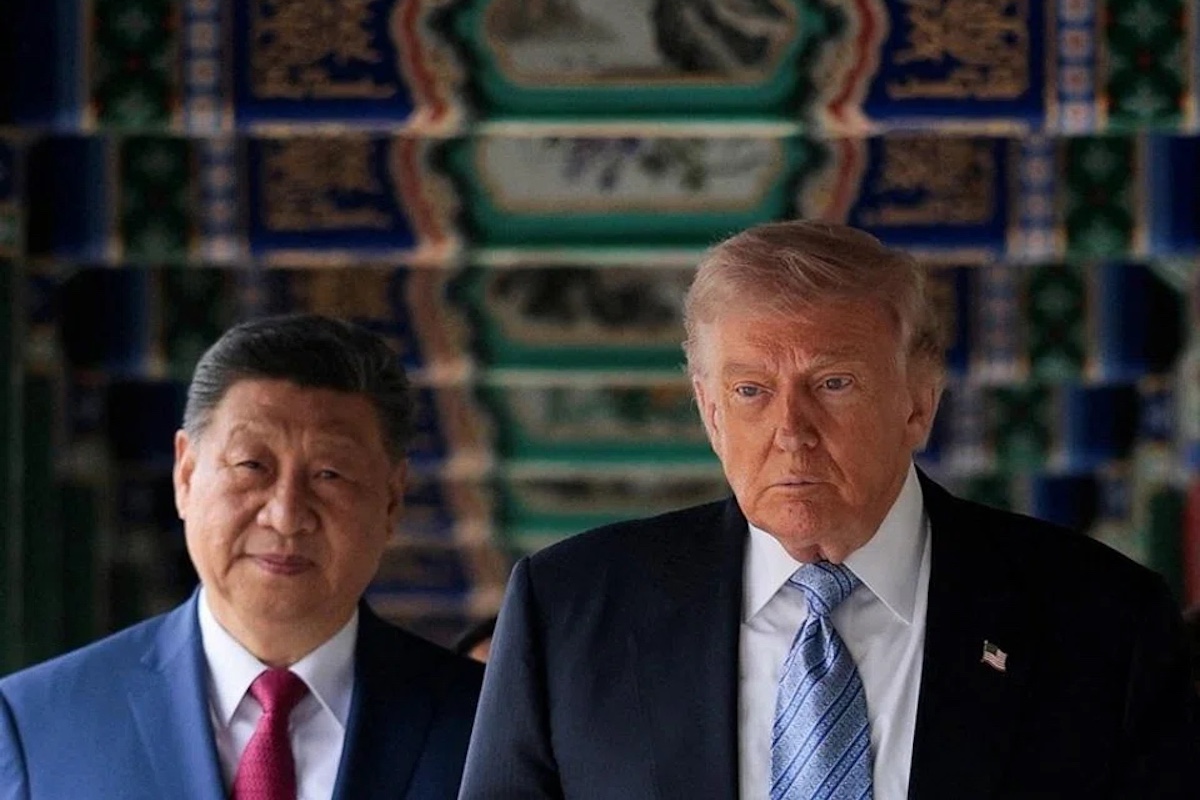
For generations, one unspoken assumption shaped the architecture of global politics: despite its flaws, U.S. power would remain the steady anchor holding the international system together. Even when Washington’s unilateral moves frustrated allied capitals, nations ultimately stayed aligned with the United States, convinced that a world without this anchor would carry far greater risk. Today, that decades-old foundation is being tested under the pressure of Donald Trump’s second term, and mounting evidence suggests the old consensus may not survive.
Three interconnected recent developments lay bare the accelerating global shift: a sweeping new round of U.S. tariffs imposed on most of the world, a landmark Pew Research Center survey showing China surpassing the U.S. in global public favorability, and the European Union caught between competing pressure from Washington’s trade agenda and Beijing’s economic clout. Taken together, these events reveal far more than routine diplomatic friction. They signal a fundamental, likely irreversible realignment of global power.
### The New Tariff Shock, A Consistent Pattern of Unpredictability
On July 24, the Trump administration rolled out new tariffs ranging from 10% to 12.5% on imports from 60 global trading partners, covering approximately 99% of all goods entering the U.S. The White House framed the measure as an enforcement action targeting nations that failed to block imports produced with forced labor, justifying the move under Section 301 of the 1974 U.S. Trade Act. This new regime replaces a temporary 10% global tariff implemented earlier in February, which the U.S. Supreme Court struck down, ruling Trump had overstepped his authority by imposing unilateral tariffs under a declared national emergency.
For global trade partners, the specific legal technicality matters far less than the pattern it reinforces: this is already the second sweeping tariff regime of Trump’s second term, implemented just months after the first was invalidated by the nation’s highest court. For trading partners ranging from Canada and India to the European Union, the message is clear: the United States can no longer be counted on as a predictable economic partner. A government that reimposes broad trade barriers under a new legal rationale every time the previous one fails in court is one whose long-term commitments cannot form the basis of stable planning for foreign nations.
### Pew Data Confirms a Flipping of Global Public Confidence
This growing unpredictability has directly shifted global public opinion, according to new research. A Pew Research Center report published July 15, 2026, drawn from surveys of more than 42,000 adults across 36 nations conducted between February and May 2026, finds that a majority of surveyed countries now hold more favorable views of China than of the United States. Global confidence in Chinese President Xi Jinping has also overtaken confidence in Trump, the survey confirms.
What makes this finding most notable is its geographic breadth: the shift is not limited to the Global South or nations with longstanding grievances against U.S. foreign policy. Pew data shows that even Canada and Mexico, the United States’ closest geographic neighbors, now view China more positively than the U.S. Across seven major European nations — Germany, Greece, Italy, the Netherlands, Spain, Sweden, and the United Kingdom — Xi’s global approval rating outpaces Trump’s by double-digit margins.
This reversal is a recent development, driven by parallel trends: stagnant or slightly improving views of China paired with a sharp collapse in U.S. favorability since the start of Trump’s second term. Just 12 months ago, most surveyed countries still favored the United States; that is no longer the case.
As Yanzhong Huang, senior fellow for global health at the Council on Foreign Relations, notes: “China now outranks the United States in global favorability for the first time in nearly two decades, but the real story isn’t a Chinese soft-power surge — it’s American decline. China’s median favorability rating has barely shifted over the past 10 years; the crossover happened almost entirely because U.S. ratings plummeted.”
Scholar Maria Repnikova echoes this analysis, observing: “China is passively gaining global stature from America’s soft-power retreat, and is now seen by many as the more accessible and reliable great power partner. Beijing has not yet converted this relative advantage into a decisive shift of global public loyalty or a clear, coherent alternative global order.”
The Pew report also finds that populations in middle-income countries across Latin America, Africa, the Middle East and Asia are now more likely to describe China as a reliable partner, and less likely to view it as prone to unwanted foreign interference, compared to the United States. This marks a complete inversion of the roles the two powers have held in global public opinion for most of the post-Cold War era.
### South Korea: A U.S. Treaty Ally Pursues Strategic Hedging
Perhaps the clearest example of this shifting alignment among formal U.S. allies is playing out in Seoul, in a development that defies longstanding expectations. On August 16, Trump announced he had spoken with South Korean President Lee Jae Myung and asked if South Korea would lend the U.S. “a little hand” with tensions surrounding Iran. When Lee declined, Trump ordered the Pentagon to “substantially reduce” the scope of the annual Ulchi Freedom Shield joint military exercises, which launched August 17 and run through August 27.
Lee’s progressive government has centered its foreign policy on what it calls “pragmatic diplomacy,” prioritizing greater strategic autonomy and national economic interest over rigid ideological alignment with Washington. The shift has been sharp enough that South Korea’s conservative opposition has accused the Lee administration of abandoning the U.S. alliance, a critique echoed by American conservative commentators in a recent Wall Street Journal op-ed cited by multiple regional outlets.
The specifics of South Korea’s domestic political debate carry broader meaning. Even a treaty ally that hosts tens of thousands of U.S. troops on its territory is now recalibrating how closely it will tie its foreign policy to Washington. This recalibration is being led by a government that campaigned on hard-nosed pragmatic engagement, rather than automatic alignment with either great power — a telling indicator of how the center of gravity in South Korean politics has shifted.
### Europe Caught In a Two-Front Bind
South Korea is far from alone in this new balancing act. No region faces greater tension from competing great power pressure than Europe, which now finds itself squeezed between two competing economic forces at once.
European policymakers have grown increasingly alarmed by Chinese industrial overcapacity, particularly in the electric vehicle sector, which has contributed to an estimated 10,000 industrial job losses per month in Germany alone. This anxiety has generated loud rhetoric from Brussels and Berlin about the need to “de-risk” European supply chains from overreliance on China.
Yet as analyst James Curran recently outlined in the *East Asia Forum*, this tough rhetoric has yet to translate into a coherent, unified policy. The EU wants to raise the economic cost of overreliance on China without inflicting major damage on its own economy, and it has so far failed to build internal consensus on how to achieve that goal.
Compounding this policy paralysis is the simultaneous pressure of the new U.S. tariffs, which apply to the EU alongside 59 other global economies. European officials are now fighting a two-front economic battle: managing exposure to Chinese industrial overcapacity while absorbing new protectionist trade barriers from the United States. For now, the result is stalemate, rather than a clear pivot toward either power. But pressure on Europe is not easing, and the bloc’s eventual compromise is likely to look far less like close alignment with Washington than it would have a decade ago.
### The Data Catches Up To Shifting Rhetoric
Early this year, Canadian Prime Minister Mark Carney publicly articulated what new data now confirms. In a January 20, 2026 address to the World Economic Forum in Davos, delivered one day before Trump was set to speak at the event, Carney declared the world is experiencing “a rupture, not a transition.”
He argued that the rules-based international order underwritten by U.S. power — which guaranteed open sea lanes, global financial stability, and multilateral dispute resolution — will not return, and that middle powers like Canada must prioritize building their own strategic autonomy rather than waiting for the old system to be restored. Carney has repeated this framing repeatedly, including in remarks ahead of the June 2026 G7 summit. What began as one leader’s assessment is now backed by hard empirical data, and points toward a global order that is reconfiguring itself independent of any single U.S. election cycle.
Individually, none of these developments — new tariffs, shifting public opinion, South Korean hedging, European policy paralysis — is enough to trigger a permanent global realignment. Together, they describe an international system where broken trust and eroded credibility take years to rebuild, if they can be rebuilt at all. A global consensus around U.S. leadership built over a generation has eroded in just a few years. U.S. allies are quietly building alternative hedging strategies rather than waiting for U.S. policy to stabilize.
Global trading partners now treat U.S. commitments as transactional, rather than binding. Even if U.S. policy shifts again in the future, under this administration or a later one, the bilateral and multilateral relationships that have already been recalibrated across the world may not simply snap back to the old status quo. That is what makes this moment more than a temporary rough patch for U.S. foreign policy: it is a structural shift in how the rest of the world positions itself relative to American power.
Trump 2.0 and the unraveling global order