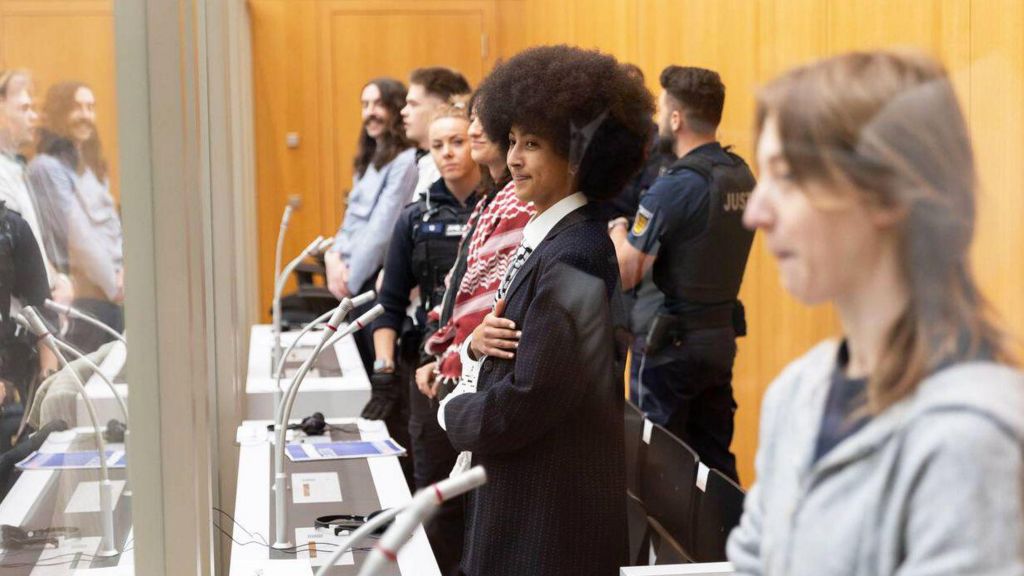
A high-profile trial of five pro-Palestinian activists in Germany has ignited fierce national debate over the treatment of political dissent, with the outcome poised to set a lasting legal precedent for future protest-related cases. Known publicly as the “Ulm 5,” the group — with citizenship spanning the UK, Spain, Ireland, and Germany — has remained in pre-trial detention since September over accusations that they are members of a criminal organization and caused roughly €1 million ($1.1 million) in damage at a German facility operated by Israel’s Elbit Systems, one of the Middle Eastern nation’s largest defense contractors.
The incident at the heart of the case dates back to September 2025, when the five activists gained unauthorized entry to Elbit Systems’ Ulm premises. Videos of the action shared to social media showed the demonstrators wearing branding for Palestine Action Germany, chanting the slogan “Germany finances, Elbit Systems produces, Israel bombs,” and spray-painting the phrase “Baby Killers” on facility walls. Prosecutors allege the group destroyed computer monitors, personal computing devices, precision measuring equipment, and other critical electronic infrastructure during the incursion. Additional charges include the use of symbols linked to Hamas, a Palestinian militant group classified as a terrorist organization under German law.
Court proceedings are being held in a high-security courtroom at Stuttgart’s Stammheim Prison, a location with deep historical resonance: it hosted the iconic 1970s trial of violent far-left Red Army Faction militants. Defense attorneys have argued that holding the trial in this venue deliberately frames the activists as dangerous extremists, creating an implicit bias that could lead to a wrongful conviction before all evidence is heard. Prosecutors have rejected these claims, noting they never requested special detention conditions for the defendants, and that all current restrictions align with standard German legal protocols.
The core legal dispute in the case centers on whether Palestine Action Germany qualifies as a criminal organization under Section 129 of the German Criminal Code. Prosecutors maintain that the group’s explicit mission centers on committing serious criminal acts, a legal framing that has been upheld in recent lower-court rulings for similar cases. Defense teams counter that the only substantiated offense is straightforward property damage, arguing the sweeping criminal organization charges are wildly disproportionate and have violated the defendants’ right to a fair trial.
This specific provision of German criminal law has grown increasingly controversial in recent years, as authorities have invoked it against a range of protest movements from climate activists to pro-Palestinian organizers. Amnesty International researcher Yasmin Khuder warns that the application of Section 129 in the Ulm 5 trial carries dangerous implications. “This case creates a risk that measures actually intended to combat organised crimes are now being used against political protest,” Khuder explained, noting that the activists were simply exercising the right to freedom of expression guaranteed under Germany’s constitution.
The German trial comes amid parallel, equally contentious developments involving Palestine Action in the United Kingdom. Earlier this month, four UK-based Palestine Action activists were convicted of criminal damage for a 2024 break-in at an Elbit Systems facility near Bristol; one defendant also received a conviction for grievous bodily harm. The UK government designated Palestine Action a terrorist organization in July 2025, a ruling that was later struck down as unlawful by the UK High Court in February. The British government has since appealed the High Court’s decision, and the ban remains in legal limbo. Khuder said that repeated references to the UK’s contested designation in German court proceedings are a major point of concern for human rights observers.
Unlike the UK, Germany has not formally designated Palestine Action as a terrorist group, though it has ramped up monitoring of pro-Palestinian organizers since 2023, when it banned several pro-Hamas slogans and symbols. To date, most German courts have adjudicated cases involving the use of these symbols on an individual basis, as the bans do not carry full force of law in all contexts.
After eight months in pre-trial custody, the conditions of the defendants’ detention have added further fuel to the controversy. Family members and advocacy groups argue German authorities are deliberately using harsh conditions to make an example of the five activists. Kit Tricks, sibling of defendant Crow Walt Tricks, told reporters that Crow is held in solitary confinement for 22 hours per day — a classification recognized as solitary confinement under UN guidelines — despite the fact that none of the activists have been accused of harming any person. Nicky Robertson, mother of British defendant Hannah “Zo” Hailu, one of two UK citizens on trial, said she is “absolutely disgusted and outraged” by the treatment of her daughter, particularly the requirement that she appear in court in handcuffs. “What we are looking for is a fair trial, and what we have seen so far is not very fair,” Robertson said. She has called on the UK government to intervene, having already contacted her local Member of Parliament and written to the British ambassador in Berlin. A spokesperson for the British Embassy in Berlin confirmed that it is “providing support to two British nationals detained in Germany and was in contact with the local authorities.”
Analysts trace Germany’s stringent approach to pro-Palestinian protest back to the country’s post-Holocaust political and social identity, shaped by the “never again” doctrine that emerged after World War Two. Joel Crisetig, an analyst at the Armed Conflict Location & Event Data project, notes that former German Chancellor Angela Merkel once codified Israel’s security as Germany’s “reason of state,” a principle that has guided decades of policy toward the Middle East.
“For these historical reasons, the pro-Palestinian movement is much weaker in Germany than countries like Britain or France,” Crisetig explained. His research shows that over the past year, Germany has hosted half the number of pro-Palestinian demonstrations as neighboring France, and far fewer than the United Kingdom. Crisetig added that property damage targeting an Israeli defense firm is particularly shocking to the German public, leading authorities to treat the Ulm incident with the same severity as a major terrorism case.
The trial got off to a chaotic start in late April, when supporters of the defendants chanted “Free Palestine” in the courtroom, and defense attorneys refused to take their seats in protest of the court’s decision to keep defendants separated behind a glass partition. Proceedings are ongoing, and if convicted on all charges, each of the Ulm 5 faces up to five years in prison.