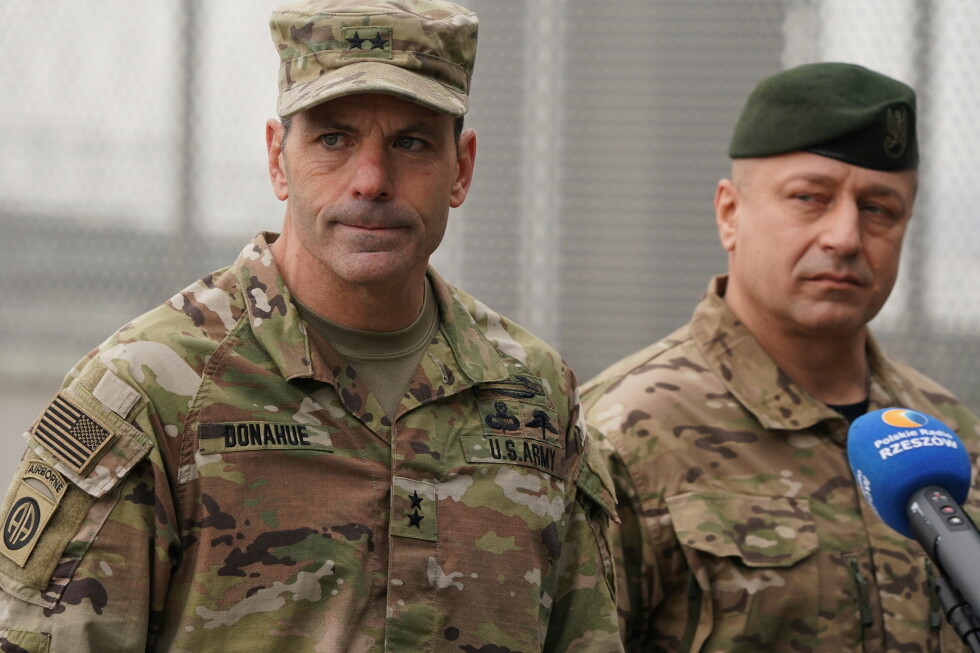
WASHINGTON — The U.S. Army confirmed late Tuesday that the commander of American ground forces across Europe and Africa, a four-star general best known for making history as the final American service member to exit Afghanistan in 2021, is stepping down from his command role unexpectedly after just 18 months on the job.
Gen. Christopher Donahue, who holds dual posts leading both U.S. Army Europe and Africa and NATO’s Allied Land Command, will officially hand over his command on July 2, according to an official Army statement shared with The Associated Press. His early departure marks the 20th near-top military leader to retire or leave their post prematurely since Defense Secretary Pete Hegseth took office, launching a high-profile push to reduce the number of senior general officers under his slogan “less generals, more GIs.”
Maj. Gen. Christopher Norrie, Donahue’s current deputy, will step in to handle all command responsibilities on an acting basis while a permanent replacement is finalized, the statement added.
A graduate of the U.S. Military Academy at West Point, Donahue built his decades-long military career as a special operations leader, heading elite Delta Force units during combat tours in Iraq and Afghanistan before taking command of the 82nd Airborne Division from 2020 to 2022. It was during that tenure that he oversaw security operations at Kabul’s Hamid Karzai International Airport during the chaotic 2021 U.S. troop withdrawal from Afghanistan. On August 30 that year, Donahue became the final American soldier to leave the country, bringing an end to a nearly 20-year war launched after the September 11, 2001 terrorist attacks. This historic moment was captured in an iconic night-vision photograph showing the general boarding the final U.S. C-17 cargo plane to depart Afghanistan.
Hegseth, alongside President Donald Trump, has repeatedly targeted the 2021 Afghanistan withdrawal for political criticism, launching a new Pentagon review of the operation despite multiple prior assessments. The original withdrawal agreement with the Taliban was negotiated during the Trump administration’s first term, and last May Hegseth ordered a fresh probe even after the Pentagon, U.S. Central Command, the State Department, and Congress had already completed exhaustive reviews that included hundreds of witness interviews and analysis of thousands of pages of visual and documentary evidence. It remains unclear what new insights the latest review is intended to uncover.
Despite the political controversy surrounding the withdrawal, Donahue’s leadership during the Kabul evacuation earned bipartisan praise from lawmakers across the political spectrum. Within Army ranks, he was long viewed as a rising star, with many senior observers expecting he would eventually go on to lead the Army service or be selected as Chairman of the Joint Chiefs of Staff.
One senior Army official, speaking on condition of anonymity to discuss internal sensitive deliberations, told the AP that Donahue’s exit aligns with ongoing discussions to downgrade the U.S. Army Europe and Africa command from a four-star billet to a three-star position. The proposed restructuring comes amid repeated public criticism of European NATO allies from Hegseth. Just last week, the defense secretary announced a six-month Pentagon review of U.S. force posture in Europe, framing the assessment as an effort to push NATO toward an irreversible shift that puts European allies in the lead for their own territorial defense. “It’s a review that some countries will fail and others will pass with flying colors,” Hegseth told alliance representatives last week.
The Pentagon has not issued an immediate formal response to news of Donahue’s departure, which was first broken by The Atlantic.