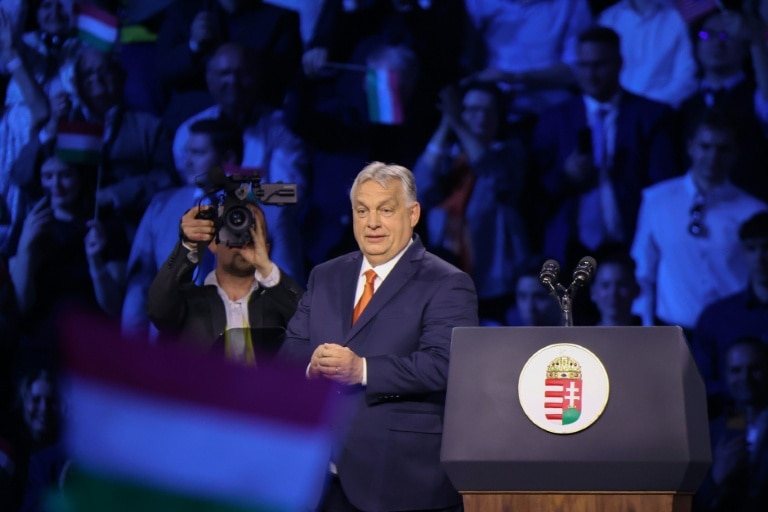
As Hungary prepares to hold its national parliamentary election this Sunday, long-serving nationalist Prime Minister Viktor Orban finds himself facing a surprisingly competitive challenge from opposition candidate Peter Magyar — but independent observers and international monitoring organizations have raised urgent alarms over a deeply skewed electoral landscape that heavily favors the incumbent. Over Orban’s 16 consecutive years in power, his ruling Fidesz-KNDP coalition has reshaped nearly every pillar of Hungary’s electoral and media ecosystem to entrench its hold on power, turning what should be a free democratic contest into a test of European democratic norms, analysts say.
The first and most structurally significant advantage Orban holds stems from sweeping changes to Hungary’s electoral framework enacted after his coalition returned to power in 2010. Analysts note that even if the Fidesz-KNDP alliance loses the overall popular vote by a margin of three to four percentage points, the 2011 electoral overhaul and subsequent redrawing of constituency boundaries would still allow the ruling bloc to retain its parliamentary majority.
Additional structural advantages come from specialized rules for ethnic minority representation and cross-border voting that disproportionately benefit Orban. Preferential mandates for ethnic minority groups require far fewer votes to secure a parliamentary seat, and representatives from both the German and Roma minority communities have a long history of aligning with the ruling coalition. Orban’s 2010 citizenship law granted simplified naturalization to ethnic Hungarians living in neighboring countries, most of whom hold favorable views of the policy and the prime minister, and these voters are eligible to cast mail-in ballots — a privilege not extended to Hungarian emigrants living further abroad, who tend to hold critical views of Orban’s nationalist government.
Human rights groups have warned that outdated voter rolls and weak ballot security for mail-in voting create openings for irregularities, including the possibility of ballots being cast in the names of deceased voters. Concerns are further amplified by the fact that political parties allied with Orban oversee the collection of cross-border ballots in Romania and Serbia, leaving the process open to potential manipulation.
A second core advantage comes from the ruling coalition’s near-total control of Hungary’s media landscape, a transformation overseen by business allies of Orban since 2010. Hundreds of independent media outlets have shuttered over the past 14 years, while remaining independent outlets have been acquired by pro-government oligarchs and converted into mouthpieces for Fidesz. Media freedom watchdog Reporters Without Borders (RSF) estimates that 80 percent of Hungary’s print and broadcast media is controlled by business figures tied to the ruling coalition, and these pro-government outlets receive the vast majority of all state advertising spending.
Critics point to stark data confirming the media’s pro-Orban bias: an 11-month study conducted in 2023 by the independent liberal think tank Republikon Institute found that 95 percent of all coverage of Orban on public television’s flagship news broadcast was positive, while challenger Peter Magyar was portrayed in a negative light 96 percent of the time. Orban’s government has repeatedly denied that it interferes with media editorial decisions.
The third key advantage for the incumbent stems from widespread allegations that he has diverted taxpayer funds and state resources to power his re-election campaign, a practice the government defends as a legitimate duty to inform the public. In the lead-up to Sunday’s vote, Fidesz has accessed multiple official state mailing lists — including confidential records held by the national tax authority — to distribute campaign messaging directly to voters. The government has also run a massive taxpayer-funded media campaign promoting its anti-Ukraine policy positions, including opposition to Ukraine’s EU accession, with ubiquitous billboards featuring Orban’s image urging Hungarians to “stand together” with his government.
Multiple state-owned enterprises, including national electricity distributor MVM, have also paid for out-of-home advertising that repeats Orban’s key campaign messaging on energy policy. A 2024 investigation by independent conservative Hungarian outlet Valasz Online found that the government has allocated millions of euros in public funding to dozens of local non-governmental organizations that have direct ties to Fidesz, many of which share office space with local ruling party chapters. Local media has documented that many of these NGOs have been distributing pro-Fidesz campaign pamphlets directly to voters during the election cycle.
International monitors have been sounding the alarm over Orban’s undue electoral advantage for more than a decade. The Organization for Security and Co-operation in Europe (OSCE) first documented that Fidesz held an “undue advantage” in the 2014 election, and has issued increasingly critical assessments of Hungarian electoral fairness in subsequent cycles. For this election, the OSCE has deployed a full-scale election observation mission — only the third time the organization has done so for an election in an EU member state, and the second consecutive full mission for Hungary.
Orban has pushed back against all criticism, arguing that Hungary maintains a “very strong” democracy and that his government fully embraces political competition. Nonetheless, the array of advantages stacked against Magyar has led many democracy advocates to question whether the election can truly be considered free and fair, with results that will have far-reaching implications for the future of democratic governance within the European Union.