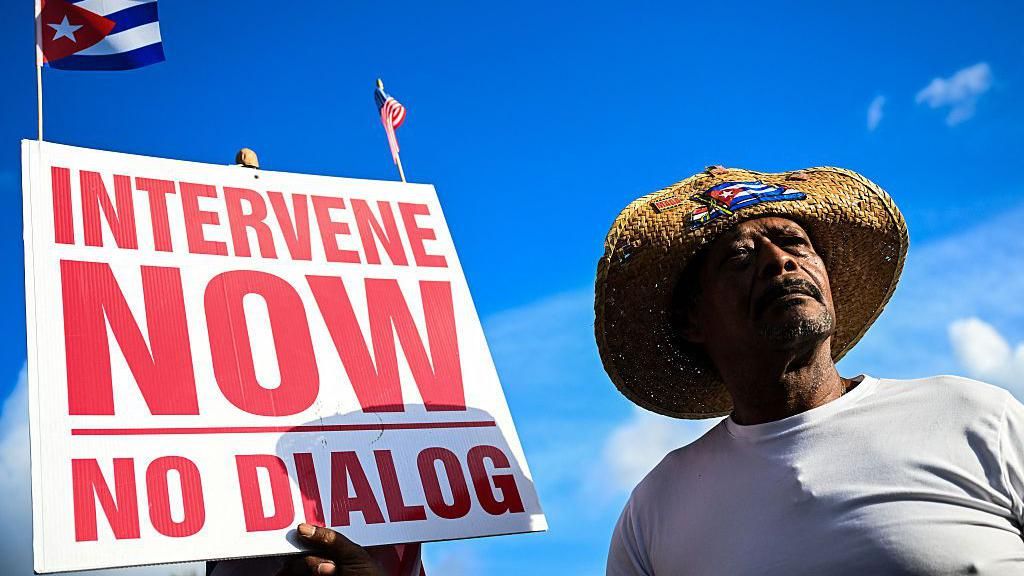
The long-strained relationship between the United States and Cuba has entered a new, highly unpredictable phase after US authorities brought murder charges against 94-year-old former Cuban president Raúl Castro. This unprecedented legal action has ignited widespread global speculation that the Caribbean island could be the next target of Washington’s regime change agenda, coming on the heels of a years-long US maximum pressure campaign that has pushed Cuba into its worst fuel and energy crisis in decades. For 66 years, Cuba has been governed by a Communist system, and a growing bloc of US officials have publicly pushed for that government to be removed from power.
While sitting US President Donald Trump has stated publicly that he does not believe any military escalation will be needed to achieve US goals, the White House has simultaneously doubled down on its vow to not tolerate what it labels a “rogue state” located just 90 miles (144 kilometers) off the US coast. Analysts and policymakers are now examining three distinct scenarios that could unfold as tensions escalate.
The first, and most immediately dramatic pathway, is a US military operation to capture Castro to stand trial in an American courtroom. The charges against Castro stem from the 1996 downing of two civilian aircraft by Cuban fighter jets, and the indictment has stoked fears of a repeat of previous US capture missions. This kind of operation is not without precedent: earlier this year, US special operations forces carried out a rapid raid in Venezuela to capture then-President Nicolás Maduro, a long-time close ally of Cuba, to face US drug and weapons charges in New York. Going back further, the 1989 Operation Just Cause saw 20,000 US troops invade Panama to overthrow and detain then-leader Manuel Noriega.
While Trump has declined to confirm or deny whether a similar mission is being planned for Cuba, a number of sitting US lawmakers have openly called for exactly that approach. “We shouldn’t take anything off the table,” Florida Senator Rick Scott told reporters, adding that “the same thing that happened to Maduro should happen to Raúl Castro.”
Regional security experts note that from a purely military perspective, a capture mission is logistically feasible, but it carries significant risks and unforeseen complications. One key factor is Castro’s advanced age, and analysts also anticipate fierce resistance from Cuban security forces. Adam Isacson, a regional specialist at the Washington Office on Latin America, a non-governmental organization, explained that while Castro’s age might simplify extraction, his iconic status means he is under extremely heavy security protection. “It’s certainly possible,” Isacson noted, but added that removing Castro would likely do little to shift Cuba’s existing power structure. Castro stepped down from the presidency in 2018, and has since functioned primarily as an influential symbolic figurehead rather than holding direct day-to-day governing power. “He’s 94. I don’t think it would affect the power structure in Cuba very much anymore,” Isacson said. “The Castro dynasty retains influence, but it is no longer central to the system the revolution built.” Still, he acknowledged that a capture would carry major domestic political benefits for the Trump administration, which has long courted the anti-Castro Cuban exile community in Florida. “They’d love to humiliate the Castros and lock up one of the original 1959 revolutionaries,” Isacson said. “But the strategic value of that move is really questionable.”
The second scenario being pushed by senior Trump administration officials is a negotiated transition to a new, US-aligned leadership structure that leaves most of Cuba’s existing governing institutions intact. This approach, experts point out, would mirror the recent transition in Venezuela that saw Nicolás Maduro replaced by Delcy Rodriguez, who has since governed the country while working directly with the Trump administration. Trump has repeatedly stated that his administration is already in contact with dissident figures inside Cuba who are seeking US support amid the island’s deepening economic crisis. “Cuba is asking for help, and we are going to talk,” Trump wrote on his social platform Truth Social on May 12.
Just days after that post, CIA Director John Ratcliffe held a closed-door meeting with multiple senior Cuban officials, including Castro’s grandson Raúl Guillermo Rodríguez Castro and Interior Minister Lázaro Álvarez Casas. Secretary of State Marco Rubio told reporters during a Florida appearance that “We’ll engage with the Cubans… at the end of the day they need to make a decision. Their system just doesn’t work.” Rubio added that the administration’s top preference is reaching “a negotiated agreement” that would leave core government structures in place. The changes Washington is demanding include commitments to liberalize Cuba’s state-controlled economy, open the country to increased foreign investment, grant greater political power to US-based Cuban exile groups, and expel all Russian and Chinese intelligence operations from the island.
Georgetown University Latin American studies professor Michael Shifter, former president of the Washington-based think tank Inter-American Dialogue, explained that this approach aligns with US strategic goals: “Just like they wanted to avoid instability in Venezuela, they want to avoid instability in Cuba. Forcing a full regime collapse would be too risky for that.” The biggest challenge to this plan, multiple experts note, is that there is no clear, pre-vetted alternative leader waiting in the wings inside Cuba, unlike the situation in Venezuela. “I don’t think there’s an obvious Delcy Rodriguez in Cuba, and power works differently in Cuba than it does in Venezuela,” Shifter said. “It’s hard for them to find the kind of figure they’re looking for, but that doesn’t mean they aren’t actively searching for a cooperative governing structure.”
The third and most passive scenario is that Cuba’s government will eventually collapse entirely under the weight of ongoing US economic pressure, which has already left most Cuban residents coping with hours-long daily blackouts and widespread shortages of basic food and consumer goods. President Trump has argued that this outcome is already well underway, saying “There will be no escalation. I don’t think it’s necessary. The place is falling apart. It’s a disaster, and they have lost control to some extent.”
But experts warn that this narrative overlooks key strengths of the Cuban state, noting that even amid a catastrophic economic downturn, government and security institutions still maintain firm control over daily life across the island. “You have to distinguish between the Cuban economy and the Cuban state and government,” Shifter explained. “The Cuban economy can collapse, and is collapsing… but the state still functions, especially on the security side.”
A full state collapse would also create major new problems for the Trump administration, as it would likely trigger a massive wave of Cuban migration, primarily toward the US southern border. The Trump administration has already imposed harsh new immigration restrictions that have blocked most recent Cuban arrivals from accessing political asylum and other legal pathways to resettlement. “If there’s a collapse, you’re going to see a big portion of the Cuban population do everything they can to get away, the same way they have from Haiti over the years,” Isacson said. He added that while Florida would be the primary destination for most migrants, many would also likely travel through Mexico to reach the US. Isacson noted that he has been surprised a mass exodus has not already begun, given the extreme conditions many Cubans are facing: “People are probably subsisting on 1,000 or 1,500 calories a day, and are not able to get basic healthcare. You’d think that people would already be building their boats.”
For the hundreds of thousands of Cuban exiles living in the US, many of whom have spent decades advocating for the overthrow of the Havana government, the current moment brings long-awaited hopes that their goal may finally be within reach. But for Cuban residents on the island, the uncertainty of what comes next brings new hardship and anxiety after decades of economic isolation and political tension.