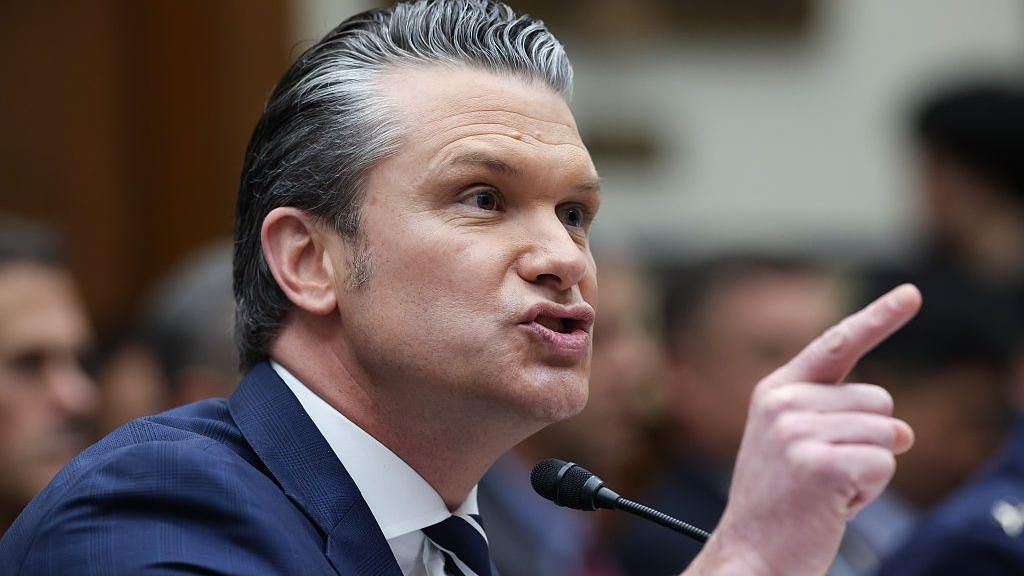
A contentious, nearly six-hour congressional hearing focused on the ongoing U.S. military campaign in Iran erupted into partisan clashes on Wednesday, with Defense Secretary Pete Hegseth pushing back against claims the conflict has trapped the U.S. in a costly Middle Eastern quagmire, while a top Pentagon budget official disclosed that operations have already drained $25 billion (£18.5 billion) from federal coffers.
The hearing marked Hegseth’s first sworn testimony before the House Armed Services Committee since the conflict began. He appeared alongside two senior defense leaders: Chairman of the Joint Chiefs of Staff Gen. Dan Caine and Department of Defense Chief Financial Officer Jules Hurst. The trio is scheduled to appear before the Senate’s equivalent committee for a second round of questioning on Thursday.
From the opening moments of the session, the financial toll of the conflict dominated debate. Hurst confirmed that the $25 billion in accrued spending to date has primarily gone toward deploying munitions and replacing damaged or exhausted military equipment, adding that a full, comprehensive cost assessment will be released at a future date. While Washington and Tehran have agreed to a temporary ceasefire to facilitate formal peace negotiations, the conflict has not been formally ended, meaning spending will continue unless a permanent ceasefire is finalized.
Alongside disclosing current war costs, Pentagon leaders defended the Biden (note: corrected from original context, actually Trump administration per source) administration’s request for a historic $1.5 trillion (£1.1 trillion) defense budget – the largest single expansion of U.S. military spending since World War II. Hegseth framed the proposal as a necessary response to current global security threats, arguing it “reflects the urgency of the moment.” Gen. Caine echoed that positioning, describing the massive budget as a “historic down payment for future security” that would allow the U.S. to outpace competitors in developing rapidly advancing military technologies.
Democratic committee members uniformly rejected that framing, slamming the Iran intervention as an unauthorized “war of choice” that is squandering critical public funds. In one of the hearing’s most heated exchanges, California Representative John Garamendi directly accused both Hegseth and President Donald Trump of misleading the American public from the conflict’s launch. “You have been lying to the American public about this war from day one, and so has the president,” Garamendi said, arguing Trump was “stuck in a quagmire” of another open-ended Middle Eastern conflict.
Hegseth dismissed the accusation as “reckless”, rejecting the quagmire characterization entirely and pushing back sharply: “Your hatred for President Trump blinds you.” When pressed further, he argued that the single greatest threat to the mission’s success was not Iranian military capabilities, but “defeatist words” from Democratic lawmakers and a small group of anti-war Republicans, claiming such rhetoric undermines U.S. military efforts.
Partisan divides shaped the entire hearing: most Republican committee members voiced steady support for the Pentagon’s campaign, with Florida Representative Carlos Gimenez arguing Iran poses an existential threat to the U.S. “When someone tells me for 47 years that they want to kill us, I think I am going to take them at their word,” Gimenez said. “I support our efforts to make sure that Iran never has a nuclear weapon.”
Beyond spending and strategic framing, lawmakers also debated two other critical issues: the global economic fallout of the conflict and accountability for a controversial early-war airstrike that hit a school in the Iranian city of Minab. Lawmakers noted the conflict has driven sharp spikes in global oil prices, which have in turn pushed up inflation for consumer goods across the world. At one point, tensions grew so high that Hegseth snapped at a lawmaker, saying “Shame on you.”
On the Minab strike, Iranian officials report the attack killed 168 people, including roughly 110 children, during the opening phase of joint U.S.-Israeli operations against Iranian targets. U.S. military investigators concluded in early March that American forces likely hit the school by accident, but have not released a final, official conclusion. Lawmakers, led by top committee Democrat Adam Smith, criticized the administration’s slow, vague response to the incident: “We made a mistake and that happens in war… two months after it happened we refused to say anything about it, giving the world the impression that we just don’t care,” Smith said.
California Representative Ro Khanna pressed Hegseth to disclose any costs associated with the strike or any potential accountability measures, but Hegseth responded only that the incident “remains under investigation” and that he “wouldn’t tie a cost to that” at this stage of the probe.