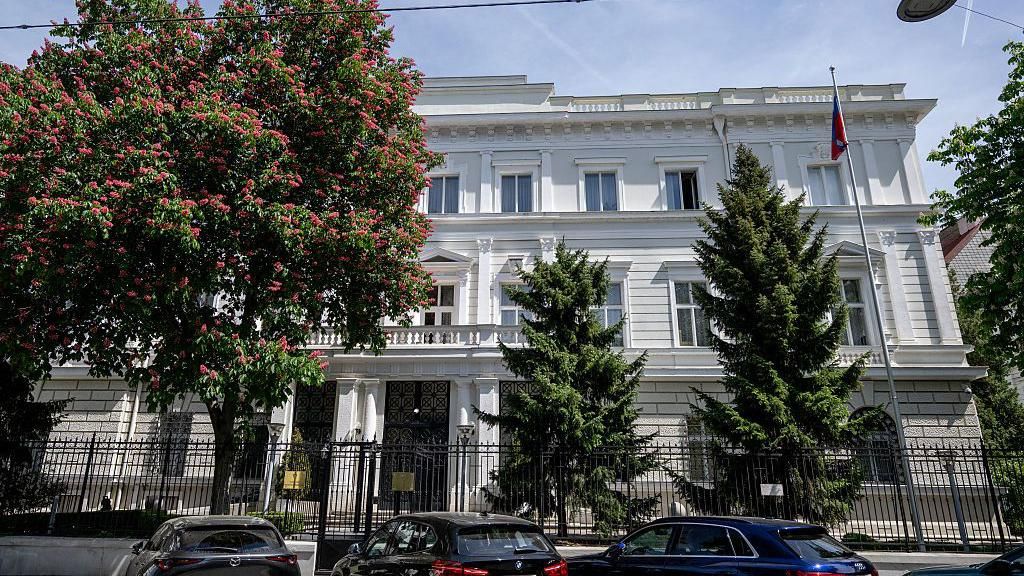
In a sharp escalation of diplomatic tensions between Vienna and Moscow, Austria has ordered the expulsion of three Russian diplomats over allegations of unauthorized espionage activity carried out from official Russian diplomatic sites within the country. The expelled personnel have already departed Austrian territory, according to top government officials.
Austrian Foreign Minister Beate Meinl-Reisinger confirmed that the intelligence gathering operation relied on an extensive network of surveillance antennas, described as a “forest of antennas,” installed across the rooftops of Russian diplomatic properties — including the main Russian embassy in central Vienna and a separate Russian diplomatic compound outside the capital. Initial reporting by Austria’s national public broadcaster ORF, which was later formally verified by the Austrian foreign ministry, first brought the existence of the antenna network to public attention.
Long a source of friction for Austrian domestic intelligence agencies, the antennas have enabled Russian operatives to intercept satellite internet data from a wide range of organizations, including multiple international bodies based in Vienna, ORF reported. In an official statement shared with the BBC, Meinl-Reisinger framed the expulsion as a decisive break from past policy under Austria’s new governing coalition. “Espionage is a security issue for Austria,” she said. “We have brought about a change of course in this government and are taking decisive action against it. We have made this clear to the Russian side, particularly with regard to the forest of antennas at the Russian embassy.” The foreign minister added that the misuse of diplomatic immunity to conduct spying operations was completely unacceptable under international norms.
The Russian embassy in Vienna has rejected the Austrian allegations in strong terms, denouncing the expulsion as an unjustified, politically motivated move that Moscow will not let go unanswered. “We regard this latest unfriendly move by the Austrian authorities as entirely unjustified, purely politically motivated and categorically unacceptable,” the embassy said in a formal statement. “Moscow will undoubtedly respond harshly to these completely ill-considered actions on the part of the Austrian side.”
This latest incident comes amid a growing string of Russian espionage accusations across Central Europe, affecting both Austria and neighboring Germany. In January 2026, Vienna launched the highest-profile Austrian spy trial in decades, when former Austrian intelligence official Egisto Ott went on trial on charges that he passed classified information to Russian intelligence operatives and fugitive former Wirecard executive Jan Marsalek in exchange for payment. Ott’s legal team has vigorously denied all allegations, and the trial remains ongoing as of this reporting.
Marsalek, an Austrian citizen who is wanted on fraud charges by German authorities and listed on an Interpol Red Notice, is widely accused of operating as an asset for Russia’s Federal Security Service (FSB). He fled Europe through Austria in 2020 after the collapse of Wirecard, and is currently believed to be residing in Moscow. Just weeks after Ott’s trial began, Germany also expelled a Russian individual accused of spying and summoned the Russian ambassador to Berlin to formally protest the activity. In a public social media statement, the German foreign ministry stressed that it would not tolerate espionage on German soil, especially when conducted under the protection of diplomatic status.
Vienna’s status as a global hub for espionage stretches back decades, rooted in its Cold War history as a neutral European power located directly along the Iron Curtain, which made it an ideal listening post for both Western and Eastern bloc intelligence agencies. Today, the city hosts permanent headquarters for multiple major international bodies, including the United Nations and the Organization for Security and Co-operation in Europe (OSCE). Most nations maintain multiple diplomatic missions in Vienna to serve these international organizations alongside their official bilateral embassies, creating a large community of diplomats who enjoy universal diplomatic immunity — a status that is frequently abused to cover unauthorized intelligence activity.
Austria’s most recent annual Report on the Protection of the Constitution identifies Vienna as “one of the last remaining locations for Russian signals intelligence in Europe.” The report notes that the extensive signals intelligence operation has directly led to the unusually large contingent of Russian diplomatic staff accredited in the capital, which currently stands at roughly 220 personnel even after multiple expulsion actions. The document also warns that ongoing Russian intelligence activity originating from Vienna has caused measurable damage to Austria’s international reputation. Since the full-scale Russian invasion of Ukraine in 2022, Austria has expelled a total of 14 Russian diplomatic staff in response to espionage-related incidents.