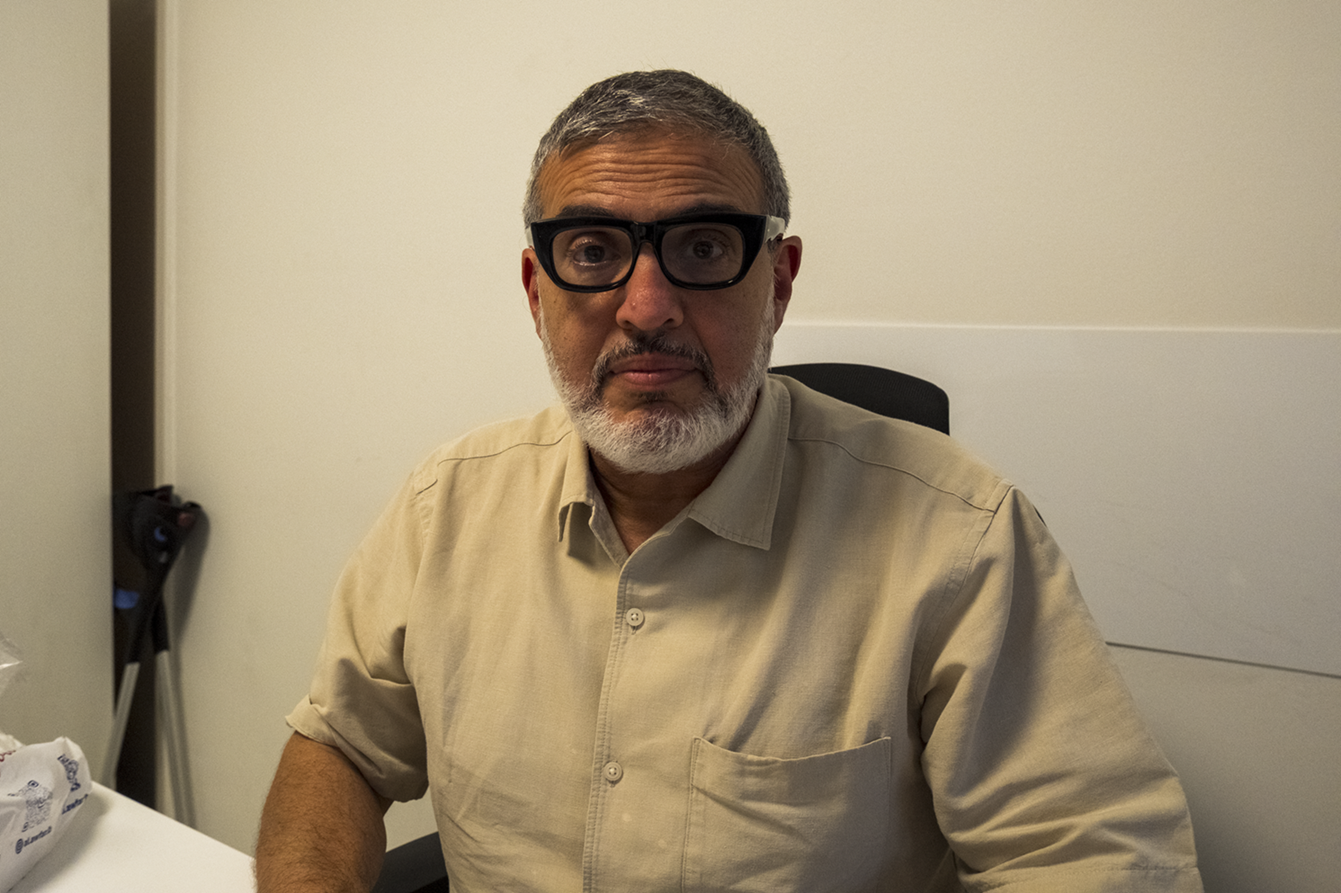
BEIRUT, Lebanon — In a sunlit office in central Beirut, prominent British-Palestinian plastic and reconstructive surgeon Dr. Ghassan Abu Sittah leans over a stack of patient files, his weekend operating schedule filled with names that tell a devastating story of Israeli military campaigns across Lebanon and Gaza. All 11 patients waiting for his care are children, each bearing catastrophic, life-altering injuries from ongoing conflict.
Among the cases he reviews are two siblings carrying unexploded shrapnel from the 2024 cross-border war that has only recently begun to trigger dangerous secondary complications. There is a young boy with a partial foot amputation in need of complex reconstruction, another who requires final work on an amputation stump to prepare for prosthetic rehabilitation, and a child with a severe elbow injury that will demand hours of delicate surgery to save the joint from permanent disablement. “And so on, they are all like that… catastrophic,” Abu Sittah told Middle East Eye in an interview.
One of those waiting for their next procedure is 12-year-old Fatima al-Jabal, the youngest of three surviving sisters who escaped death when an Israeli strike flattened their family home in the small mountain village of Libbaya, located in Lebanon’s Bekaa Valley, on March 7. The attack killed Zainab, their 10-year-old fourth sister, whose body was torn apart in the blast and never fully recovered. Their mother, who was severely wounded in the strike, later died of her injuries in a Beirut hospital.
Fatima survived, but she lost an eye, suffered a dislocated jaw and extensive foot damage that has already required multiple surgeries. Now, Abu Sittah plans to remove remaining shrapnel embedded in her face and back to stop recurrent, life-threatening infections.
Days before her upcoming procedure, a Middle East Eye reporter visited the three surviving sisters and their father, 60-year-old Hassan Ali al-Jabal, in their temporary two-bedroom hotel apartment in Beirut’s Hamra neighborhood, where they have stayed while receiving ongoing care at the American University of Beirut Medical Centre. The smell of caramelized onion hung in the air as Hassan cooked moudardara, the traditional Lebanese lentil and rice dish that is his daughters’ favorite. In the corner of the living room, the three girls, still in soft pajamas, sat shoulder to shoulder stringing blue and pink beads into bracelets and phone straps to sell for pocket money, snacking on barbeque-flavored potato chips. Leaned against the balcony wall, a folded wheelchair waited – a reminder that only months ago, all three girls relied on it to move.
When 16-year-old Malak, the eldest sister, instinctively tugged her lavender nightdress down to cover the extensive burns that scar her legs, Hassan gently reassured her there was no reason for shame. Malak suffered the most devastating injuries of the three surviving girls: a traumatic brain injury, multiple compound fractures across her body, and permanent disfigurement that left her reliant on round-the-clock care for months. After months of intensive physiotherapy, she has reclaimed small but vital pieces of independence. “I can now go to the bathroom on my own, so I have improved a lot,” she said, weeks after spending months in intensive care following the strike.
Fourteen-year-old Kawthar now walks with the support of a walker, but an external fixation frame held in place by metal pins drilled into her bone still stabilizes a finger on her right hand and her entire left leg. A thick scar stretches across half her face, a permanent marker of the attack.
“All three have progressed a lot, but they still have a long road ahead and it can take a long time,” Hassan said, as he stirred his pot of lentils and rice. He explained that each girl faces a unique, lifelong set of medical challenges: Kawthar’s leg requires months more of reconstruction to regain function; Malak still carries extensive unhealed back injuries from broken vertebrae, and spent two and a half months unable to move on her own, her skin shredded from shrapnel that required multiple skin grafts to repair. “It was like something was eating off her body because of all the shrapnel,” Hassan said of Fatima’s recurrent wound infections, common for blast injuries where shrapnel carries contaminants deep into tissue.
None of the three girls wanted to speak about the harrowing weeks they spent in intensive care after the strike. But when Hassan teased them about their contrasting personalities – Malak the responsible, caring oldest sister, Kawthar the quiet stubborn thinker, Fatima the rambunctious youngest – giggles filled the small apartment, and for a few minutes, the space felt like any other family home. When he began to recount anecdotes of their quiet life in the village before the strike, the moment of soft warmth held, until he turned to the day he dug his surviving daughters out of the rubble that had been their home.
The smiles faded quickly. A framed portrait of Zainab, decorated with painted flowers, sits on the mantelpiece above the girls’ shared bed. “There is no point in a nice picture,” Hassan said, his voice thick with anger. “People tell me that my daughter is in heaven. I want her here, with me, not in heaven. I raised her for 10 years.” This is not the first time Hassan has lost a family member to Israeli war: his brother was killed during Israel’s 1982 full-scale invasion of southern Lebanon, 44 years to the month before Zainab’s death. The pain of the past has blurred into the present, leaving him struggling to untangle the multigenerational tragedy that has destroyed his family.
For years, Hassan had built a quiet life in the Bekaa Valley village, nursing a dream to build four stacked apartments for his four daughters, so they would always live close to one another. He never once considered leaving Lebanon, he said, until the day the strike hit. Now, he wonders what the future holds. “Kawthar said no. She doesn’t want to live elsewhere,” he said. “It is nice in Lebanon, but you need a future. And wars keep happening. I am 60, so I have lived my life. I don’t know how long I have left.”
Malak, Kawthar and Fatima still long to return to the Bekaa Valley to see their old friends and the home they loved, even as they know nothing will be the same. Israeli military operations and demolitions continue across southern Lebanon, and Israeli officials have repeatedly stated they have no plans to withdraw from territory seized during the 2024 offensive. “We used to love our lives before,” Malak said, her voice carrying a gravity no teenager should ever have to hold. “We were all good students in school… We will certainly go back, carry on, and love life. But, of course, things won’t be the same as before. We want to be a support system to each other and want to go back and divide the work in the house and be like our mum would want us to be.”
The al-Jabal sisters are just three of more than 400 children across Lebanon who have received care through the Ghassan Abu Sittah Children’s Fund, launched by the surgeon in January 2024 to provide free reconstructive care to child war victims in both Gaza and Lebanon. For decades, Abu Sittah – who resides primarily in London – has traveled to conflict zones to treat the most vulnerable victims of war, from the First Intifada in Gaza to the Gulf War, Yemen and Syria.
He says the pattern of pediatric injuries he is treating in Lebanon today is “almost identical” to what he witnessed in Gaza when Israel launched its full-scale military campaign in October 2023. As of August 2026, Israel has killed more than 73,200 Palestinians in Gaza since the offensive began, including more than 1,250 after a May 2025 ceasefire took effect, with thousands more still buried under rubble. Across the Lebanese border, more than 4,330 people have been killed by Israeli strikes since March 2024. Combined, more than 185,000 people across both fronts have been wounded by Israeli military action.
“These children were wounded when Israel bombed their homes… so all of their injuries are either a direct result of the blast wave – shrapnel injuries, burns and tearing of tissue – or they were pulled under the rubble and they have crush injuries,” Abu Sittah explained. “And you rarely get a child with a single injury. It is usually a head injury and a fracture and a burn and other things, and they are all severe.”
Nearly all of his young patients have sustained life-altering injuries that will leave them with permanent disability or disfigurement, he said, with roughly 80 percent requiring intensive care at the time of their first treatment. Saving a child’s life is only the first step of care; ongoing reconstruction will require an average of 12 to 16 surgeries before the child reaches adulthood, as growing bodies require repeated re-intervention: scar tissue and damaged tissue does not grow at the same rate as healthy tissue, leading to complications that require additional procedures as children age.
Even after the U.S.-brokered ceasefire that took effect on April 16, 2024, the number of injured children requiring care continues to climb, as previously undiagnosed complications emerge and delayed care becomes available. Lebanon’s already fragile, heavily privatized healthcare system has been pushed to the breaking point by the crisis, leaving NGOs like Abu Sittah’s fund to fill gaps in care.
For children like the al-Jabal sisters, a ceasefire cannot undo the harm already done, nor does it guarantee safety in the future. Abu Sittah acknowledges that the cumulative weight of working with such profound daily suffering is difficult to process, but he says action is the only antidote to despair. “I deal with it by seeing it within the bigger picture and by being grateful that I have ended up in a junction in my life that I am able to not feel paralysed and not feel like a spectator,” he said. “Being a spectator is probably the worst thing that you can do when you are watching this horror unfold.”