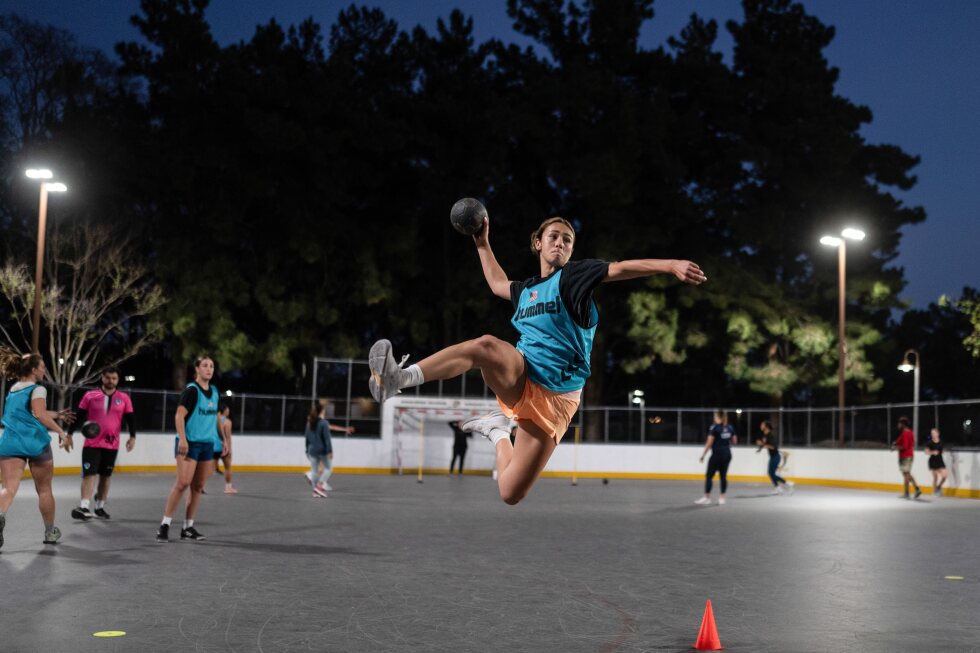
When 27-year-old Los Angeles screenwriter Rylee White first stumbled across a TikTok about open tryouts for the U.S. Women’s Olympic Handball Team — a sport she had never even heard of — with no prior experience required, she knew immediately she had to show up. White was far from alone. Buoyed by the video’s viral spread across the platform, more than 150 aspiring female athletes turned out for the January tryouts, marking a five-fold jump in turnout compared to previous recruitment cycles.
Five months after that fateful open call, White is one of a small group of recruits who have relocated to Florida to join USA Handball’s national residency program, putting everything on hold in pursuit of a spot on the 2028 Summer Olympics roster, to be held right in her home city of Los Angeles.
Unlike in much of Europe, where handball ranks among the most watched, high-participation competitive sports, it has remained largely obscure in the United States for decades. The fast-paced full-contact sport pits two teams of six outfield players plus a goalkeeper against each other, with athletes using a resin-coated ball to pass and score. Introduced to the Olympic program for men in 1936 and women in 1976, it regularly draws tens of thousands of fans to top matches in powerhouses like Germany, France, Norway, Denmark, and the Balkan nations of Southeastern Europe, which almost always claim the top Olympic medals in the sport.
As the 2028 host nation, the U.S. automatically qualifies for a spot in every Olympic event, meaning the women’s handball team will return to the Games for the first time since Atlanta 1996. But building a competitive roster from a tiny domestic talent pool has long been a steep challenge; for years, the U.S. team has primarily relied on dual citizens who play professional handball in Europe to fill its ranks. Unlike most Olympic sports where athletes begin training in childhood, U.S. handball recruits almost always switch to the sport later in life, often coming from other competitive athletic backgrounds.
For White, that switch came after injuries derailed her planned college career playing basketball and lacrosse, requiring multiple knee surgeries that kept her sidelined from high-level competition. Handball offered a second chance to pursue elite sport. “I think a lot of people would describe me as the most competitive person they’d ever met,” White said. “I definitely was raised in a house where we had big, big dreams.” After her tryout, she told head coach Sarah Gascon she was ready to commit fully, telling her partner she would bring him along to Europe if she earned a professional contract overseas, the end goal for many residency athletes. The final 2028 Olympic roster won’t be finalized until a few months before the Games, and only 14 to 18 spots are available out of dozens of current training athletes — making the entire journey a high-stakes gamble.
Gascon, a long-time veteran of the U.S. women’s national handball team who recently took over as head coach, has made rebuilding the struggling program her top priority. “We’ve had great successes in my career and some really great moments but still didn’t get an opportunity to play in the Olympic Games because we just weren’t good enough,” she explained. Gascon has found that multi-sport athletes make the strongest handball recruits, as the sport borrows core skills from other popular games: basketball builds ball handling, volleyball teaches blocking, and softball or rugby develop throwing technique. “It’s really about their athleticism,” she said. “Do they have a good foundation that we could build upon? And how are they able to adapt with learning something new at 22 or 23 years old?”
Despite the wave of new enthusiasm sparked by the viral TikTok, the biggest barrier to the program’s success remains a crippling lack of funding. Gascon confirmed that USA Handball is the only national governing body for an Olympic sport that receives no funding from the U.S. Olympic & Paralympic Committee, and the women’s team is entirely cut off from core support including elite athlete health insurance. The USOPC did not respond to a request for comment from the Associated Press on the matter. Gascon and all her coaching staff are unpaid volunteers, and athletes must hold full-time jobs while balancing the demands of elite training. “Some of our best athletes haven’t been able to go to tournaments or go to events because they can’t afford it,” Gascon said.
For new recruits like 30-year-old Devyn Holbrook, who had also never heard of handball before the viral tryout announcement, the once-in-a-lifetime opportunity is worth the risk. A self-described “queen of side quests” who trained in ballet, soccer, basketball, softball, and javelin throw growing up, Holbrook became obsessed with the sport after just a few days of play. “I just loved it and then I couldn’t stop watching videos online of past Olympic Games,” she said. “You don’t get a lot of chances to do like women’s team sports later in life. There will never be a chance again that I could go to the Olympics in this capacity. So why not give it everything that I have? And if I don’t make it, then I don’t make it.”