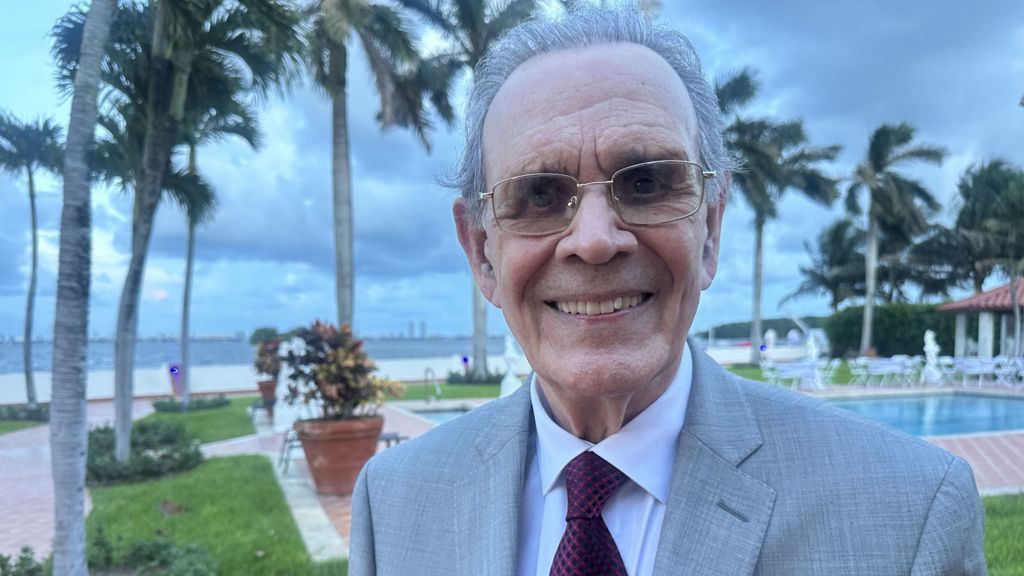
Against a sparkling backdrop overlooking Biscayne Bay, at the opulent Miami residence of a leading local plastic surgeon, a select gathering of some of Florida’s most affluent Cuban-American families has convened. This meeting marks the fourth session of the newly launched Cuban-American National Chamber of Commerce (CANCC), where attendees are mapping out their vision for a post-revolutionary Cuban economy. Clutching premium rum and displaying luxury timepieces, this circle of long-established Cuban-American wealth—including members from renowned business dynasties like Bacardi and Babun—lingered by the pool, debating the dire state of Cuba’s current economy and exchanging whispers of the latest political shifts on the island.
“Tonight, we’ve brought together the most prominent Cuban-American entrepreneurs across Miami-Dade County under one roof,” explained CANCC president Juan Omar Sixto, an 80-something real estate developer who fled Cuba as a teen. “Our end goal is clear: we will re-establish our presence in Cuba the moment the current regime collapses.” Sixto and his guests are confident this turning point is imminent.
This influential exile community has held deep opposition to Cuba’s Communist-led government since Fidel Castro seized power in 1959, when his administration expropriated private lands and nationalized family-owned businesses. Over decades, the group has leveraged its significant political and economic sway in Florida to shape U.S. policy toward Havana. Now, CANCC is drafting detailed blueprints for what Sixto calls Cuba’s “day after” the current government falls. The organization has already drafted a formal proposal for a Cuban national stock exchange and established working groups covering critical sectors from energy infrastructure to national food security.
Preparations for a post-Communist Cuba are not a new undertaking for Miami-based exile groups: for decades, a wide range of organizations have drawn up countless strategic and logistical plans, varying widely in their thoroughness and pragmatism. But Sixto argues that today’s context is fundamentally different, pointing to the Trump administration’s aggressive push for sweeping regime change on the island. He adds that the group has direct access to high-profile Washington contacts, including close allies of Senator and Secretary of State Marco Rubio. “Alongside delivering humanitarian aid and critical medical supplies, we are ready to go and do business in Cuba right away,” Sixto stated.
Inside Cuba, these plans are met with widespread skepticism. In response to Washington’s ongoing “maximum pressure” campaign, Havana’s leadership recently unveiled 176 new economic liberalization measures. Cuban President Miguel Díaz-Canel framed the reforms as a way to “advance the defense of socialism, to support and widen social justice.” Critics, however, argue the changes amount to a de facto shift toward full capitalism: the reforms lift caps on the number of employees allowed at private businesses, permit private business owners to directly hire and fire workers, and allow Cuban Americans to own multiple enterprises simultaneously.
Even so, CANCC attendees dismiss these reforms as merely cosmetic changes that fail to deliver meaningful legal protections for foreign investors. Sixto made clear the group would “not put a foot into Cuba” as long as the current government remains in power.
Many independent analysts argue these pre-transition planning efforts are premature. While Cuban-American business leaders are convinced rapid political change is on the horizon, no one can predict exactly what that change will look like: would it come via a U.S. military intervention similar to the 2019 action in Venezuela, or through a negotiated economic agreement with the current Cuban leadership?
Mike Bustamante, associate professor of history at the University of Miami, notes that the high expectations for imminent change stoked by the Trump administration have been delayed. With U.S. midterm elections approaching in November and the Trump administration mired in what Bustamante calls the “quagmire” of the Iran conflict, there is little political appetite for new large-scale foreign interventions. “It’s really tough to think that they will escalate further than what they’re doing now, which is this steady drip of sanctions,” he explained. That sanctions pressure is already severe: Cuba’s oil imports have been effectively cut off since January, a move Bustamante calls a major escalation. While the squeeze has made daily life unbearable for most ordinary Cubans, it has not yet created the conditions for a decisive political shift on the island, he added.
The Cuban government has not issued an official response to CANCC specifically, but it has long condemned such exile-led planning groups. Cuban revolutionaries have repeatedly stated they will not be pushed out of power by Miami-based critics.
When asked about the irony that the same group that has long backed the decades-long U.S. economic embargo and current fuel blockade—policies widely blamed for deepening Cuba’s current crisis—is now mapping out the island’s reconstruction without input from most Cubans currently living on the island, attendees pushed back. For Hugo Orizondo, a Cuban-American agricultural expert, pre-planning is simply a practical step. “Right now, Cuba is like a black hole, we don’t know what is happening over there, but we do know the enormous potential for investment,” he admitted. Orizondo said he understands why many Cubans are wary of foreign investors acquiring rights to sensitive arable land, but he argues that outside capital is desperately needed. “What are they going to do with it now? When investors come, they bring money and technology into the land,” he said, adding that both are urgently needed if Cuba is to become food self-sufficient and end its reliance on costly imports.
Restoring historical property rights is a core demand of the wealthy Cuban-American group. Sixto says his own father lost five properties and a 500-acre farm in Cuba’s Pinar del Río province during the 1959 revolution. While he says he has no plans to evict any families currently living on those properties, he is demanding financial compensation for the nationalized land. “I worked on that farm for five years of my life with my father, and they took it away. I want restitution or compensation. Even if they give me just a penny on the dollar, I’ll take it,” he said. “It’s moral justice.”
The Cuban government frames these historical property claims as the resentment of a corrupt old elite that built its fortunes on the backs of enslaved people and indentured laborers—systems that only ended in Cuba in the late 19th century. Havana also argues that exiles have never accepted Castro’s land reforms, which redistributed large estates to poor workers and the state.
But exile leaders say their plans would revitalize unproductive land for the benefit of all Cubans. “Most of our sugar mills have been dismantled, but we will recover those lands and put them into production,” said Nicolás Gutiérrez, president of the exile-led National Association of Sugar Mill Owners of Cuba, which advocates for property title restitution. “I’m not promising it will be in sugar. It might be in ethanol, co-generation, solar panels or water purification cells. Who knows? There are a lot of different options. We need to get them producing, we need to have a real wage paid to Cuban workers and create a multiplier economic effect across the island.”
As ice clinked in cocktail glasses and a warm ocean breeze rustled palm fronds across the perfectly manicured lawn, CANCC members framed their post-change vision as straightforward and achievable. But just hours after the meeting concluded, Cuba suffered its sixth nationwide blackout of the year—an stark reminder of the gap between Miami’s plans and the harsh realities of daily life on the island.
The disconnect between the exile community’s hopes for rapid change and the on-the-ground reality in Cuba is impossible to ignore. While many Miami-based Cuban Americans believe the long-awaited political shift is almost here, any sudden transition would almost certainly bring massive social and humanitarian disruption that the already struggling island is unprepared to handle. Even if the diaspora’s goals are well-intentioned rather than purely self-interested, estimates suggest rebuilding Cuba’s failing electrical grid alone would cost between $8 billion and $10 billion. Before any sector from agriculture to tourism can be revitalized by exile wealth and political connections, ordinary Cubans continue to grapple with acute shortages of food, clean water, fuel, and life-saving medicines. For all Miami’s ambitious plans, most Cubans simply hope for small, incremental improvements to their daily lives in the near term.