A new joint investigation by two Palestinian and French rights advocacy groups has uncovered that French authorities approved 35 new military equipment sales to Israel between May and September 2026, shedding fresh light on ongoing French arms exports amid mounting controversy over Israel’s military campaign in Gaza.
The probe, carried out by the Palestinian Youth Movement and French grassroots collective Urgence Palestine, documents that the approved shipments include a range of components for Israeli military systems: cooling units for tanks and missile launchers, helmet visors for helicopter and fighter jet pilots, electronic connectors and specialized hardware, and surveillance technology. According to the report, which has been reviewed by independent outlet Middle East Eye, all of the exported components were bound for subsidiaries of Elbit Systems, Israel’s largest and most prominent private arms manufacturer.
Researchers traced production of the equipment to facilities across five French regions, identifying well-known French firms among the suppliers. Major French military conglomerate Thales was listed as one of the producers, responsible for manufacturing and exporting remote weapons control panels that are integrated into Israeli military systems.
This latest disclosure follows an initial joint investigation released by the same organizations in April 2026, which documented more than 525 military equipment shipments from France to Israel between October 2023 and March 2026. That first report also recorded 117 flights carrying F-35 fighter jet components departing from Paris’ Roissy-Charles de Gaulle (CDG) Airport, France’s busiest international aviation hub. In the new round of research, investigators identified four previously unreported French suppliers, and found that 33 of the 35 newly approved shipments passed through CDG, with 32 of those transported by El Al, Israel’s state-owned national airline.
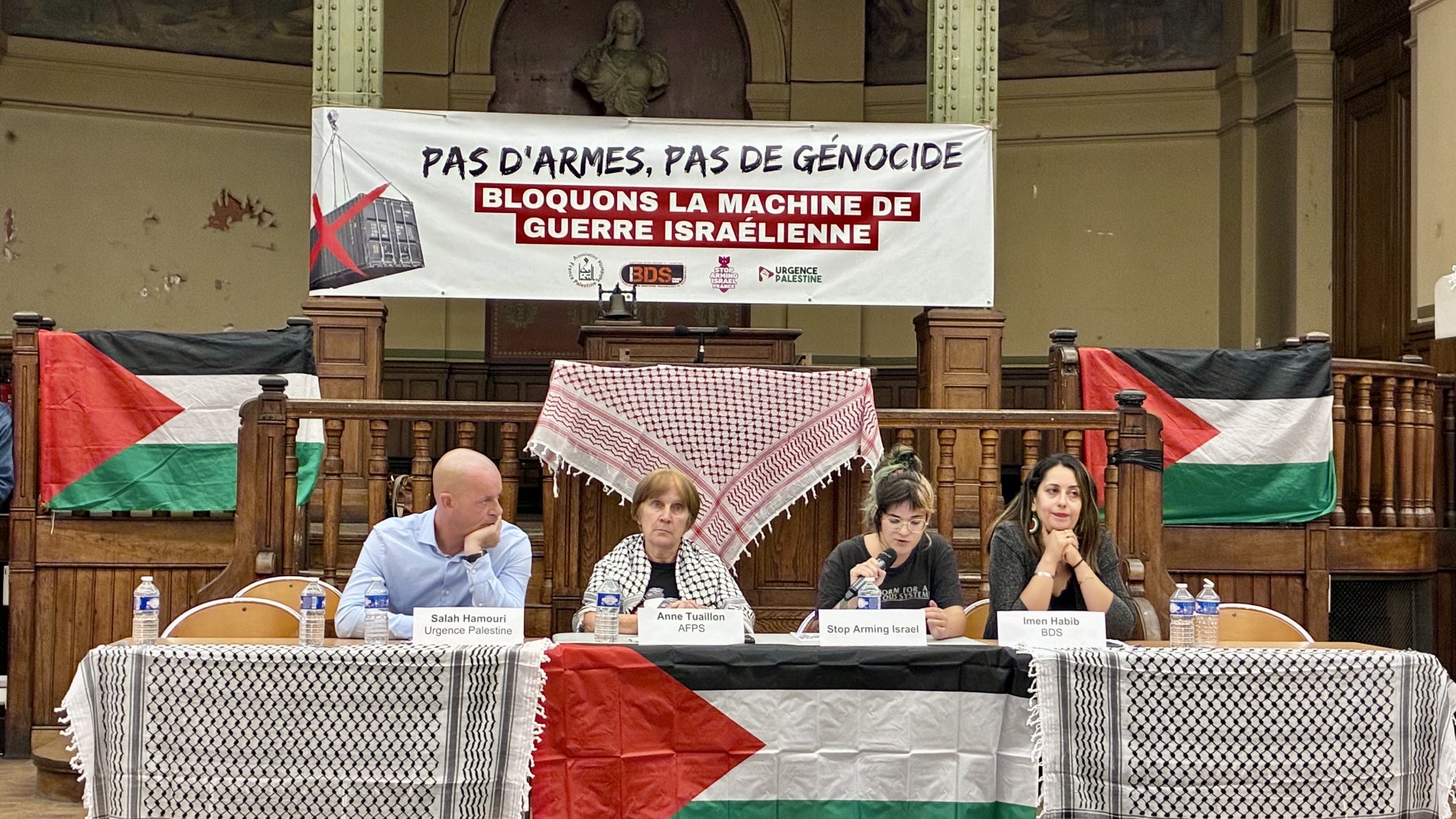
The findings were publicly launched on Thursday to kick off a “nationwide month of protest against French arms sales to Israel”, organized by a broad coalition of French trade unions, human rights groups and pro-Palestinian advocacy organizations including Urgence Palestine, BDS France, Stop Arming Israel, and the Association France Palestine Solidarite.
Speaking at the launch event, Salah Hammouri, a French-Palestinian human rights lawyer who was detained for years by Israeli authorities, called out French President Emmanuel Macron over a perceived contradiction in his public remarks and policy. Last week, during his address to the United Nations General Assembly, Macron described the humanitarian catastrophe unfolding in Gaza as a “spectacle that shames us all”. Hammouri pointed out the stark gap between this rhetoric and continued French arms approvals: “Macron says he is ashamed of the murderous spectacle offered by Israel. But he is not ashamed of having allowed 525 shipments of military components destined for Israeli factories to pass through over the course of two years. Despite our previous report, despite trade-union and parliamentary mobilisation, and despite all the actions carried out by our organisations, the transfers continue.”
For months, investigative media outlets and non-governmental organizations have repeatedly documented that French military components continue to flow to Israel amid widespread allegations of genocide in Gaza. Members of the French parliament have repeatedly criticized the government for failing to provide transparency on arms exports and for lacking meaningful parliamentary oversight of the licensing process.
The French government has repeatedly defended its policy, stating that it halted approvals for “offensive” weapons sales to Israel in 2024, and only permits exports of so-called “defensive” components. All French military exports require government-issued licenses before shipments can proceed. Just two days ago, French Defence Minister Catherine Vautrin reaffirmed this position during a parliamentary session, stating: “When the government authorises the export of components intended to defend Israeli territory and population, it ensures that the equipment is not used against civilian populations.”
Yet the new investigation directly contradicts the government’s distinction between offensive and defensive equipment, as do multiple previous reports from independent outlets and NGOs. Critics have long argued that even so-called non-offensive components sustain Israel’s military supply chain for combat operations in Gaza, and that the government’s categorization is deliberately misleading.
Thomas Nayla, a lawyer for Urgence Palestine who co-led the investigation by cross-referencing public databases and using open-source intelligence, explained to Middle East Eye why the government’s claims do not hold up to scrutiny: “When you look at all the components that were sold – a cooling system for a tank, a visor for a helicopter pilot – there is no way these can be considered defensive. They are necessarily going into offensive weapons systems.” Nayla also emphasized that there is a “complete lack of oversight” over what components are ultimately delivered to Elbit’s subsidiaries, with no independent checks on their end use.
Nayla told Middle East Eye that he contacted all the companies identified in the new report ahead of its publication. Half of the contacted firms confirmed they had made the shipments, but many told the investigation team: “Yes, it’s true, we sent these components, but we don’t know what the Elbit Systems subsidiary does with them.” The remaining companies declined to respond to requests for comment.
With the new findings in hand and formal support from major French trade unions, Urgence Palestine and its partners plan to directly inform workers at the listed supplier companies about the final use of the components they produce and transport. Nayla said the campaign is rooted in the belief that worker awareness can disrupt the arms supply chain: “We are convinced – and there has already been much evidence – that once workers know what they are manufacturing and what they are transporting, they will refuse to do it.”
Over the coming month of protest and advocacy, the coalition aims to amplify its call for a full halt to French arms sales to Israel, share its research findings with the public, and coordinate collective action across civil society. “Civil society, trade unions, members of parliament and political parties must work together to block the chain of complicity that allows the Israeli regime to be armed,” Nayla added.