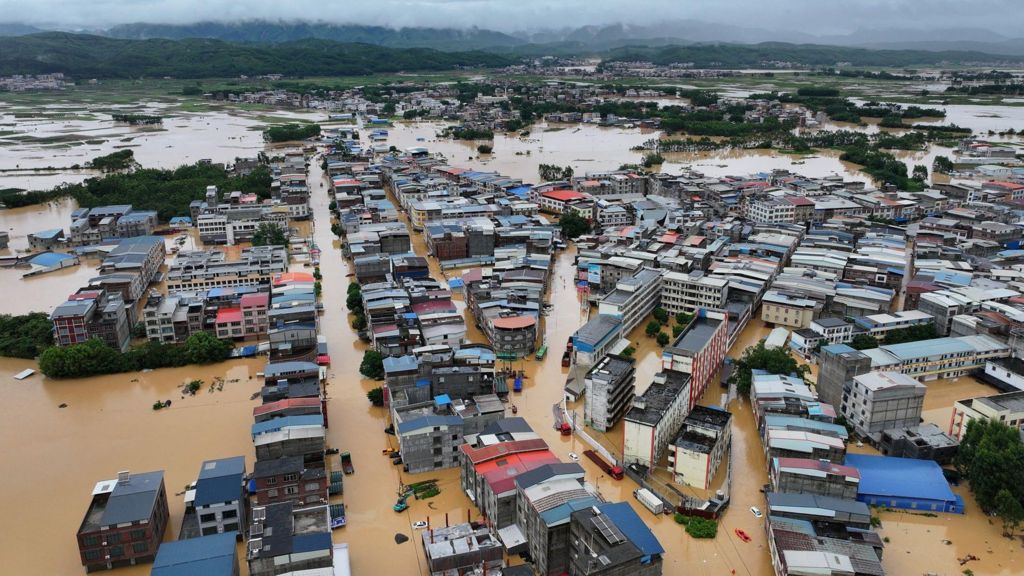
The 2026 Pacific typhoon season has opened with a catastrophic blow as Typhoon Maysak tore through southern and central China over the weekend, leaving at least 15 people dead, tens of thousands displaced, and widespread destruction in its wake. Characterized by sudden onset and intense, short-duration gale-force winds, the storm dumped unprecedented volumes of rain across southern Guangxi Zhuang Autonomous Region, triggering dam breaches, riverbank overflows and flash floods that engulfed communities in mere hours.
In Renhe Village, located near the regional capital Nanning, the downpour began on a seemingly typical Sunday. What started as routine seasonal rain quickly escalated into an unmanageable disaster: by the early hours of Monday, floodwaters reached knee height across the village, and by dawn, the entire first floors of residential buildings were fully submerged. Local resident Zhou, who is currently staying outside Guangxi, recounted the chaos of the evacuation to the BBC, noting that the flood advanced so rapidly that fleeing villagers had no time to grab essential supplies including food.
Zhou’s family is among more than 60,000 people displaced across Guangxi, with official figures putting the total number of people affected by the deluge at close to 90,000. Even days after the storm hit, thousands of residents remain trapped on rooftops and in isolated mountain communities, struggling with critical shortages of food and clean water. Zhou told reporters that four-month-old niece of hers, still trapped in the village with other family members, has been without milk for more than 24 hours. Trapped communities gathered on higher ground are also rapidly running out of basic necessities, as a lack of sufficient rescue personnel and equipment slows relief efforts. Another local resident, Huang from Yunbiao Town, told the BBC that floodwaters submerged entire villages in just 10 minutes, leaving rescuers unable to reach every vulnerable resident in time. “The lifeboats they brought were too small to travel far through the swollen floodwaters, and there simply were not enough workers to cover all the affected areas,” Huang explained. Compounding the danger, widespread power and internet outages have cut off communication between trapped residents and their family members outside the disaster zone, leaving many to wait in agonizing uncertainty for news of their loved ones.
Worsening the already dangerous conditions, floodwaters have swept both wild snakes and commercially farmed snakes from local farms into residential areas. A video shared with the BBC from a local village chat group shows a large black snake slithering across the mud-caked floor of a flooded home, as onlookers react in alarm. Commercially raised snakes are common in parts of China, farmed for use in traditional medicine, meat, and the production of anti-venom, making their escape into flooded communities an added lethal hazard for displaced residents waiting for rescue.
The impact of Typhoon Maysak extended hundreds of kilometers north to central China’s Hubei Province, where the storm’s warm southern air collided with cold northern air masses to spawn rare tornadoes – the first to hit the region since 2021. The twisters swept through the cities of Ezhou and Huanggang, leaving 11 dead, thousands of homes damaged, and widespread panic. Videos circulating on Chinese social media capture the chaos: outdoor dining furniture is tossed through the air by powerful winds, electrical sparks fly across storm-battered streets, and diners scream as they scramble for safety. In one devastating incident in Huanggang, a man was sucked out of his 12th-floor apartment after the tornado shattered his windows, blowing him and his furniture out onto the street. He remains in intensive care as of the latest updates. A Huanggang student told the BBC he initially expected an ordinary summer thunderstorm, until he saw debris flying through the air outside his dormitory window. “Many students were cut by flying broken glass,” he said. “It wasn’t until the wind stopped that I realized I had just survived a major disaster.”
Tragedy from this season’s early extreme weather has also struck other parts of northern China. Over the weekend, flash floods in Tongliao, Inner Mongolia, killed two cattle farmers, while record-breaking rainfall in Fushun, Liaoning Province, left three people dead. Average rainfall in parts of Fushun between 1 a.m. and 7 a.m. local time shattered all historical records for the region, according to state media.
In response to the widespread devastation, Chinese President Xi Jinping has ordered all-out rescue and relief operations across affected regions, emphasizing the critical importance of treating injured residents, resettling displaced communities, and executing disaster prevention work effectively. State media has broadcast regular footage of rescue crews in life vests and helmets navigating swollen floodwaters on inflatable boats to reach trapped residents. However, local authorities in Nanning have warned that continuing extremely heavy rainfall is hampering ongoing search and rescue efforts, slowing access to isolated communities.
As emergency crews work to reach those trapped, a new threat is already approaching on the horizon: meteorological forecasts show Super Typhoon Bavi is currently churning across the western Pacific, on track to make landfall on China’s eastern coast later this week, bringing the risk of a second wave of extreme weather and flooding for already strained disaster response teams.