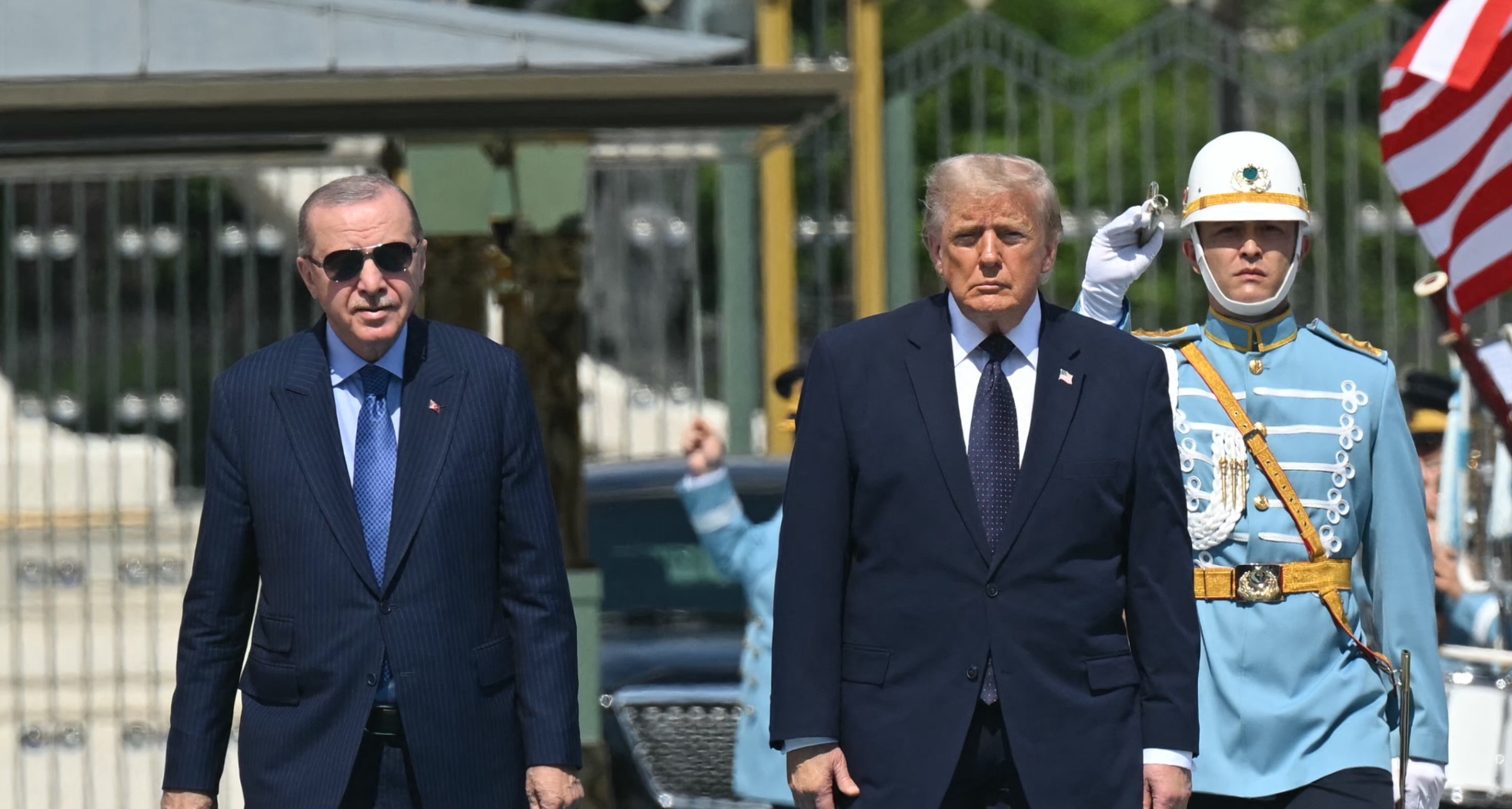
During a joint appearance with Turkish President Recep Tayyip Erdogan in Ankara ahead of the NATO summit, former President Donald Trump made a sweeping promise to roll back existing U.S. sanctions on Turkey and revive the stalled sale of American F-35 stealth fighter jets to the NATO ally. “We don’t want to sanction friends. It’s very simple,” Trump stated, adding that a final decision on the F-35 deal – which he described as “the best plane by far” – would be finalized after careful consideration.
Despite Trump’s public confidence, regional and foreign policy experts warn that significant legal and political barriers stand between the proposed policy shift and implementation, with congressional buy-in emerging as the single biggest obstacle.
Geopolitically, Turkey occupies a uniquely important position for the Western alliance today: it boasts NATO’s second-largest standing military, and has gained renewed goodwill across European capitals amid ongoing efforts to counter Russian aggression following the invasion of Ukraine. For many policymakers in Washington, Turkey also serves as a critical counterweight to Iranian regional influence, particularly after Ankara-backed Syrian leader Ahmed al-Sharaa ousted the Iran-aligned Assad government in 2024. For Trump personally, the push for warmer ties is also shaped by a longstanding close personal relationship with Erdogan – so much so that Trump confirmed he attended the NATO summit primarily as a favor to his Turkish counterpart.
But that warmth has not extended to Capitol Hill, where Turkey has faced deep, bipartisan criticism for years. U.S. lawmakers have repeatedly condemned Erdogan’s domestic crackdown on political opposition, while foreign policy disagreements have further strained relations: pro-Kurdish lawmakers have decried Turkish military incursions into northern Syria, pro-Israel legislators have pushed back against Ankara’s support for Palestinians and Erdogan’s description of Hamas as resistance fighters, and supporters of U.S. ally Greece have criticized Turkey’s longstanding territorial disputes in the Aegean Sea.
The most consequential rift, however, dates back to 2019, when Turkey completed its purchase of Russia’s S-400 air defense system, triggering sweeping U.S. punitive measures that derailed the original F-35 partnership. Before the S-400 purchase, Turkey was an integrated partner in the F-35 joint production program, set to manufacture roughly 900 parts for the jet and purchase 100 aircraft for its own air force. Within days of the S-400 delivery, the Trump administration at the time removed Turkey from the program and canceled the sale. In 2020, the Turkish Defense Industry Agency (SSB), the country’s arms procurement body, was formally sanctioned under the Countering America’s Adversaries Through Sanctions Act (CAATSA), a law initially crafted to respond to Russian interference in the 2016 U.S. presidential election.
Experts note that Trump does retain limited flexibility to work around CAATSA sanctions: the administration recently notified Congress of a planned $700 million sale of jet engines to Turkey for its domestic Kaan fifth-generation fighter program, bypassing SSB by structuring the deal directly with Turkish Aerospace Industries. But that small step is far different from reviving full F-35 participation and sales, which face additional legal barriers. A 2020 National Defense Authorization Act amendment explicitly bans F-35 sales to Turkey as long as it retains possession of the S-400, with no provision for a presidential waiver.
This has sparked speculation of a behind-the-scenes compromise between Trump and Erdogan to resolve the S-400 impasse. Notably, Turkey has never activated the S-400 system, with most components still stored in original packaging, a choice experts frame as a deliberate gesture to Washington. Former U.S. Ambassador to Turkey James Jeffrey, now a senior analyst at the Washington Institute for Near East Policy, told Middle East Eye that he expects a deal under which Turkey would render the S-400 permanently inoperable. “I suspect Trump and Erdogan are talking behind the scenes on some sort of deal to render the S-400 inoperative,” Jeffrey said.
Aaron Stein, president of the Foreign Policy Research Institute, echoed that assessment, noting that any path forward hinges on redefining what “possession” of the S-400 means for the purposes of U.S. law. “Trump wants to sell stuff, but he is prevented from doing so by pieces of legislation that he has no control over. One option is to lean on Congress to make changes. He can also certify non-possession and get Congress to agree,” Stein explained. Even if the two leaders reach a compromise on the S-400, however, experts warn that congressional opposition remains a major risk. Longstanding procedural rules allow any chair or ranking member of the House or Senate Foreign Affairs Committees to place a hold on proposed arms sales, and the Trump administration already faced pushback over the recent jet engine deal, overriding a hold placed by House Foreign Affairs Committee ranking member Gregory Meeks, who accused the White House of refusing to share details of the transaction.
For F-35 sales, opposition is expected to be even fiercer. As Gonul Tol, a senior fellow at the Middle East Institute, put it: “The engine sale is low-hanging fruit. The most challenging element to the sanctions is Turkey becoming part of the F-35 production line again.” In a reflection of the long odds facing the proposal, Stein noted that Trump has no ability to unilaterally override existing law. “This is very messy. Trump can’t wave a magic wand,” he said.